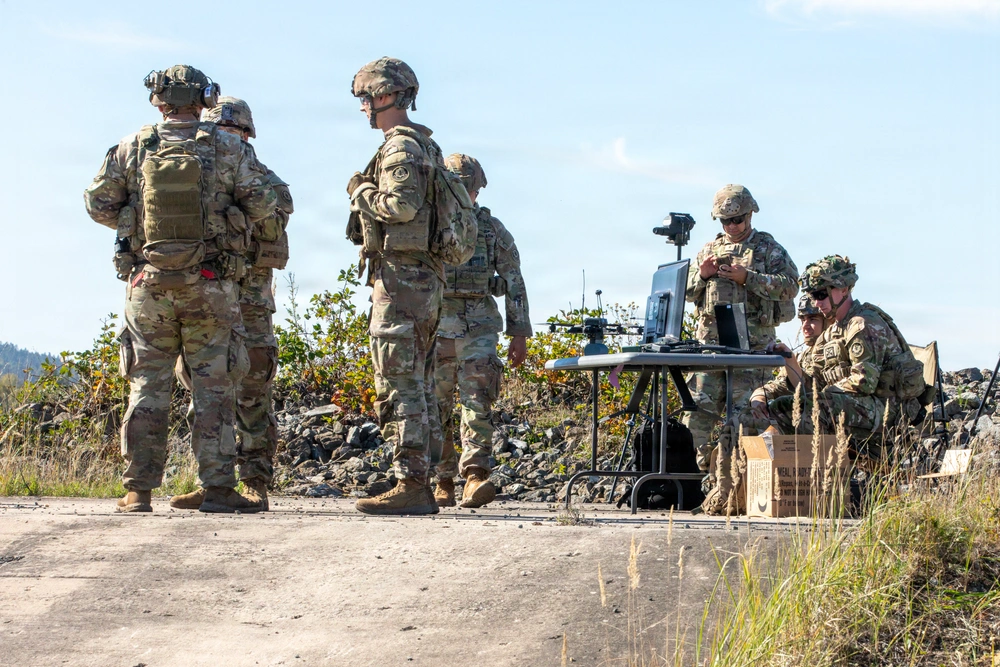
Soldiers of the U.S. Army’s 1st Squadron, 2nd Cavalry Regiment (2CR) destroyed a staged target at Grafenwoehr Training Area, Germany, on September 30, 2026, with a first-person view (FPV) attack drone they assembled, armed and flew without outside help. The strike used an Orqa MRM2-10 quadcopter carrying 250 grams of C-4 and was executed under the Army’s Purpose-Built Attritable System (PBAS) effort. Unit leaders describe it as the conventional Army’s first live, kinetic drone strike conducted without contractor or external-unit support.
The event caps more than two years of work inside the Stryker-equipped regiment, forward-stationed in Bavaria, to rebuild an organic unmanned capability after Army-wide restructuring led it to divest its legacy unmanned aircraft. It also lands three months before a deadline set in Pentagon chief Pete Hegseth’s July 10, 2025, memo on military drone dominance, which reclassified small drones as consumables, delegated procurement authority to O-6 commanders, encouraged local 3D printing and directed that every squad field low-cost expendable drones by the end of 2026.
Inside the PBAS Drone Strike at Grafenwoehr Training Area
Staff Sgt. Angel Caliz, who earlier this year shared top tactical-squad honors at the Army’s inaugural Best Drone Warfighter Competition, flew the mission through an FPV headset. He needed less than five minutes to cover more than a mile (1.6 kilometers) from the launch point, acquire the target and detonate the payload. A second drone streamed the impact live to the squadron.
Soldiers assembled the MRM2-10 airframes from manufacturer-supplied parts, then fitted an electronic safety and arming device and a 3D-printed casing designed in-house. Troopers call the result the Dragoon bomb, after the regiment’s nickname. For the live strike, the casing carried 250 grams of C-4 initiated by M6 low-voltage blasting caps, according to 1st Lt. Eugene Lee, a reconnaissance platoon leader.
The casing accepts close to two pounds (about 0.9 kilograms) of explosive and can be reconfigured by mission. Lee said ball bearings can be added for use against dismounted personnel, and the charge can be shaped to defeat light armored vehicles and armored personnel carriers. Capt. Michael Bapp, a company commander in the squadron, said the lack of precedent slowed the logistical and operational approvals. The unit’s claim to a first has not been independently verified and hinges on the absence of contractor or external support.
Orqa MRM2-10 Specifications: Payload, Datalink and Flight Control
The MRM2-10 comes from Orqa, an Osijek-based Croatian manufacturer that markets the platform as NDAA-compliant and built in the European Union without Chinese components. Publicly available manufacturer specifications describe a carbon-fiber quadcopter on 10-inch dual-blade propellers, driven by Orqa 2814 motors rated at 880 kV through a 70-amp four-in-one electronic speed controller running AM32 firmware. The H7 QuadCore flight controller, built on an STM32H743 processor, supports ArduPilot, iNav, Betaflight and PX4, with MAVLink support and Android Team Awareness Kit (ATAK) integration. Rated payload reaches 3.5 kilograms.
Command and control runs over Orqa’s IRONghost dual sub-GHz link on switchable 4xx and 9xx MHz licensed bands, which the company markets as resistant to electronic warfare (EW). Video returns over a 5.8 GHz analog transmitter of up to 5 watts from a Justice analog camera rated at 1,200 TV lines for low-light use. Some MRM2-10 versions instead ship with a 2.4 GHz link on an unlicensed band; the Army has not disclosed which configuration 2CR used, or how it acquired the kits.
The 250-gram live charge used less than a tenth of rated lift, leaving margin for heavier shaped charges or a larger battery. The unlicensed 5.8 GHz video downlink remains the element most exposed to jamming, a gap Orqa’s MRM2-10AI variant, unveiled at Eurosatory in June 2026, targets with a hybrid radio and fiber-optic link and vision-based terminal guidance for GNSS-denied environments. Lee said the current drones could engage targets more than three miles (4.8 kilometers) away, and beyond 12 miles (19 kilometers) with an additional receiver. Bapp contrasted that reach with the AT4, which soldiers struggle to land accurately beyond 300 meters under combat conditions.
Organic Drone Building and the Army’s PBAS Procurement Track
The strike follows an iterative build-and-test cycle. In July 2025, 2CR troopers attended a three-week course at Balli Army Airfield to solder and assemble PBAS drones, then flew self-built airframes alongside Skydio X10 quadcopters at Saber Junction 25 in September 2025. The regiment has since tested them during Project Flytrap 5.0 in Lithuania and integrated one-way attack drones into a Saber Strike fire support exercise in Poland, both in May 2026.
That organic track runs parallel to the formal PBAS program, which the Army designed to give platoons an FPV capability. Army descriptions of a PBAS set list two 10-inch and four 5-inch air vehicles with modular lethal and non-lethal payloads at roughly $35,000 per set. In November 2025, the Army selected three primary vendors for Tranche 1, including Neros with its Archer and Archer Strike drones and Flatbow ground control system. Congress provided $512.8 million in fiscal 2026 for the Army’s Family of Small Unmanned Aircraft Systems initiatives, according to a Congressional Research Service review.
Analysis: The strike matters less for the explosion than for the approvals behind it. Certifying a soldier-assembled munition with an electronic arming device has been the main bottleneck separating U.S. units from Ukrainian battlefield practice, and 2CR has now cleared it inside a formation that trains routinely on NATO’s eastern flank. If the Army codifies that approval chain, brigades could pair vendor-delivered PBAS kits with locally fabricated warheads tuned to the threat, giving squads precision reach several kilometers beyond organic anti-armor weapons at a fraction of the cost of guided missiles.
Key unknowns remain the unit cost of a Dragoon bomb, the number of strike-qualified operators across the regiment and whether the Army will standardize the casing and arming design for other formations. The next markers are the end-2026 deadline for squad-level drones, follow-on PBAS tranches and further Project Flytrap iterations, where contested spectrum conditions will test the MRM2-10’s link architecture.