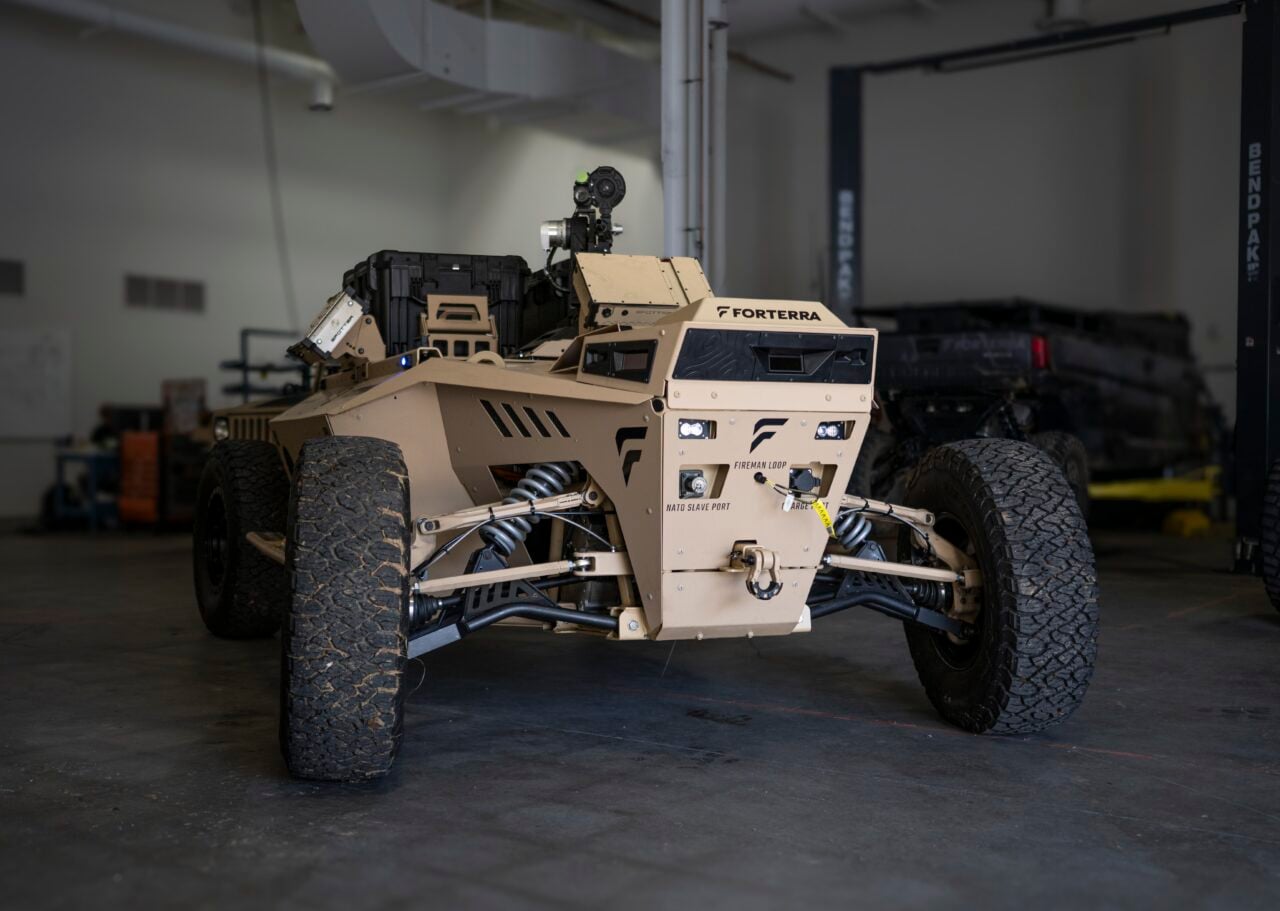
Hypercraft and Forterra announced on October 7, 2026 an exclusive partnership to integrate Forterra’s AutoDrive autonomous driving system into Hypercraft’s Razorback unmanned ground vehicle (UGV), aimed at contested logistics missions that today put soldiers behind the wheel under fire. The integrated vehicle makes its public debut at the Association of the U.S. Army (AUSA) annual meeting, held October 12 to 14 in Washington.
The announcement lands as the U.S. Army moves to take drivers out of frontline resupply. On August 11, 2026, the service selected six vendors, Forterra among them, for its Infantry Last Tactical Mile (ILTM) initiative, covering autonomous frontline resupply and casualty evacuation. Each vendor delivers four prototypes ahead of an operational assessment with an Army unit in early 2027 that will inform a production decision. Forterra has not confirmed which vehicle it is fielding for ILTM, but its MESA design, built on a Polaris Ranger XD 1500, was unveiled for that mission set in April 2026. Razorback offers a second, purpose-built path into the same market.
Razorback UGV Architecture: Hybrid Drive, Payload and Exportable Power
Razorback is the first complete vehicle from Hypercraft, a Provo, Utah, company that began building electric powertrains for commercial vehicles. Unveiled in May 2026, it rides on Hypercraft’s CARBON software-defined vehicle platform, which combines a central-zonal compute architecture, an open vehicle operating system and drive-by-wire controls designed for autonomy from the outset. Control, propulsion, compute and power form a single system, not a crewed chassis with sensors bolted on.
Propulsion is diesel hybrid-electric: a 50 kW range extender, peaking at 95 kW, feeds a four-motor torque-vectoring drive rated at a combined 300 hp. Publicly released figures describe a vehicle more than 13 feet long on 37-inch tires, with four-wheel hydraulic steering, neutral-steer capability and a top speed of 60 mph.
The October announcement credits Razorback with up to 4,000 pounds of payload, a range of up to 500 miles and as much as 38 kW of exportable power. Both payload and range exceed the 2,400 pounds and 280 miles published at the May unveiling; neither company has explained the gap.
The 38 kW export capacity is the platform’s most operationally relevant parameter. It lets a single vehicle run counter-drone sensors, electronic warfare kits, communications nodes or drone charging at the forward edge without a towed generator. Commercial off-the-shelf components are meant to support scalable U.S. production.
How Forterra AutoDrive and Vektor Integrate With Razorback
Forterra, formerly Robotic Research Autonomous Industries, does not build vehicles. AutoDrive packages software, sensors and compute for driverless operation, while the Vektor software-defined communications and data-brokering layer manages links in degraded networks. On Razorback, both integrate at the vehicle architecture level with native access to control, compute and power systems, which the companies say speeds payload integration and enables over-the-air software updates.
AutoDrive runs on more than 200 vehicles in active service and has been integrated on more than 50 vehicle types, according to Forterra. Applications include the Marine Corps’ Remotely Operated Ground Unit for Expeditionary (ROGUE) Fires launcher built on the Joint Light Tactical Vehicle (JLTV), Polaris Ranger 1500 utility vehicles operating in Ukraine and Ford F-250 pickups for the Army.
Forterra Chief Growth Officer Scott Sanders framed the requirement as delivering payloads “to the point of friction,” adding that Razorback can carry a range of weapon systems without modification. Beyond logistics, the open architecture follows Modular Open Systems Approach (MOSA) principles and targets communications, intelligence, surveillance and reconnaissance (ISR), counter-unmanned aircraft systems (C-UAS) and expeditionary power roles. Hypercraft has already teamed with Fortem Technologies to fit its TrueView radar to the vehicle.
The AUSA demonstrator carries the Edda C-UAS turret from Austin-based 9 Mothers. The roughly 50-pound station detects drone rotor noise acoustically, hands off to optical tracking and engages drones about 7 inches across at 10 to 100 meters with a 12-gauge shotgun. The Army live-fired Edda from a Forterra-equipped, driverless F-250 at Fort Bragg on August 18, 2026, during Project Sandhills 2.0.
Analysis: The partnership inverts the dominant approach to ground autonomy, in which kits are retrofitted onto trucks designed around a driver. Pairing a fielded autonomy stack with an unmanned-first chassis that exports 38 kW gives Razorback a credible case as both cargo carrier and self-protecting power node, a combination that matters as small drones increasingly hunt logistics traffic. The platform nonetheless remains an industry demonstrator: no military customer, contract, unit price or test schedule has been announced, and Razorback has no confirmed role in the Army’s ILTM effort.
AUSA provides the first public look at the integrated vehicle. The next markers are pricing, which Hypercraft describes as commercially viable without disclosing a figure, government-led testing and a reconciled spec sheet. The ILTM operational assessment in early 2027 will signal whether the Army favors purpose-built UGVs or autonomy-kitted commercial vehicles.