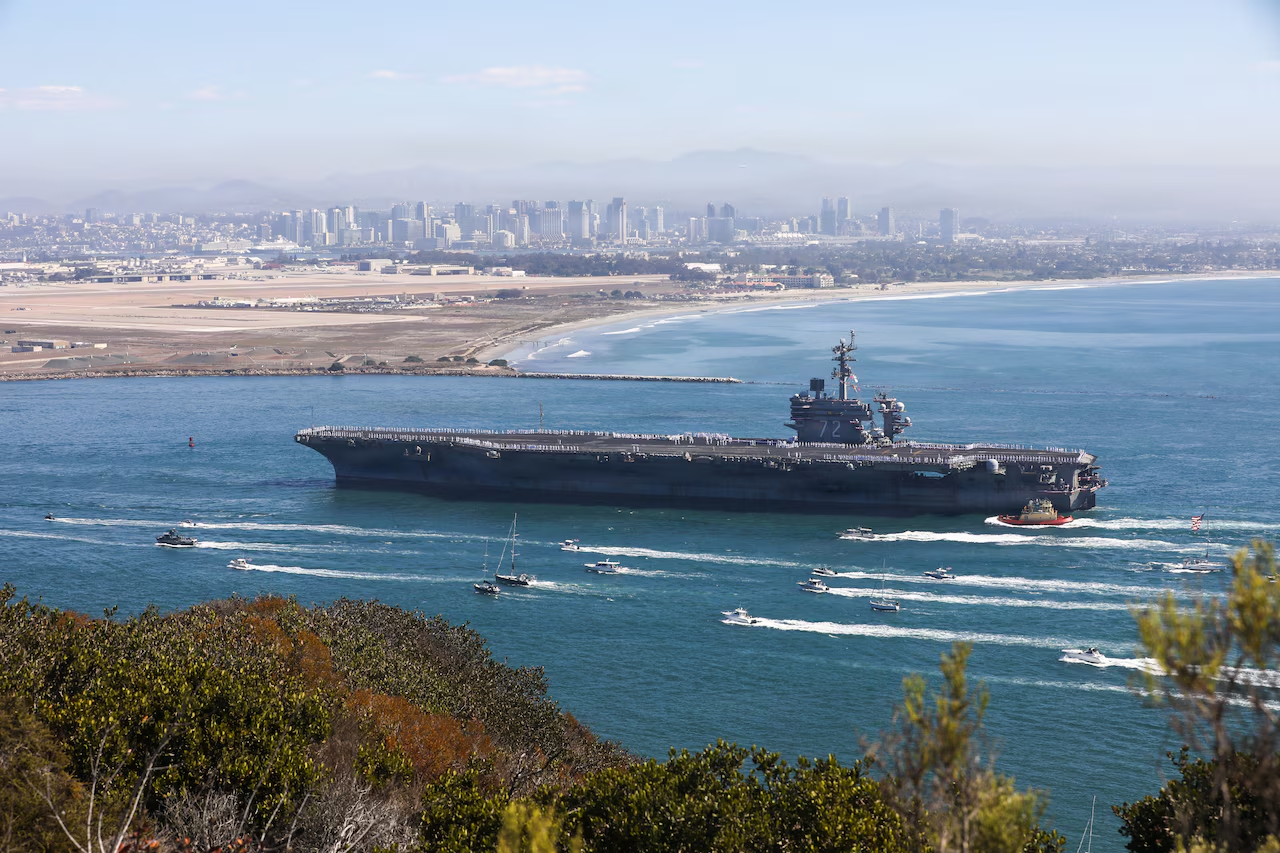
The Nimitz-class aircraft carrier USS Abraham Lincoln (CVN 72) returned to Naval Air Station North Island in San Diego on October 8, 2026, closing a 321-day deployment that put the ship and Carrier Strike Group 3 (CSG-3) at the head of the U.S. Navy’s role in Operation Epic Fury, the U.S. campaign against Iran, according to the Department of War.
It is the second-longest U.S. carrier deployment since the Vietnam War, five days short of the 326-day mark USS Gerald R. Ford (CVN 78) set when it returned to Norfolk, Virginia, on May 16, 2026. Lincoln held the previous post-Vietnam record, 295 days, set in 2020. The Navy’s Optimized Fleet Response Plan (OFRP) is built around deployments of roughly seven months, a benchmark Lincoln exceeded by more than three months after leaving San Diego on November 21, 2025.
How USS Abraham Lincoln and Carrier Air Wing 9 Fought Epic Fury
Lincoln transited the San Bernardino, Surigao and Malacca straits and reached the U.S. Central Command (CENTCOM) area of responsibility in late January. When Epic Fury opened on February 28, CSG-3 took the lead naval role along Iran’s southern coast as Commander, Task Force 50.
Over 40 days of major combat operations, the embarked Carrier Air Wing 9 (CVW-9) flew nearly 4,000 combat sorties, an average of roughly 100 per day, and delivered more than 1.5 million pounds of ordnance on thousands of targets. Task force units destroyed more than 100 Iranian drone, missile and small-boat attacks aimed at the force. The Department of War assesses that the strikes significantly degraded Iranian naval capabilities.
CVW-9 deployed with nine squadrons and more than 70 aircraft: three F/A-18E/F Super Hornet squadrons, the EA-18G Growlers of Electronic Attack Squadron (VAQ) 133, the F-35C Lightning IIs of Marine Fighter Attack Squadron (VMFA) 314, the E-2D Advanced Hawkeyes of Carrier Airborne Early Warning Squadron (VAW) 117, two MH-60R/S Seahawk squadrons and a CMV-22B Osprey logistics squadron. Against an integrated air defense network, that mix is the point: the Growler provides stand-off jamming and suppression, the F-35C adds low-observable penetration and sensor fusion, and the E-2D supplies airborne early warning and battle management. Lincoln first deployed a Marine Corps F-35C squadron in 2022; Epic Fury put that mixed fourth- and fifth-generation wing into sustained combat.
Carrier Strike Group 3 Enforces Two Blockades of Iranian Shipping
After the April 8 ceasefire between Washington and Tehran, the strike group shifted from strike warfare to sea control. A U.S. blockade of Iranian ports took effect on April 13, and Lincoln’s group enforced it against Iranian-flagged vessels in the northern Arabian Sea and Gulf of Oman, denying the flow of Iranian oil and materiel while U.S. officials negotiated with Tehran. That mission leaned on the E-2D, the MH-60R and Destroyer Squadron 21 escorts, including the Arleigh Burke-class destroyer USS Frank E. Petersen Jr., as much as on strike fighters.
The blockade was lifted on June 18 under a memorandum of understanding, then reinstated on July 14 after Islamic Revolutionary Guard Corps (IRGC) attacks on commercial shipping in the Strait of Hormuz. Lincoln and CVW-9 supported strikes on Iranian coastal defense systems and cruise missile storage and launch sites, then reinforced the second blockade until leaving CENTCOM on August 22. USS George Washington (CVN 73), normally forward-deployed in Japan, relieved Lincoln in theater.
Lincoln’s commanding officer, Capt. Dan Keeler, cited major combat operations, two blockades and presence across multiple numbered fleets. “This team is literally rewriting the book of what an aircraft carrier is capable of,” he said.
321 Days at Sea: Endurance Records, Logistics, and Crew Strain
Publicly available specifications indicate the 1,092-foot carrier displaces roughly 100,000 tons at full load and runs on two A4W nuclear reactors at speeds above 30 knots. Nuclear propulsion removes fuel as a constraint on the ship, not on the air wing: Lincoln conducted 72 replenishments-at-sea, roughly one every four and a half days, and received more than 20.5 million gallons of aviation fuel while steaming more than 93,000 nautical miles. CVW-9 logged more than 13,000 sorties and 28,500 flight hours. Lincoln’s only stops were brief overnight calls at Guam in December 2025 and at Duqm, Oman, in July, followed by a port visit to Thailand in early September and a final overnight stop at Guam later that month. The Navy counts 208 uninterrupted days at sea between Guam and Duqm, and 286 consecutive days at sea between San Diego and Thailand, as records for modern aircraft carriers.
Reports of food and hygiene supply shortages and crew stress surfaced over the summer, and four members of San Diego’s congressional delegation, joined by California’s two senators, asked the Pentagon’s inspector general for an independent review. Secretary of War Pete Hegseth said the reports misrepresented conditions aboard, though Navy leaders later acknowledged some problems. In a September 22 letter to Sen. Kirsten Gillibrand (D-N.Y.), Acting Secretary of the Navy Hung Cao confirmed eight suicide attempts among sailors across the strike group since the deployment began. Hegseth visited the carrier on October 7 and presented the crew a top unit award, as he did for Ford in May.
What Lincoln’s 321-Day Deployment Means for Carrier Readiness
Analysis: The two longest carrier deployments since Vietnam, completed less than five months apart and both extended by the Iran campaign, show a carrier force operating well outside the OFRP model. Every month a carrier stays forward beyond plan comes out of its maintenance and training phases, lengthening the next shipyard availability and compressing the cycle for the carriers behind it. The combat figures cut both ways: more than 100 defeated drone, missile and small-boat attacks show the strike group’s layered defense held, but the interceptor cost remains undisclosed. Combined with the welfare findings now before Congress, Lincoln’s deployment will sharpen scrutiny of how long the Navy can sustain a multi-carrier presence in the Middle East.
The Navy has not announced the scope or timing of Lincoln’s next maintenance availability, nor released after-action data on munitions expenditure or air wing readiness. Those disclosures and the course of U.S.-Iran negotiations will determine how quickly the West Coast carrier rotation recovers and how long USS George Washington remains on station.