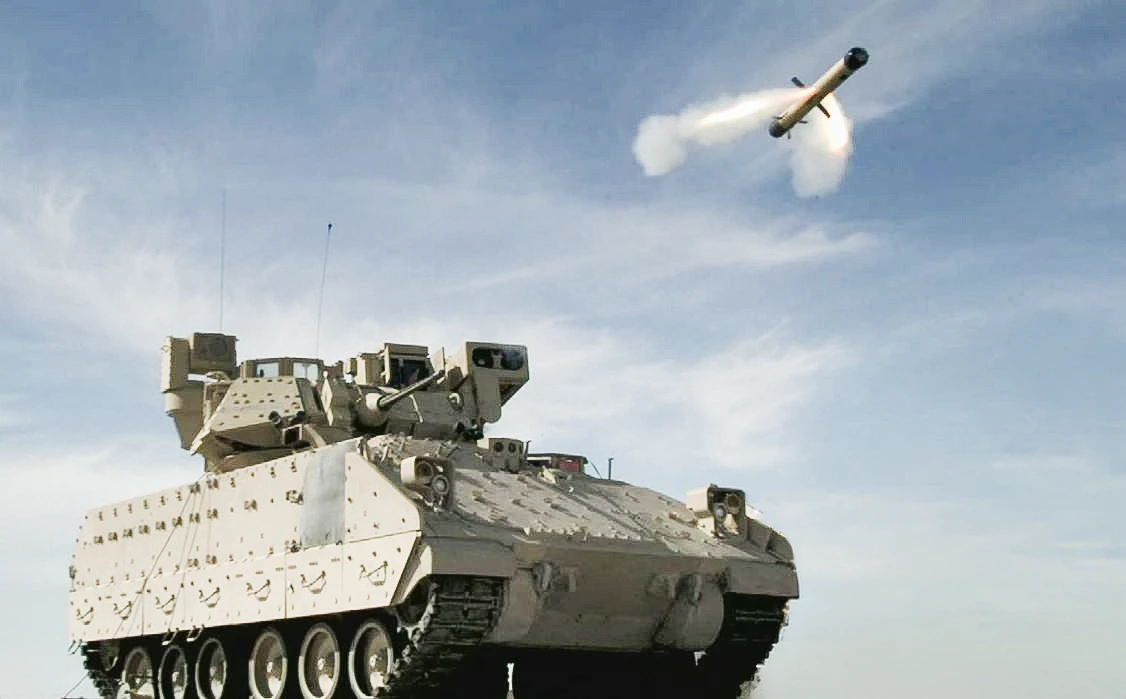
Leonardo DRS introduced its Multi-Purpose Missile Launcher (MPML) on October 14, 2026, a field-reconfigurable launcher designed to let vehicles fitted with Tube-launched, Optically tracked, Wire-guided (TOW) launchers fire Rafael Advanced Defense Systems’ Spike LR2 anti-tank guided missile while retaining full TOW compatibility. The company and Rafael USA presented the system at the Association of the U.S. Army (AUSA) annual meeting in Washington, and Leonardo DRS names the Bradley and Stryker families as target platforms.
The launch lands while the Army’s search for a TOW successor remains open. Under the Close Combat Missile System-Heavy (CCMS-H) effort, the Army has sought since 2021 a missile sized to work with existing vehicle-mounted and infantry TOW launchers and able to reach 10 kilometers, and Program Executive Office Missiles and Space issued a request for information in 2022. No CCMS-H selection has been announced. Meanwhile, the Army awarded Raytheon a $193.7 million contract modification on January 27, 2026, to keep producing TOW missiles through September 30, 2028.
Leonardo DRS MPML Hardware, Weights, and Interfaces
MPML combines three elements: a new lightweight launcher derived from the Upgraded TOW Missile Launcher (UTML), two Spike LR2 adapter assemblies, and a Common Missile Control Unit (CMCU) hosting TOW and Spike electronics and software for missile selection, firing and guidance. Rafael USA partnered on the effort. The concept has flown before: during the Army’s Project Convergence 2021 experiment, two Spike missiles fired from a TOW launcher reportedly struck their targets.
Company data put the launcher at 110 pounds in its Spike LR2 configuration, against 100 pounds for a UTML loaded with TOW 2B, with each Spike adapter weighing 22.5 pounds. Length grows from 52 to 55 inches, with width and height unchanged at 21 and 14 inches. The 35-pound CMCU measures 13.5 by 7.9 by 8 inches, outputs CoaXPress and HD-SDI video, communicates over Ethernet and RS-422, and draws 18 to 32 volts DC under MIL-STD-1275. Leonardo DRS describes it as compliant with the Ground Combat Systems Common Infrastructure Architecture (GCIA) and aligned with the Modular Open Systems Approach (MOSA).
The company claims zero net impact on size, weight and power or onboard stowage compared with a TOW-only system, and says crews can switch missile types in the field without special tools. Because the Bradley’s turret launcher holds two rounds, the companies say a vehicle could carry one Spike LR2 alongside one TOW, letting commanders tailor the load to the threat. Aaron Hankins, who leads Leonardo DRS Land Systems, called MPML “a practical path to introduce new anti-armor capability.”
Spike LR2 vs TOW 2B: Range, Seeker, and Warhead Options
Publicly available specifications indicate the fifth-generation Spike LR2 weighs about 13 kilograms and reaches 5.5 kilometers from ground launchers, compared with roughly 4.5 kilometers for the longest-range TOW variants. That margin matters less than the guidance architecture. TOW relies on semi-automatic command to line-of-sight (SACLOS) guidance, so the gunner must hold the target in the sight until impact while the vehicle stays exposed. Spike LR2 carries an electro-optical seeker pairing an uncooled infrared sensor with a high-definition color day camera and streams video to the operator in flight over a fiber-optic or radio-frequency datalink.
That seeker supports fire-and-forget, fire-and-observe and fire-to-target-coordinates modes, allowing the gunner to watch the target area during the approach, switch targets in flight or strike targets behind obstacles beyond direct line of sight. An embedded inertial measurement unit enables third-party target allocation in networked engagements. Rafael offers two warheads: a tandem high-explosive anti-tank (HEAT) charge it credits with more than 30 percent greater armor penetration, and a multipurpose blast warhead with gunner-selected fuzing for structures and personnel.
For a Bradley crew, the operational gain is a shorter exposure window, since the vehicle can displace after a fire-and-forget launch, and the ability to exploit the longer detection, recognition and identification ranges of newer sights. Training remains a cost, since gunners keep their console but inherit new engagement procedures. The open architecture also leaves room for loitering anti-armor munitions. The range gap persists, however: 5.5 kilometers covers barely half of the 10-kilometer CCMS-H objective.
Analysis: MPML decouples the launcher decision from the missile decision. By keeping the UTML footprint, supply chain and TOW compatibility, Leonardo DRS lowers the cost of fielding a second missile without waiting for CCMS-H. Spike already flies with the Army on the AH-64E Apache in its NLOS variant, and Spike LR2 is on order with NATO members including Italy and Slovakia, easing munitions commonality with allied formations in Europe.
Leonardo DRS has disclosed no customer, contract or price, and no Army program to qualify Spike LR2 on either vehicle has been made public. Fire control integration and funding come next. The XM30 Mechanized Infantry Combat Vehicle, whose General Dynamics Land Systems and American Rheinmetall prototypes are now in Army testing ahead of a downselect expected in spring 2027, offers a second entry point.