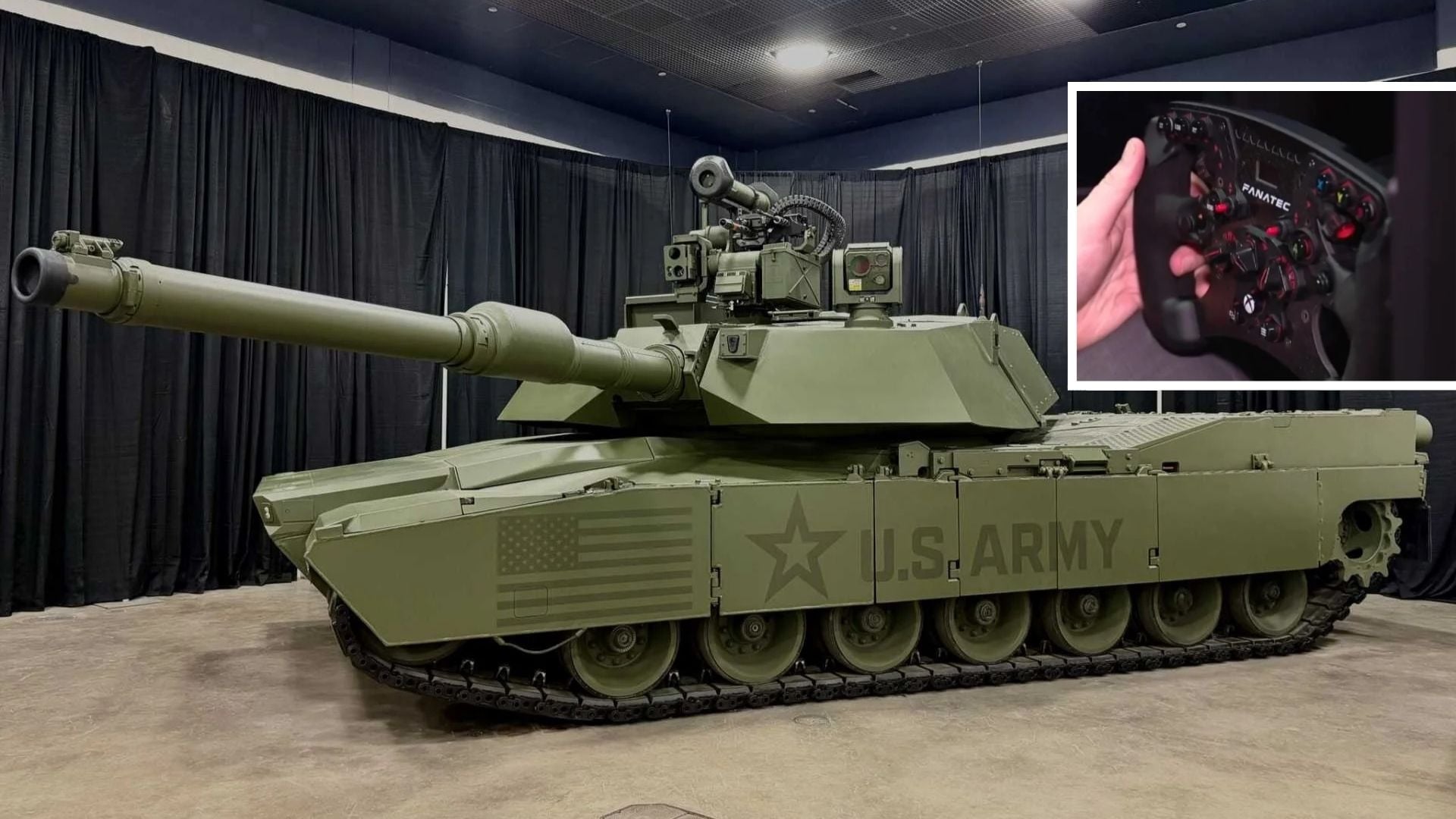
The Pentagon’s selection of Kord Technologies’ Firefly high-energy laser for a yearlong counter-drone pilot at US military installations puts a commercial Xbox controller inside the fire-control chain of a homeland air defense weapon. Firefly joins a growing list of US systems, from the Army’s M1E3 Abrams tank to the Navy’s Virginia-class submarines, that trade bespoke military hand controls for gaming controllers.
Joint Interagency Task Force 401 (JIATF 401), the Army-led counter-drone task force, named Firefly on October 5, 2026, alongside AeroVironment’s Palletized High-Energy Laser, Boeing’s Compact Laser Weapon System and Epirus’ Leonidas high-power microwave. Service members will operate and maintain the weapons at US bases for a year while the Pentagon collects cost and logistics data. The timing matters: the services are adding sensors and effectors while shrinking crews, and must train recruits quickly on counter-drone, robotic and directed-energy systems. The interface now shapes training pipelines, crew size and how much control a human actually exercises over a lethal engagement.
How Gaming Controllers Entered the Firefly Laser Fire-Control Loop
Kord, a subsidiary of KBR, builds Firefly as a mobile counter-unmanned aircraft system (C-UAS) laser. Company literature describes a single-operator workstation running on a standard desktop computer, with a touchscreen human-machine interface (HMI), an Xbox controller, a hardwired arm and abort function and a safety interlock. Laser power options run from 5 to 30 kilowatts, with an optical design the company rates as scalable to 40 kilowatts, and the system plugs into command-and-control networks including the Army’s Forward Area Air Defense (FAAD) system.
The engagement sequence explains why a gamepad fits. A radar cue alerts the operator, who uses visible and infrared cameras to zoom in on the contact and decide whether it is a bird, a manned aircraft or a drone. AI-enabled trackers then hold the target while the operator selects an aimpoint, down to a specific propeller, engine or fuel tank, according to KBR. David Zoller Jr., a senior director at KBR, said the system still has a person who “decides not just when to fire, but also where to fire.” He added that the controller shortens training because operators already know the button layout.
The approach has more than a decade of precedent in directed energy. Boeing’s 10-kilowatt High Energy Laser Mobile Demonstrator (HEL MD) ran on an Xbox controller and a laptop during 2014 trials. Raytheon’s 10-kilowatt High-Energy Laser Weapon System (HELWS), Boeing’s 5-kilowatt Compact Laser Weapon System (CLWS) and AeroVironment’s LOCUST family use the same form factor. In September 2026, the Army awarded AeroVironment $464.8 million to produce the 30-kilowatt LOCUST X3 under the Enduring-High Energy Laser (E-HEL) program. A laser engagement is a slew, zoom, track and authorize task, and a dual-stick gamepad maps those functions to two thumbs and a trigger.
M1E3 Abrams Fanatec Controls and the Three-Crew Hull Cockpit
The first M1E3 pre-prototype, developed with Roush leading cockpit and vehicle integration among more than ten industry partners, debuted at the Detroit Auto Show in January 2026. Army Chief of Staff Gen. Randy George described a “Formula One cockpit” with a driver interface he compared to an Xbox controller. The device comes from Fanatec, a manufacturer of sim-racing wheels and gaming cockpits.
The production M1E3 is designed to move a three-person crew into the hull beneath an uncrewed turret, with an autoloader replacing the human loader of the four-person M1A2 System Enhancement Package version 3 (SEPv3). A crew that fights through cameras and screens rather than periscopes treats a commercial gamepad as one more input device on a digital backbone. Army officials say the design is roughly 25 percent lighter than current Abrams variants and that its hybrid-electric drive should make it 40 to 50 percent more fuel efficient. A handheld driving controller only works when steering and throttle commands travel as electronic signals, and the hybrid-electric architecture points in that direction.
The Army compressed the schedule by putting hardware in soldiers’ hands early. Four early prototypes were slated for a platoon in summer 2026, five years ahead of the original plan. Army Chief Technology Officer Alex Miller released images of M1E3 live-fire testing in early October 2026, and the first pre-prototypes are expected to join the 1st Armored Brigade Combat Team, 1st Cavalry Division, at Fort Hood by year’s end. Brent Ingraham, the Assistant Secretary of the Army for Acquisition, Logistics and Technology, said in March 2026 that production could begin within roughly 12 months, with pilot production planned for fiscal 2027. The Army has not said whether the Fanatec controller is fitted to the interim test vehicles or will survive into the production configuration.
From Virginia-Class Periscopes to Ukrainian Turrets: The Commercial Controller Record
The Navy offers the clearest cost case. Lockheed Martin replaced the photonics mast handgrip and imaging control panel on Virginia-class attack submarines, which cost about $38,000 according to the company, with an Xbox 360 controller that typically sold for under $30. Sailors testing it in Lockheed Martin’s lab learned the new control in minutes rather than the hours the legacy joystick required. USS Colorado (SSN-788), commissioned in March 2018, became the first boat to carry it as standard equipment, with earlier hulls receiving it through routine modernization.
Israel tested the same idea in armor. In the Carmel future armored fighting vehicle program, unveiled in August 2019, Israel Aerospace Industries (IAI) fitted its two-crew demonstrator with Xbox-style controllers after teenage gamers critiqued an earlier fighter-style joystick. Elbit Systems paired its IronVision helmet display with a jet-style stick instead, a reminder that the gamepad remains a design choice, not a standard.
Ukraine pushed the concept to the front line. In April 2023, Ukrainian troops were photographed operating the Sabre remote weapon station, which mounts a 7.62x54mm PKT or PKM machine gun, with a Valve Steam Deck handheld from up to 500 meters away. A commercial handheld packages screen, sticks and processing in one unit, but without military qualification for shock, moisture or electromagnetic interference.
The Army has used Xbox-style controllers on small explosive ordnance disposal robots for more than 15 years, including in Afghanistan. Industry answered the durability gap with ruggedized equivalents such as Ultra Electronics’ Freedom of Movement Control Unit (FMCU), fitted to the MQ-8 Fire Scout and the Navy’s 30-kilowatt AN/SEQ-3 Laser Weapon System aboard USS Ponce.
Where Simplified Military Interfaces Fail: Lessons From the USS John S. McCain
Simplification has a failure record. On August 21, 2017, the destroyer USS John S. McCain (DDG-56) collided with the tanker Alnic MC near Singapore, killing 10 sailors. The National Transportation Safety Board (NTSB) concluded that the ship’s touchscreen steering and thrust control system increased the likelihood of the operator errors that led to the collision, citing the unintentional transfer of steering control between stations and port and starboard throttles that were not ganged and became mismatched. Investigators also judged crew training on the Integrated Bridge and Navigation System inadequate. After sailors overwhelmingly told fleet surveys they preferred mechanical controls, the Navy decided in August 2019 to retrofit physical throttles on Arleigh Burke-class destroyers fitted with that system.
The McCain case is not an argument against gamepads, which keep physical sticks and buttons. It is an argument against assuming that a familiar consumer interface is automatically a safe one. A standard gamepad offers fewer than two dozen physical inputs, so complex systems compensate with layered modes, and mode confusion is a recognized source of operator error. Firefly’s architecture shows one mitigation: the arm and abort functions sit on dedicated hardwired controls, separate from the commercial controller.
A second limit is speed. Against small, fast drones, a human slewing a thumbstick can lose the engagement window, which is why Firefly and its peers lean on AI-enabled acquisition and tracking. Firefly also engages one target at a time, so a swarm forces the operator to prioritize. As automation absorbs tracking and aiming, the controller shifts from steering the weapon to supervising it. Sikorsky’s optionally piloted Black Hawk shows where that leads: during Exercise Northern Strike 25-2 in August 2025, an Army National Guardsman with no aviation background learned in under an hour to task the MATRIX-equipped helicopter from a handheld tablet.
Analysis: The gamepad is the visible edge of a deeper shift from operating machines to supervising software. Its value is measurable in training hours, unit cost and crew size. Every program that adopts a commercial controller is also deciding how authority splits between the operator and the algorithm, a decision that carries doctrinal weight under Department of Defense Directive 3000.09, which requires appropriate levels of human judgment over the use of force by autonomous and semi-autonomous weapons. Firefly’s model, in which software tracks but a human chooses when and where to fire, preserves that judgment; a design that reduces the operator to a confirm button under time pressure would not, even with identical hardware. The more consequential test is whether the services treat controller selection as a human-systems integration decision, validated against standards such as MIL-STD-1472 and live testing, rather than as a procurement shortcut. For NATO, common control conventions across lasers, robots and vehicles would ease coalition training, if agreed before national programs diverge.
The next data points arrive quickly. JIATF 401 will host a directed-energy shoot-off at Dugway Proving Ground, Utah, in December 2026, while the base pilot generates the first sustained operator data on these weapons. The first M1E3 pre-prototypes are due with the 1st Cavalry Division by year’s end, ahead of pilot production in fiscal 2027. Still unknown: whether the Fanatec controller survives soldier evaluation, how the Army will qualify commercial input devices for durability and cybersecurity, and how much manual control operators will keep as AI-enabled tracking matures.