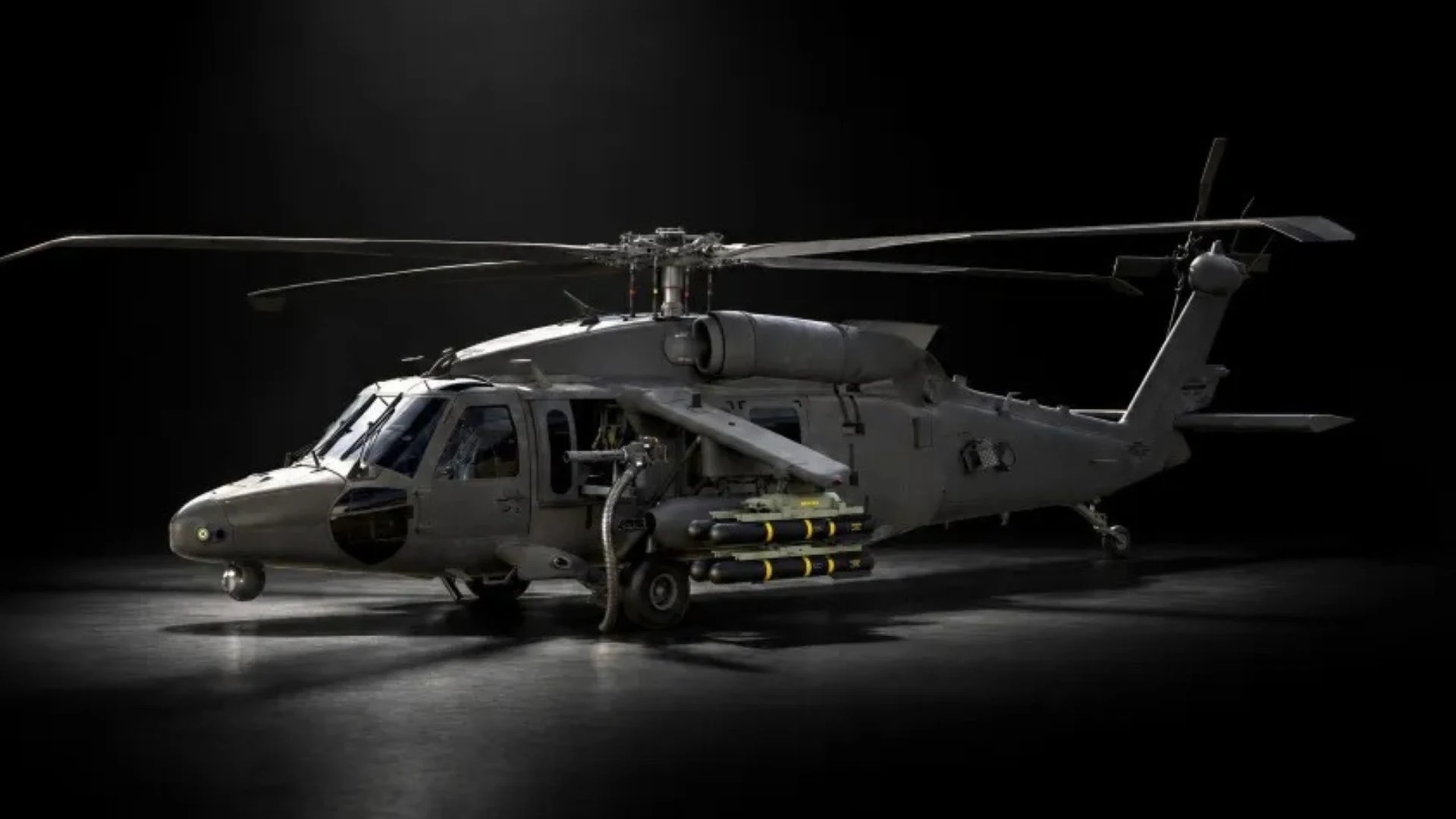
Sikorsky expects to make a new modular, swappable nose section for the H-60 Black Hawk family available within roughly a year, on new-production aircraft and as a retrofit for in-service helicopters, company officials said on October 14, 2026, at the Association of the U.S. Army (AUSA) annual meeting in Washington. The enlarged structure offers roughly double the internal volume of the current UH-60 nose, built around an open architecture for sensors, communications and autonomy hardware.
The timing is pointed. The Army’s fiscal 2027 budget request cut Black Hawk procurement from $913 million to $39 million, enough for a single UH-60M, as the service shifts investment toward the Bell MV-75 Cheyenne II tilt-rotor, even as Army leaders plan to fly the Black Hawk through at least 2050 and potentially 2070. Sikorsky’s Black Hawk 2070 roadmap, also briefed as Black Hawk Next, targets that gap with four upgrade lines: the GE Aerospace T901 engine, airframe enhancements, a new digital backbone and autonomy. The nose is closest to fielding.
Black Hawk Modular Nose Design Doubles Forward Mission Volume
Jason Wrigley, Sikorsky’s director of business development for Black Hawk, said the company has completed an initial design cycle. “Within the next, I would say, year or so, the nose will be available to be retrofitted or to be coming off the line,” he told The War Zone at AUSA.
Sikorsky 3D-printed noses so engineers, aircrews and maintainers could physically test access, and their feedback is shaping the next iteration. A scale model on the show floor shows the structure opening from the top, and cooling for densely packed electronics has been a design driver from the outset. Sikorsky says the section combines internal volume for avionics with an integrated mount for external sensor pods, wired into the new digital backbone under a modular open systems approach (MOSA).
The Army set outcomes rather than a specification, Wrigley said, and the demand is established: the 160th Special Operations Aviation Regiment’s MH-60M and the U.S. Air Force’s HH-60W Jolly Green II already fly with noses crowded with radars, electro-optical/infrared turrets and mission systems, each the product of bespoke integration. A standardized, retrofittable section would bring that forward real estate to baseline UH-60Ms without a dedicated variant.
Key unknowns remain. Sikorsky, still writing the retrofit documentation, does not see the installation as very invasive but has not said how long a swap takes, what the section weighs or how it shifts the center of gravity.
From Gunship to Drone Controller: Swappable Nose Configurations
The AUSA model is configured as a gunship; Sikorsky also cites search and rescue and airborne control of uncrewed systems. The logic is a small pool of mission noses shared across a larger fleet: a radar for one series of sorties, a wide-area electro-optical surveillance package for the next, laser designators and targeting sensors when a utility aircraft is reconfigured for armed escort. Defensive systems could likewise move between airframes.
For smaller H-60 operators, that means multi-mission capability without sustaining separate variants. For the Army, it supports the drone command integration Sikorsky lists among its enhancements as the service experiments with launched effects.
Autonomy is the other driver. Sikorsky’s MATRIX autonomy system, matured on an optionally piloted UH-60A under Defense Advanced Research Projects Agency (DARPA) sponsorship, needs lidar, cameras and processing that compete for space up front; some of it could move into the new nose. Full autonomy goes further: the S-70UAS U-Hawk, converted from a UH-60L, replaces the cockpit entirely with clamshell doors and a ramp, carries about 7,000 lb internally and 9,000 lb on its external hook, and remains slated to fly before the end of 2026.
T901 Engine and Airframe Upgrades Underpin Black Hawk 2070
The GE Aerospace T901-GE-900, developed under the Improved Turbine Engine Program (ITEP), is a 3,000 shaft horsepower (shp) class engine promising up to 50 percent more power than the UH-60M’s twin T700-GE-701D engines, which publicly available specifications place in the 2,000 shp class. Sikorsky pairs it with a 30 percent larger main fuel cell and a strengthened structure. The company says the combined package adds 1,000 lb or more of payload, 100 nautical miles of range and 45 minutes of time on station.
The T901-powered UH-60M has logged more than 70 flight test hours. Sikorsky reports climb rates above 1,000 ft per minute at 19,000 ft, and above 500 ft per minute at 17,000 ft at the aircraft’s 22,000 lb maximum gross weight, margins that matter for high-altitude and long-range operations.
The engine’s future is less certain. The Army requested no additional ITEP funding in fiscal 2026 before Congress appropriated $238 million, and its fiscal 2027 request again seeks no new money. Wrigley said Army officials describe their approach as “targeted modernization,” upgrading by battalion or unit rather than fleetwide: autonomy for some aircraft, launched effects, engines or stub wings for others.
Analysis: The modular nose is Sikorsky’s fastest and least budget-exposed lever. Unlike the T901, which the Army has twice left unfunded in its budget requests, a bolt-on nose can be bought in small lots, fitted to legacy airframes and justified mission by mission, consistent with the Army’s preference for spending on payloads and drones over platforms. It also protects the industrial base. The September 30, 2026, Novel Production Agreement, opened with a $234 million undefinitized contract action for 16 UH-60Ms, delivers from 2028 and could grow by more than 100 aircraft as foreign military sales cases mature. A nose that fits new-build and in-service H-60s gives Sikorsky a product for the global installed base even if U.S. orders thin. The open architecture’s value will hinge on who controls the interface standards.
Sikorsky has announced no date for flight testing the nose, and no dedicated Army funding line has been identified. Fiscal 2027 appropriations remain the swing factor: House appropriators moved to restore Army aviation funding, while the Senate Armed Services Committee backed the cuts. The production agreement is expected to be definitized in the first half of 2027.