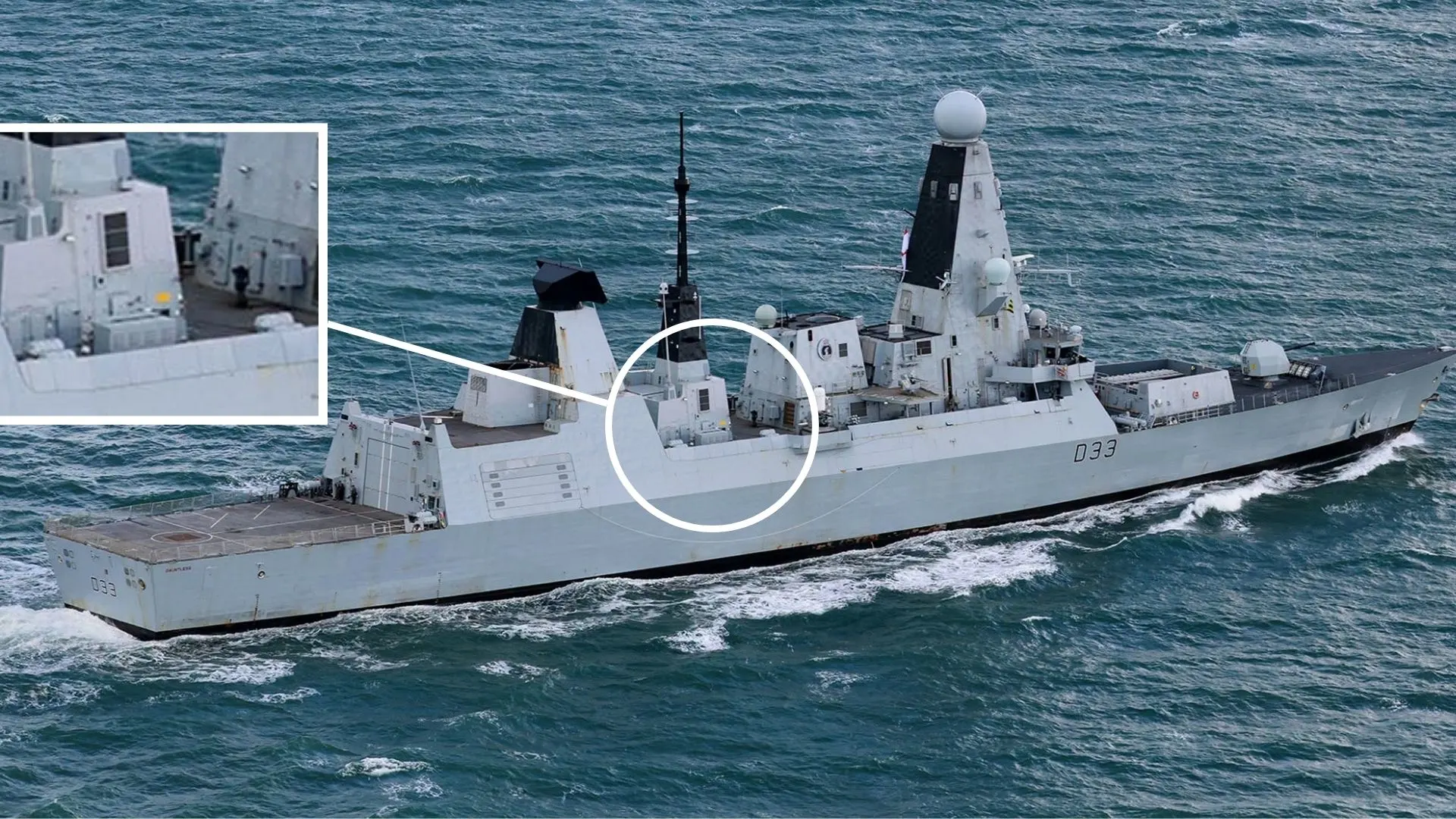
The Royal Navy has fitted the Type 45 destroyer HMS Dauntless (D33) with two box-type launchers, visible in UK Ministry of Defence (MoD) imagery dated October 10, 2026, that a visual analysis by Naval News assesses as housing interceptor drones for counter-unmanned aircraft system (C-UAS) self-defense. The boxes sit on the port and starboard sides of the destroyer’s black-painted main communications mast. Contacted by Naval News, a Royal Navy spokesperson declined to discuss the equipment fit, citing operational sensitivities.
The images show Dauntless conducting a passing exercise (PASSEX) off the Isle of Wight with five Ukrainian Navy minehunters, Henichesk, Mariupol, Melitopol, Chernihiv and Cherkasy, as they closed out Exercise Lion Protector, a Joint Expeditionary Force (JEF) activity that ran from August to rehearse the defense of Europe’s northern flank. Dauntless is now preparing to escort the carrier HMS Prince of Wales when the flagship resumes Operation Firecrest, the UK Carrier Strike Group’s 2026 deployment to the North Atlantic and High North. The fit follows HMS Diamond’s 2023-2024 Red Sea engagements and HMS Dragon’s 2026 deployment to shield British bases in Cyprus from drone and missile attack.
How Type 45 Drone Interceptors Tie Into the Sampson Radar Picture
The two enclosures do not match standard ISO container dimensions. Measured against the nearby SOLAS liferaft canister, each appears to be roughly 2 meters long and 1 meter wide, an estimate rather than an official figure. Their layout is consistent with a multi-cell vertical launch arrangement. Rotor-driven interceptors generally need generous cell volume to spin up and leave the launcher under their own power.
No new radar, electro-optical director or antenna appears alongside the boxes. That points to target cueing from the existing sensor suite: the BAE Systems Sampson multifunction radar (Radar Type 1045) on the foremast, the S1850M long-range volume search radar (Radar Type 1046) on the aft mast, and the ship’s electro-optical systems. If confirmed, that architecture would make the capability an integrated part of the destroyer’s combat system rather than a standalone quick-reaction kit with its own sensor and fire control chain.
Interceptor type, cell count, kill mechanism, range and the role of the Sea Viper command and control system all remain unknown. The MoD has not identified the interceptor. The UK ordered the jet-powered Cambridge Aerospace Skyhammer in April 2026; publicly released figures give it a top speed of 700 km/h and a range of more than 30 kilometers. In July 2026, the MoD awarded Low-Cost Air Defence Effectors (LCADE) contracts to Frankenburg Technologies, Greenjets and Cambridge Aerospace under the Low-Cost Effectors and Autonomous Platforms (LEAP) framework shared with France, Germany, Italy and Poland. No public evidence links any of these systems to the Dauntless installation.
Type 45 Magazine Depth and the Red Sea Cost-Exchange Problem
Each Type 45 carries 48 SYLVER A50 vertical launch cells loaded with Aster 15 and Aster 30 missiles, and those cells cannot be reloaded at sea. Between December 2023 and April 2024, HMS Diamond (D34) shot down nine Houthi drones and one anti-ship ballistic missile in the Red Sea and Gulf of Aden, using Sea Viper missiles and guns. Seven of those drones came in a single engagement on January 9, 2024, when her 30mm gun accounted for one of them. Open-source estimates place each Sea Viper missile above $1 million.
The threat returned in 2026. HMS Dragon (D35) sailed from Portsmouth on March 10, eight days after a Shahed-type drone struck RAF Akrotiri in Cyprus, and spent 214 days away, shielding the UK sovereign base areas. Dragon returned on October 9, 2026, and the new launchers have not been observed aboard her, which suggests Dauntless may be the first Type 45 to trial the system. The constraint is European, not British: Horizon-class destroyers also carry 48 cells and French air-defense FREMM frigates carry 32.
How Sea Viper CAMM and DragonFire Layer Type 45 Drone Defense
Under the Sea Viper CAMM program, MBDA UK is installing a 24-cell silo for the Common Anti-Air Modular Missile (CAMM) forward of the existing SYLVER launchers, raising missile capacity by 50% and freeing all 48 SYLVER cells for Aster 30. CAMM replaces Aster 15 as the inner-layer interceptor. HMS Defender (D36) is the first ship, with installation scheduled to finish in late summer 2026 according to a parliamentary written answer; all six ships are due to receive it by the end of 2032.
Directed energy follows. In November 2025, the MoD awarded MBDA UK a £316 million contract for DragonFire, with the first system to be fitted to a Type 45 by 2027, five years ahead of the original plan. The MoD puts the cost per shot at about £10. Wildcat HMA2 helicopters armed with the Thales Martlet Lightweight Multirole Missile already add an organic C-UAS layer.
Allies are converging on the same answer. In August 2026, the Royal Netherlands Navy announced it will integrate Destinus’s containerized Hornet B2 interceptor aboard several warships, under a program slated for completion in the second quarter of 2027. The US Navy has fitted launchers for Raytheon’s Coyote interceptor to the Arleigh Burke-class destroyer USS Bainbridge (DDG 96).
Analysis: The launcher hardware matters less than the apparent absence of dedicated sensors. A drone interceptor cued by Sampson lets the Type 45 grade its response instead of choosing between expending Aster rounds and accepting risk: Aster 30 for ballistic and supersonic threats, CAMM for the inner layer, and drones or a laser for low-cost mass. For a carrier escort heading into the High North, where the threat set includes high-end Russian anti-ship missiles, every SYLVER cell preserved for those targets directly improves strike group survivability. Fielding it on a Firecrest escort signals that the Royal Navy now treats drone saturation as a NATO-theater problem, not a regional one.
The MoD has not confirmed the system’s identity, its integration with Sea Viper, or whether the fit will extend to the other five Type 45s or to the Type 26 and Type 31 frigates. Markers to watch include the resumed Firecrest deployment, confirmation that Defender’s CAMM installation is complete, and DragonFire’s first shipboard fit in 2027. Interceptor stockpile depth and production rate, the factors that ultimately decide a saturation fight, remain undisclosed.