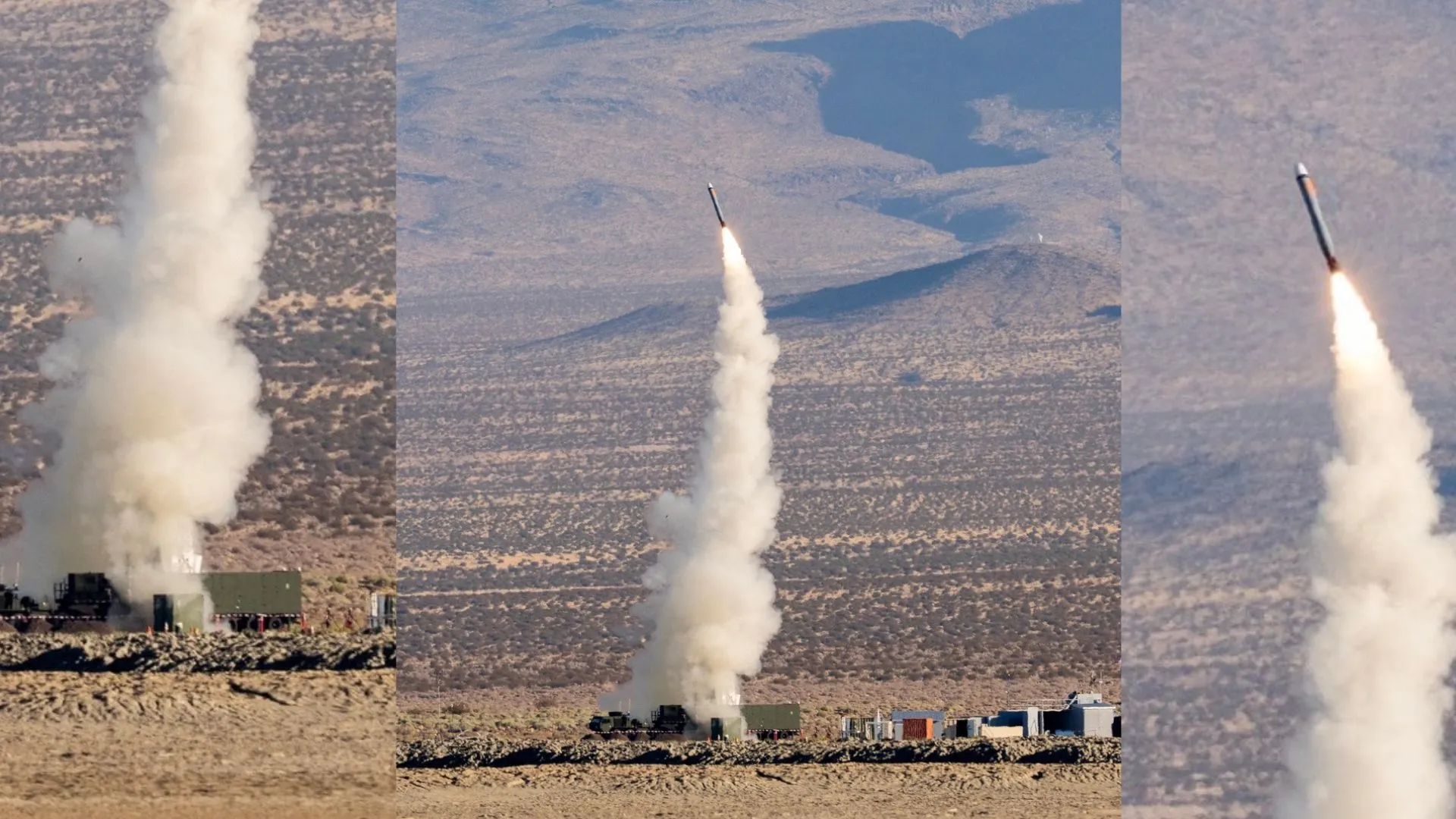
The U.S. Army’s Europe-aligned Typhon battery fired its first Tomahawk Land Attack Missile on September 28, 2026, at Naval Air Weapons Station China Lake, California. The Mid-Range Capability (MRC) Battery of the 3rd Battalion, 12th Field Artillery Regiment (3-12 FA), the Long Range Fires Battalion assigned to Multi-Domain Command Europe (MDC-E), conducted the launch with newly fielded launchers, the Army said October 15, 2026.
The Army describes the shot as the third Typhon firing inside the continental United States. It comes five months after the Pentagon canceled the battalion’s planned 2026 deployment to Germany, a decision reportedly set out in a May 1 Pentagon memo, issued the same day the department announced it would withdraw 5,000 troops from Germany. Activated at Fort Drum, New York, on October 17, 2025, 3-12 FA stood up its MRC battery in November 2025. The battalion is administratively aligned with the 10th Mountain Division but falls under the operational control of MDC-E and its 2nd Multi-Domain Task Force (MDTF).
Five Weeks From Fielding to First Typhon Missile System Live Fire
The battery’s soldiers first completed a five-week operation and maintenance course facilitated by the U.S. Navy and Lockheed Martin field service representatives. The Navy’s role reflects Typhon’s lineage: the system fires Navy-managed munitions from cells derived from shipboard vertical launch systems, and the Navy remains lead service for both the Tomahawk and Standard Missile-6 (SM-6) programs.
“They’re incredibly good at what they do now,” said Lt. Col. Derek Bartlett, commander of 3-12 FA. “I’m very comfortable deploying them forward after these five weeks.”
Bartlett framed the capability as a change in joint fires allocation. Strikes inside Typhon’s projected range previously came by request to the Joint Force, typically from the Navy. “We get that range for that combatant commander to give them options and capabilities where they really haven’t had it before from the land force,” he said, adding that “the Army now has that capability.”
Command Sgt. Maj. John Hespe, the battalion’s senior enlisted advisor, underlined the network dependency behind each shot. “It requires all domains to work in unison for a kinetic strike to happen,” he said.
The Army has not disclosed the Tomahawk variant, target, flight profile or distance flown on September 28. The two earlier continental U.S. firings came in 2023, when the Army launched an SM-6 and, in June, 1st MDTF soldiers fired a Tomahawk from the prototype battery accepted in December 2022.
Mk 41 Cells and Tomahawk Range: Inside the Typhon Battery
A Typhon battery comprises four trailer-mounted launchers, a Battery Operations Center, a reload capability and support vehicles. Publicly available specifications indicate each launcher, the Mk 70 Mod 1 Payload Delivery System, holds four Mk 41-derived cells and is towed by an M983A4 Heavy Expanded Mobility Tactical Truck, giving the battery 16 ready rounds before reload. That is a fraction of an Arleigh Burke-class destroyer’s 90 to 96 Mk 41 cells, but the launchers can disperse, relocate and fire from allied territory without drawing down a warship’s magazine.
Publicly available specifications indicate the subsonic, turbofan-powered Tomahawk in its Block IV and Block V variants reaches roughly 1,600 km, carries a warhead in the 450 kg class and cruises at about 880 km/h, combining GPS-aided inertial navigation with terrain-contour matching and a two-way satellite datalink that allows in-flight retargeting. The Block Va Maritime Strike Tomahawk adds a seeker against moving ships, while the SM-6 gives the same launchers an anti-air and anti-ship option.
The Army positions Typhon between the Precision Strike Missile and the Long-Range Hypersonic Weapon known as Dark Eagle. The Intermediate-Range Nuclear Forces Treaty barred such land-based missiles, with ranges of 500 to 5,500 km, until the U.S. withdrawal in August 2019.
The 3-12 FA battery is one of four MRC batteries the Army has created. Indo-Pacific units deployed Typhon to the Philippines in April 2024, sank a maritime target with an SM-6 during Exercise Talisman Sabre in Australia in July 2025, and displayed the system in Japan during Exercise Resolute Dragon in September 2025.
Canceled Germany Deployment Leaves 3-12 FA’s Europe Role Unsettled
The battalion was built for Europe. A July 2024 U.S.-German joint statement committed Washington to episodic deployments of MDTF long-range fires in Germany from 2026, including Tomahawk, SM-6 and developmental hypersonic weapons, as a step toward enduring stationing. A defense official confirmed in May 2026 that the battalion’s deployment, scheduled for later in the year, had been canceled.
Berlin moved to field its own capability. On July 9, 2026, following the NATO Summit in Ankara, Chancellor Friedrich Merz said Germany had agreed to acquire Tomahawk missiles and ground-based Typhon launchers. A German government planning document reported in September put the potential package at nearly 3.4 billion euros. Launcher quantities, missile numbers and delivery dates have not been made public.
“It’s going to provide better options for commanders to choose to fire from land based emplacement in any country at any time,” Hespe said.
Analysis: The China Lake shot shows the Army can turn a newly activated battery into a live-fire-qualified Tomahawk shooter within weeks, but qualification is not posture. With forward stationing canceled, the Army’s only Europe-aligned ground-launched Tomahawk capability sits in upstate New York, and its response time depends on strategic airlift and sealift rather than road moves from German garrisons. Its nearest-term value may lie in interoperability: as the Bundeswehr builds a Typhon force from scratch, a U.S. battery with live-fire experience on the same launcher is a natural partner for crew training and fires integration. Each Tomahawk mission an Army launcher absorbs also spares Navy vertical launch cells, which largely depend on port facilities to reload.
The Army has not said when 3-12 FA will next exercise in Europe or whether short rotations will replace the canceled deployment. The next markers are the contracting steps that turn Germany’s agreement into deliveries and the fielding of MRC batteries to the remaining MDTFs, which congressional researchers say the service targets between fiscal years 2026 and 2028. The battery’s first theater-level exercise with MDC-E will show how much of the Europe mission survived the posture cut.