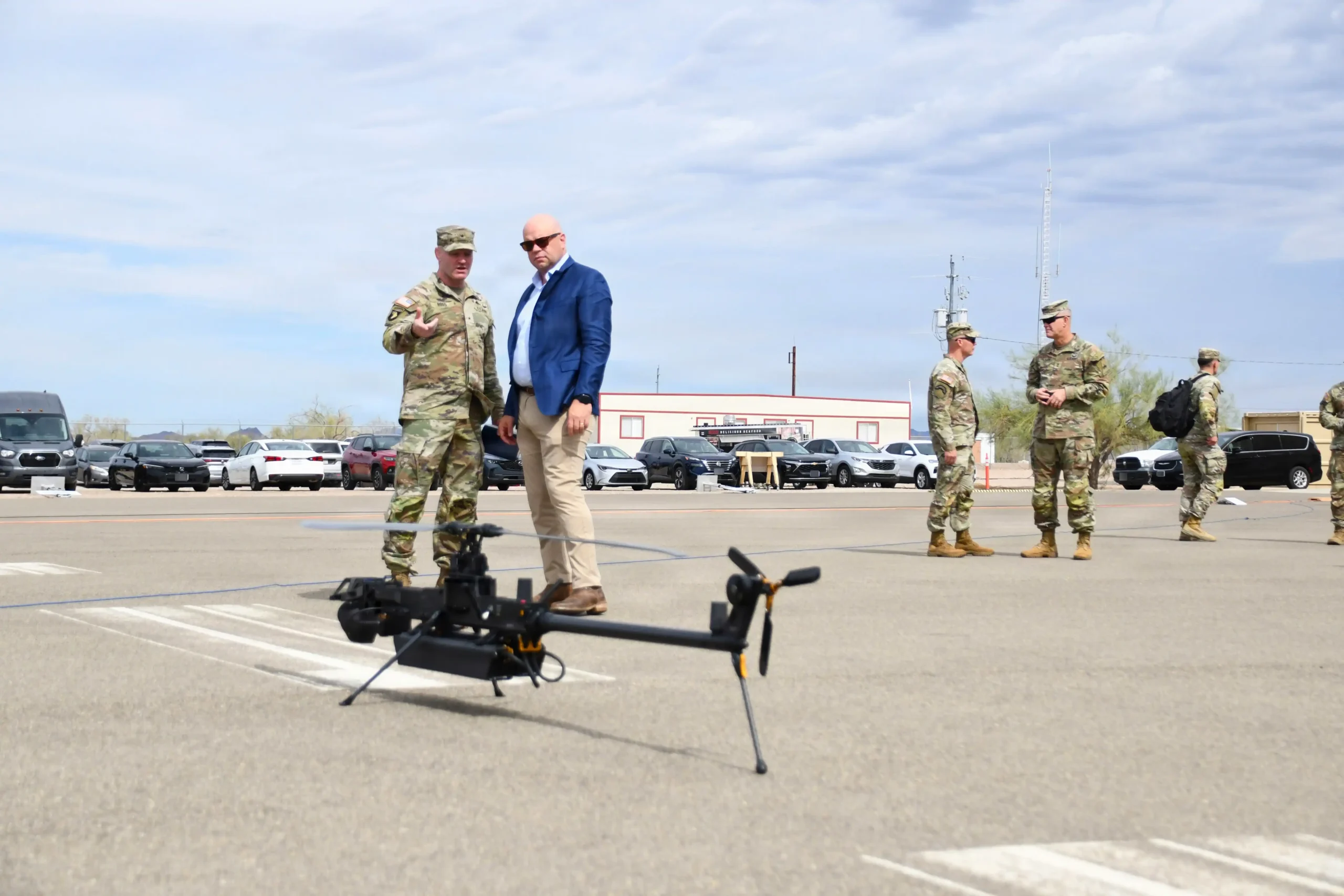
Joint Interagency Task Force 401 (JIATF 401), the Department of War’s lead organization for countering small unmanned aircraft systems (sUAS), has passed its first anniversary with more than $5 billion in counter-drone contract ceilings awarded and a homeland defense mission stretching from the southern border to 11 FIFA World Cup host cities. The task force now aims to reach $7 billion in awards by the end of October 2026.
Pete Hegseth, now Secretary of War, created JIATF 401 in an August 28, 2025 memorandum that disestablished the Joint Counter-small Unmanned Aircraft Systems Office (JCO), the Army-run body created in 2020. Led by Army Brig. Gen. Matt Ross and reporting directly to the Deputy Secretary, the task force absorbed department-wide counter-sUAS research, development, test and evaluation (RDT&E) outside service-specific and U.S. Special Operations Command programs, took over Replicator 2 resources, and gained authority to approve up to $50 million per effort against Group 1 through Group 3 drones. The Fiscal Year 2026 National Defense Authorization Act (NDAA) codified that centralization; a continuation review falls at 36 months.
How JIATF 401 Counter Drone Spending Reached $5 Billion
In February 2026, the task force brought a centralized counter-UAS marketplace to initial operational capability. It has since secured an enterprise-wide agreement for a common counter-UAS tactical user interface, a step toward shared air domain awareness across vendors. In April, it committed more than $600 million: $350 million for urgent requirements during the first month of Operation Epic Fury combat operations, $100 million for mobile counter-drone systems protecting World Cup venues, and $158 million under the Domestic Shield initiative for the highest-priority defense critical infrastructure.
Larger vehicles followed. Perennial Autonomy received a three-year, $500 million indefinite-delivery/indefinite-quantity (IDIQ) contract in May covering Merops interceptors, Bumblebee quadcopters and Hornet midrange strike drones already employed by U.S. forces in the Central Command area of responsibility. In July, CACI secured a $500 million IDIQ for its SkyValor detect-and-defeat system after operational evaluations at Marine Corps Air Station Yuma conducted with Joint Task Force-Southern Border and U.S. Customs and Border Protection (CBP).
On September 29, 2026, JIATF 401 and the Army’s acquisition office announced 10 IDIQ awards with combined base ceilings of $4.15 billion. Allen Control Systems, Digital Force Technologies, DroneShield, Napatree Technology, RADA Technologies, SRC and L3Harris WESCAM each received $500 million; Echodyne and PVP Advanced EO Systems received $250 million each; SmartShooter received $150 million. The mix spans radar, radio-frequency detection, electro-optical/infrared (EO/IR) sensing, electronic attack and fire-control optics and reflects a deliberate sensor-to-effector architecture. Leonardo DRS added a $500 million IDIQ for tactical expeditionary sensing on October 14, 2026.
According to the task force’s acquisition director, Col. Tony Lindh, cumulative awards now exceed $5 billion. IDIQ ceilings do not guarantee task orders, however, and officials have tied follow-on procurements to the continuing resolution and congressional appropriations. Delivery schedules remain undisclosed.
Border, World Cup and Combat Missions Test Layered Drone Defense
On the southern border, where officials have reported thousands of drone incursions, JIATF 401 validated capability gaps in under 60 days, a process it said traditionally takes two to three years, and deployed more than $20 million in counter-UAS technology within four months. Coordination gaps persisted: Texas airspace was temporarily closed twice in February 2026 after counter-drone deployments were not properly deconflicted with the Federal Aviation Administration (FAA).
The World Cup served as the first national-scale stress test. Under FAA temporary flight restrictions in 11 U.S. host cities, federal agencies detected more than 1,600 unauthorized drones, seized over 700 systems, opened roughly 120 federal cases and made about a dozen arrests by the tournament’s end in July, according to federal officials. December 8, 2025 guidance had already consolidated installation counter-drone authorities under 10 U.S. Code Section 130i and enabled track data sharing with the Department of Homeland Security (DHS) and Department of Justice (DOJ). A joint DHS-DOJ interim final rule effective July 1, 2026 extended limited counter-drone authority to state and local police; about 500 officers have since been trained.
Australia, Poland and South Korea signed agreements to buy through its marketplace, and the National Nuclear Security Administration (NNSA) agreed to share counter-UAS test data. A September quick reference guide set common terminology and tactics for Group 1 to 3 threats, following a July first-principles counter-drone handbook. “While there is no silver bullet to protect against drones, the threat can be mitigated if we are proactive,” Ross said at the handbook’s release. A September 28 Hegseth memorandum now requires approval authorities to treat counter-UAS spectrum and safety delays as operational risk.
Analysis: JIATF 401’s most consequential first-year output is an acquisition architecture, not a weapon. Multi-vendor IDIQs, a shared marketplace, common test standards and an enterprise mission command license turn counter-UAS into a portfolio that services, agencies and allies can draw from. That design fits a threat in which cheap commercial airframes evolve faster than programs of record. Its limits are clear: ceilings are not fielded coverage, appropriations remain uncertain, and Ross has named low-cost detection across the entire breadth of the United States as his top near-term priority. Without a command layer linking border, installation and civilian sensors, more effectors will not close that gap.
Near-term milestones include the balance of the $7 billion IDIQ target, a 30-day spectrum review ordered by the September 28 memo, and U.S. Northern Command’s next Falcon Peak counter-drone exercise, its first in a dense urban setting. The 2028 Los Angeles Olympics, with more venues than the World Cup, will be the next national-scale test. JIATF 401’s own continuation review falls in August 2028; task order volume and fielded coverage, not award ceilings, will decide that outcome.