The U.S. Air Force has added three small businesses to its Combat Air Forces Contracted Air Support (CAF CAS) program. KestrelX LLC of Driggs, Idaho, A2G International LLC of Melbourne, Florida, and Fleet Adversary Support and Training LLC of St. Augustine, Florida, received places on an indefinite-delivery/indefinite-quantity (IDIQ) contract with a $5.4 billion ceiling for adversary air and close air support services. The Acquisition Management and Integration Center at Langley Air Force Base, Virginia, made the awards on October 15, 2026, for work across the continental United States through October 8, 2029.
The competitive acquisition drew three offers. The Air Force obligated only $3,000 in fiscal 2027 operations and maintenance funds at award, so actual spending will flow through task orders. The awards appear to be an on-ramp to the CAF CAS vehicle established in September 2024, when the service selected eight providers from 11 offers: Airborne Tactical Advantage Company, Blue Air Training, Coastal Defense, Draken International, RAVN Group, Tactical Air Support, Top Aces and Valkyrie Aero. That vehicle carries the same $5.4 billion ceiling and runs to October 13, 2029. The Air Force has not said whether the newcomers draw on the existing ceiling.
What the Adversary Air Contract Covers Under CAF CAS
CAF CAS buys two services. Adversary air (ADAIR) sorties replicate advanced air threats for fighter pilot combat readiness training, sparing operational squadrons from flying red air themselves. Contracted close air support (CCAS) sorties give Joint Terminal Attack Controllers (JTACs) live aircraft to control during training.
Holders deliver a complete service, from aircraft, pilots and maintenance to support equipment and program management. The Air Force then competes individual requirements, usually tied to specific bases or exercises, among them. Because the work is paid from operations and maintenance accounts rather than a dedicated procurement line, annual volume depends on how Air Combat Command allocates its budget.
One scope difference stands out. The 2024 awards covered work both inside and outside the contiguous United States, while the October 15 notice mentions no work outside the continental United States.
KestrelX Brings Drone and Cruise Missile Threat Replication
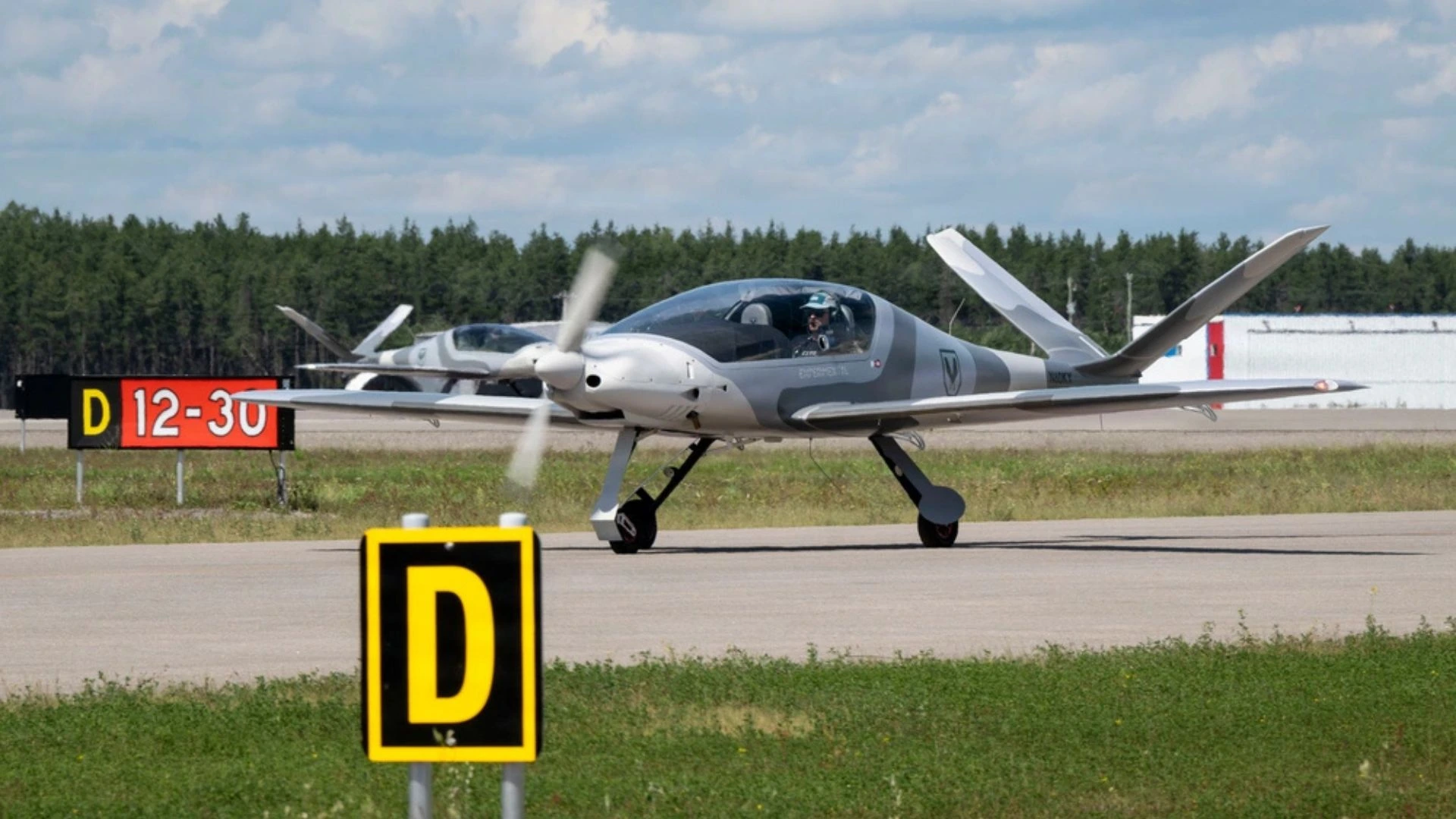
KestrelX is the most visible of the three. Founded by Don Moseley, a former Navy F-14 and F/A-18 pilot and test pilot, it won an Air Force Small Business Innovation Research (SBIR) award worth about $725,000 in 2021 for unmanned aerial vehicle and cruise missile threat replication aircraft.
Its fleet relies on small, low-cost airframes rather than former frontline fighters. The KX-1, a SubSonex JSX-2 microjet, flew at Exercise Northern Strike 24-2 in Michigan in August 2024; publicly available specifications indicate a single PBS TJ-100 turbojet and a cruise speed near 240 mph. The KX-2, derived from the Italian two-seat composite Risen, has replicated Shahed-136-type one-way attack drones during Exercise Sentry South 26.1. Production Risen variants use Rotax piston engines rated between 100 and 160 hp; the KX-2 configuration has not been disclosed. The Navy separately awarded KestrelX up to $9,987,285 for low-observable target aircraft through March 2028.
A2G International describes itself as an operator of manned and unmanned aircraft and a provider of airborne intelligence, surveillance and reconnaissance services. Little public information exists on Fleet Adversary Support and Training, and the contract notice does not identify the aircraft any of the three firms will fly.
Analysis: The on-ramp widens a pool built around fighter-class aggressors such as converted F-16s and Mirage F1s at a moment when the threat set Air Combat Command trains against includes massed one-way attack drones and cruise missiles. Light aircraft that reproduce those slow, low-signature profiles cost a fraction of a fourth-generation adversary sortie and let fighter units and air defenders rehearse the engagement problem repeatedly. The award itself guarantees nothing, however: with $3,000 obligated, each firm must still win task orders against incumbents.
Several questions remain open: which bases and mission sets the newcomers will compete for, which aircraft A2G International and Fleet Adversary Support and Training will field, and whether the three contracts share the existing $5.4 billion ceiling. The first task orders will show whether the Air Force is buying low-end threat replication or simply more capacity before the vehicle expires in October 2029.