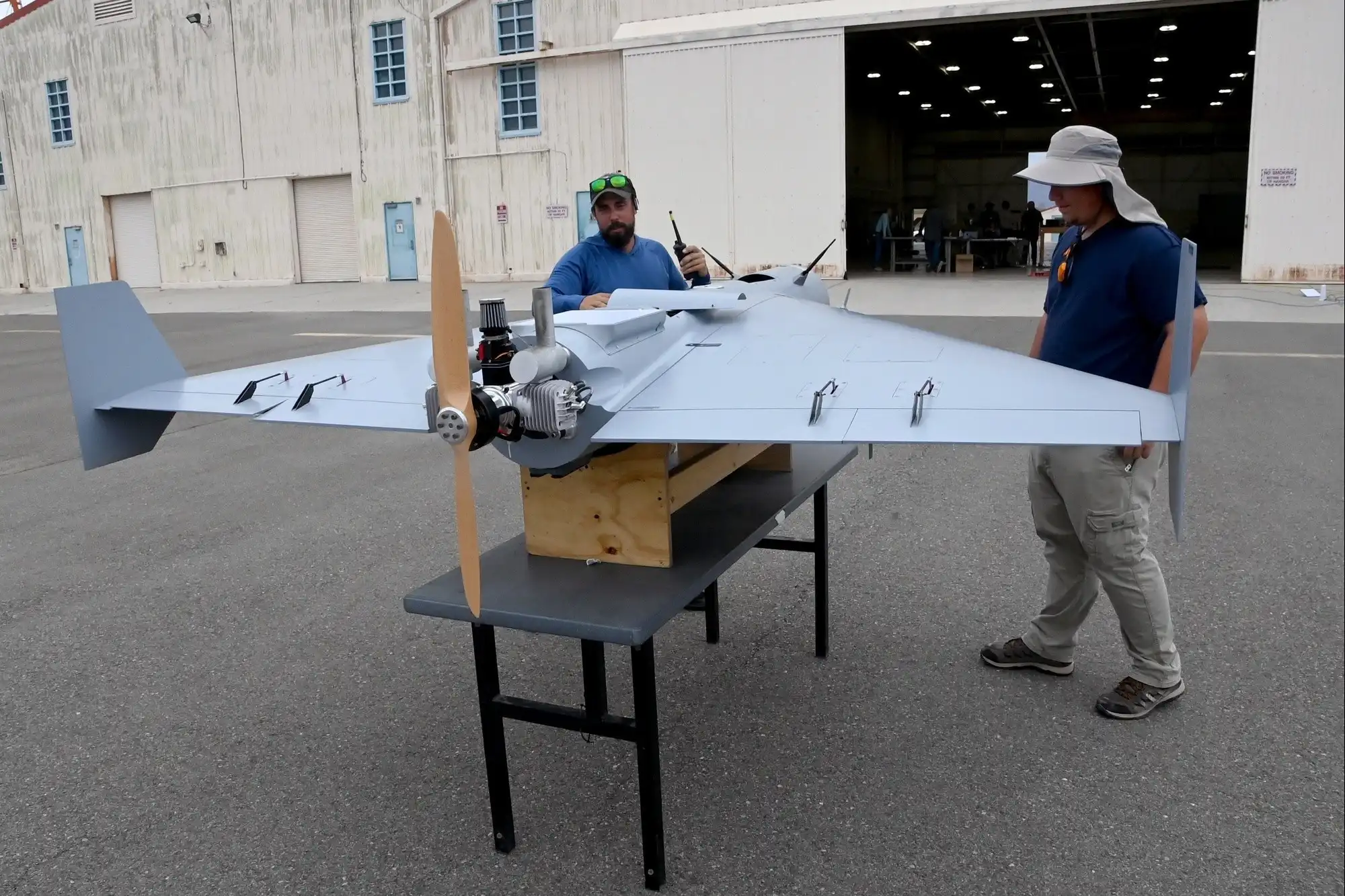
The U.S. Army has begun training soldiers to maintain and employ long-range one-way attack drones, commonly called kamikaze drones, such as the Low-Cost Uncrewed Combat Attack System (LUCAS), and its theater commanders are defining how to use them against enemy warships and Russian ballistic missile launchers. Maj. Gen. Bernard Harrington, commander of the 7th Infantry Division, and Brig. Gen. Steven Carpenter, head of Multi-Domain Command-Europe (MDC-E), described the concepts this week on a training panel at the Association of the U.S. Army (AUSA) annual meeting in Washington, in answer to a question from The War Zone (TWZ), which reported their remarks.
LUCAS is a reverse-engineered derivative of Iran’s Shahed-136, built by Arizona-based SpektreWorks. U.S. Central Command (CENTCOM) announced Task Force Scorpion Strike, the U.S. military’s first one-way attack drone squadron in the Middle East, on December 3, 2025, and CENTCOM confirmed the drone’s first combat use on February 28, 2026, in the opening strikes of Operation Epic Fury against Iran. The Army is now adapting that combat experience to the multi-domain formations it built for conflict with China and Russia.
How the 7th Infantry Division Trains to Mass LUCAS Kamikaze Drones
Harrington said the division has added long-range one-way attack employment to its Bayonet Academy training area at Joint Base Lewis-McChord (JBLM), Washington, covering maintenance, launch, and the orchestration of strikes toward a defined effect. He framed it as affordable mass that keeps exquisite munitions in reserve for targets that demand them.
Harrington also leads Multi-Domain Command-Pacific (MDC-PAC), established on June 18, 2026, by merging the 7th Infantry Division with the 1st Multi-Domain Task Force (MDTF). The two-star command pairs two Stryker brigades with the long-range fires and multi-domain effects units of the 1st MDTF, activated in 2017.
Modeling a penetration of China’s anti-access/area denial (A2/AD) network pushed the command toward a narrower objective than outright destruction. Harrington told the panel, as reported by TWZ, that “maybe I don’t necessarily need to sink a ship.” Disabling selected systems aboard a vessel would instead open a temporary window for the joint force commander to surge a carrier strike group or a bomber task force. That is a mission kill: radars and antennas are softer than hulls, and repairs sideline the ship. Harrington said the modeling showed that synchronized salvos of uncrewed surface vessels (USVs), one-way attack drones, and launched effects could produce that outcome without unmasking higher-end systems. U.S. forces first used kamikaze USVs in combat against Iran in July 2026.
How Multi-Domain Command-Europe Plans to Hunt Iskander Launchers
Carpenter named Covenant, the U.S.-Israeli startup behind the Anthem long-range strike weapon, alongside LUCAS as examples of the launched effects his command favors. Covenant, founded in 2024, fired Anthem at a U.S.-Moroccan range near Tan-Tan on August 6, 2026, and unveiled the weapon in September with a stated payload above 200 kilograms. Its range has not been disclosed.
In Europe, Carpenter said, according to TWZ, such systems would let the command dismantle the center of an adversary’s A2/AD bubble while accepting risk farther north, and help establish parity in counter-fire and long-range fires. He cited three attributes behind that preference: resilience to electromagnetic interference (EMI), longer range, and warheads heavy enough to destroy SS-26 and SS-21 systems.
Those are the NATO reporting names for Russia’s 9K720 Iskander-M and the Soviet-era OTR-21 Tochka short-range ballistic missiles, both fired from road-mobile transporter-erector-launchers. Iskander-M has long factored into U.S. planning in Europe, and the U.S. military has acknowledged that wartime upgrades have made it harder to intercept. Hitting launchers with numerous low-cost drones shifts the problem from intercepting missiles in flight to destroying them before launch. MDC-E was established in July 2025 from the Germany-based 56th Artillery Command, which oversees the 2nd MDTF.
LUCAS Range, Payload, and Hivemind Swarming Compared to Shahed-136
LUCAS retains the Shahed-136 layout: a tailless delta wing with wingtip fins, a rear-mounted piston engine, and a pusher propeller. SpektreWorks has not published a full LUCAS data sheet, but publicly available specifications for its FLM 136, the threat-emulation airframe widely reported as the basis for LUCAS, list a 3-meter length, a 2.5-meter wingspan, an 81.5-kilogram maximum takeoff weight, an 18-kilogram (40-pound) payload, and a 350-nautical-mile range. Reporting on the fielded LUCAS cites roughly 500 miles. CENTCOM has put the unit cost at roughly $35,000, against a commonly cited $2.5 million for a Tomahawk Land Attack Missile.
Payload is the main trade-off. Open-source estimates credit the original Shahed-136 with a warhead of 30 to 50 kilograms, well above the FLM 136’s 18-kilogram payload, which makes a single LUCAS better suited to disabling radars, antennas, and launchers than to destroying hardened structures.
LUCAS launches from static rails with rocket assistance, catapults, or ground vehicles; the Independence-class littoral combat ship USS Santa Barbara fired one in the Arabian Gulf on December 16, 2025. In May 2026, the Office of the Under Secretary of War for Research and Engineering selected Shield AI to integrate its Hivemind autonomy software, intended to let LUCAS drones share tasks, reroute around air defenses, and keep flying through jamming, with a human operator retaining strike decisions.
Analysis: The AUSA remarks show the Army treating long-range one-way attack drones as a theater fires capability. The targets both generals named, shipborne sensors in the Pacific and mobile missile launchers in Europe, are high-value, time-sensitive, and vulnerable to modest warheads, which suits a $35,000 airframe derived from an 18-kilogram-payload design. Cost exchange adds a second lever, draining adversary interceptor stocks the way U.S. stocks were drained in the Middle East. The open question is magazine depth. A concept built on mass works only if the Army can buy, store, and forward-position large inventories inside the first island chain and along NATO’s eastern flank, and neither commander disclosed planned quantities, unit ownership, or a fielding timeline.
The next marker is Shield AI’s single-operator Hivemind swarm demonstration, planned for fall 2026. After that, watch for LUCAS-class weapons in MDC-PAC and MDC-E exercise scenarios, progress under Covenant’s Army qualification work on Anthem, and how the service links its four MDTFs to the new theater commands. How one-way attack drones will be apportioned between those commands and CENTCOM’s existing task force remains unresolved.