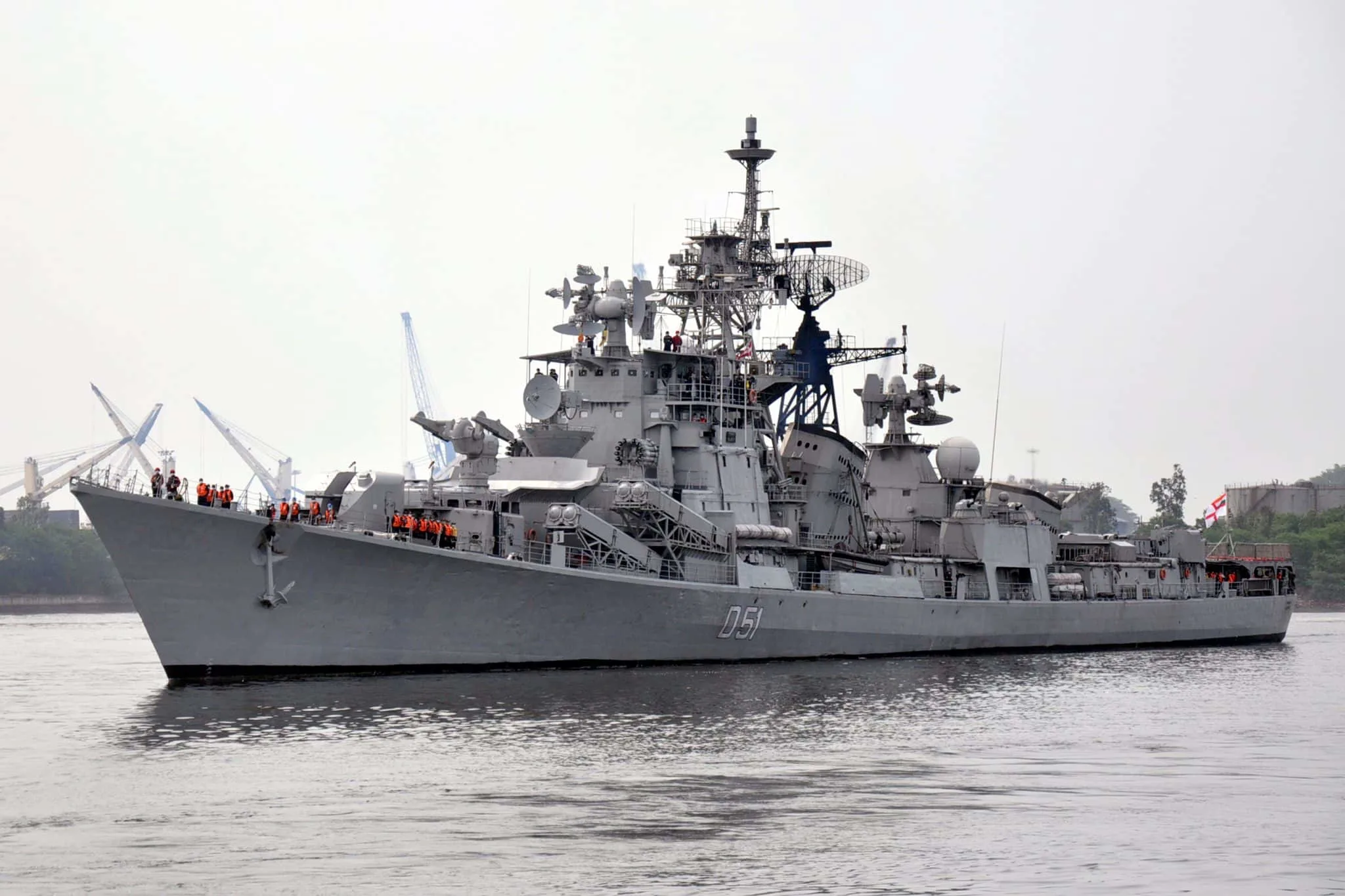
India’s Ministry of Defence signed a ₹661.50 crore (about $68 million) contract with BrahMos Aerospace on October 6, 2026, for BrahMos fire control systems and launchers to rearm four aging Indian Navy surface combatants. An image from the New Delhi signing ceremony, first reported by Naval News, shows the package covers two Ranvir-class (Kashin) destroyers and two Veer-class missile corvettes.
The contract falls under the Buy (Indian-IDDM) category and requires a minimum of 68% indigenous content, according to the ministry; that figure applies to this project, not to the BrahMos weapon system as a whole. The ministry did not name the ships. The award shows the Navy will replace legacy anti-ship missiles on hulls nearing retirement rather than run them out with legacy armament.
New BrahMos Launchers for Ranvir and Ranvijay Destroyers
India inducted five Kashin-class destroyers from the Soviet Union between 1980 and 1987. The lead ship, INS Rajput (D51), was the first warship to carry BrahMos before her decommissioning on May 21, 2021. Three ships remain in service: INS Rana (1982), INS Ranvir (1986) and INS Ranvijay (D55, 1987).
Ranvir and Ranvijay already carry eight BrahMos rounds in a stern vertical launch system (VLS) that replaced the S-125M surface-to-air launcher, but retain four inclined Styx anti-ship launchers forward. Rana, stripped of her Styx launchers by August 2025, has served as the testbed for the Defence Research and Development Organisation’s Vertically Launched Short Range Surface-to-Air Missile (VLSRSAM), using an eight-cell VLS aft. That role, Naval News assesses, makes Ranvir and Ranvijay the probable recipients.
Naval News expects the contract to cover inclined launchers only. If the Navy reproduces Rajput’s fit of eight inclined BrahMos cells in place of the Styx mounts, each destroyer would field 16 BrahMos, the same load as the Kolkata- and Visakhapatnam-class destroyers. The Navy has not confirmed the configuration. Publicly available specifications indicate the ship-launched BrahMos weighs about 3 tonnes, measures roughly 8.4 meters, cruises at up to Mach 2.8 and carries a 200 to 300 kg warhead, with in-service extended-range variants reaching about 450 km. The Styx it displaces is a subsonic Soviet design that entered service in 1960, with a reported range under 100 km.
Veer-Class Corvettes Become India’s Lightest BrahMos Shooters
The Veer class (Project 1241RE) is an Indian variant of the Soviet Tarantul missile corvette, displacing under 500 tonnes. India imported five units between 1987 and 1990; Mazagon Dock and Goa Shipyard license-built eight more, delivered between 1990 and 2002. Seven of the Indian-built boats, powered by a combined gas and gas (COGAG) plant, remain in service.
INS Vidyut appeared at Navy Day in December 2025 with two twin-tube inclined BrahMos launchers transferred from the decommissioned Rajput. According to Naval News, INS Nashak is a likely candidate for Rajput’s remaining two launchers, while the new contract’s corvettes are most likely INS Prabal and INS Pralaya, both commissioned in 2002 and the only units armed with 16 Kh-35E missiles in four quad launchers. Given the missile’s mass relative to the hull, a four-round fit is the probable outcome, matching the loadout planned for the six Next Generation Missile Vessels that Cochin Shipyard is building under a ₹9,805 crore contract signed on March 30, 2023. The swap trades magazine depth for speed and reach; the subsonic Kh-35E has a reported range of about 130 km.
Analysis: Spending $68 million to arm hulls in their final years makes sense as a commonality play. Converging on BrahMos as the single surface-to-surface missile lets the Navy retire the Styx and Kh-35E supply chains, simplify training and magazine management, and spread supersonic strike across more platforms in the Arabian Sea and Bay of Bengal. The limit is the host ship: legacy sensors cannot exploit the missile’s full range, so these platforms will depend on offboard targeting from maritime patrol aircraft and networked combatants. Domestic orders also sustain BrahMos production as exports to the Philippines, Indonesia and Vietnam expand.
The ministry said the project will generate employment over three years, but ship assignments, launcher configuration and delivery dates remain undisclosed, as does the remaining service life of each hull. The Navy’s underwater weapons account moved in parallel: on October 15, 2026, the ministry signed a ₹1,543 crore (about $160 million) contract with Bharat Dynamics Limited for additional Varunastra ship-launched heavyweight torpedoes. The ministry did not disclose the quantity; Naval News reports the order is expected to cover about 40 torpedoes, following an initial order for 73 in July 2016.