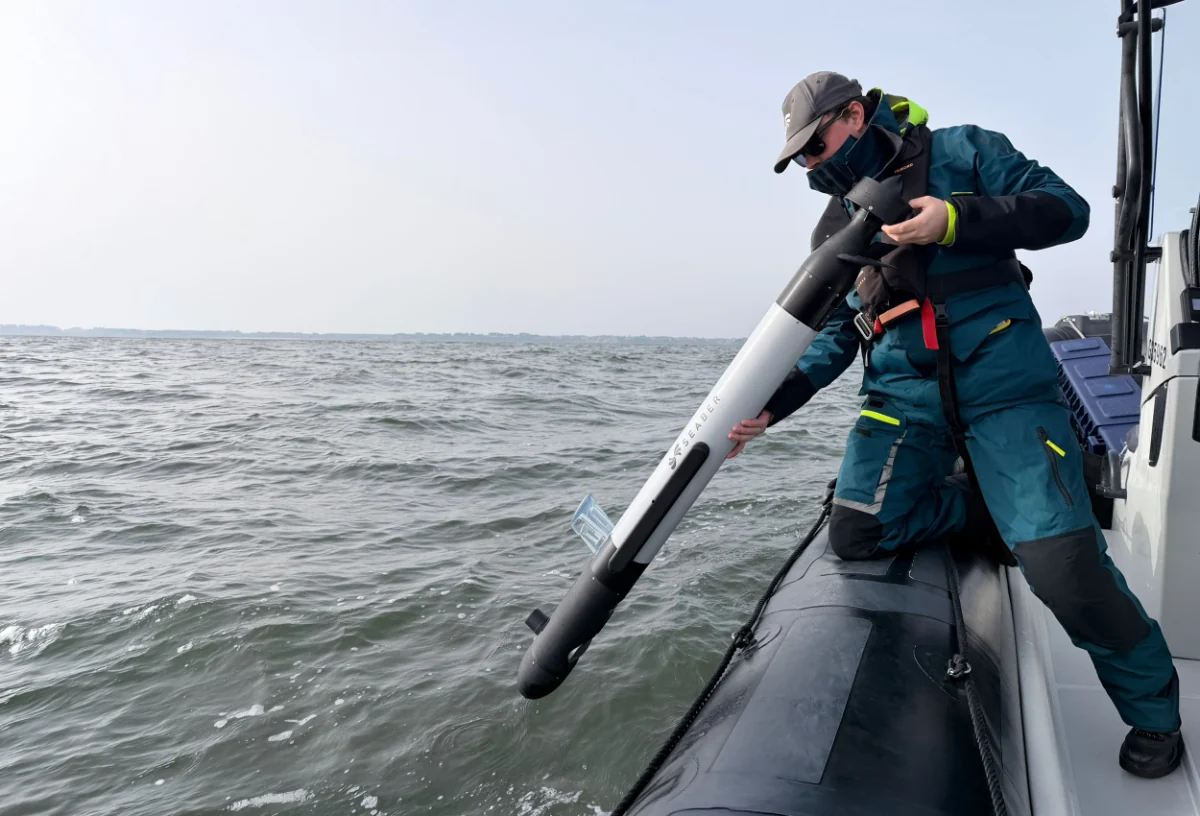
French underwater drone maker Seaber has launched RAVEN, a 13 kg autonomous underwater vehicle (AUV) designed for naval mine countermeasures (MCM) and seabed mapping. The Lorient-based company says the 12 cm diameter vehicle matches the performance of high-end conventional AUVs at roughly one-third of their price, while remaining deployable and recoverable by a single operator.
The launch comes as European navies retire crewed minehunters in favor of standoff mine warfare built around uncrewed surface and underwater vehicles. France, the United Kingdom, Belgium and the Netherlands are all fielding drone-based MCM toolsets designed to keep sailors out of the minefield, while Russian mining of Ukrainian waters since 2022 and growing concern over critical seabed infrastructure in the Baltic have pushed mine detection and seabed survey up the procurement agenda. RAVEN also marks a step up for Seaber, which built its market position on the YUCO family of micro-AUVs and added the MARVEL range for security and defense users in 2024.
RAVEN AUV Design: LYNX Navigation and Single-Operator Handling
At 13 kg, RAVEN sits only slightly above Seaber’s YUCO range, which publicly available specifications put at about 10 kg and 1 m in length, with a 300 m depth rating and 8 to 10 hours of endurance. It is far lighter than the established man-portable class: publicly available specifications indicate HII’s REMUS 100 weighs roughly 38 kg with a 19 cm hull diameter. Seaber has not named the vehicles it used as the benchmark for its one-third cost claim.
The core of the design is LYNX, an optical inertial navigation system developed in-house by Seaber. Seaber president Vidal Teixeira credited LYNX and the integration of advanced inspection and detection capabilities, saying in remarks published by Bretagne Économique that “we believe RAVEN can fundamentally change the rules of the market.” Navigation accuracy is the decisive parameter in mine hunting: a contact logged by a survey vehicle has operational value only if a clearance diver or a mine neutralization vehicle can reacquire it at the recorded position. Seaber’s earlier YUCO vehicles paired the company’s INX navigation with a Doppler velocity log to achieve drift below 1% of distance traveled. The company has not published equivalent drift figures for LYNX.
Communications follow a layered architecture. An acoustic modem allows the operator to send commands to the submerged vehicle and track it in real time at ranges of 2 to 3 km. On the surface, RAVEN remains reachable by UHF radio and by Iridium satellite link, while infrared LEDs visible only through night vision devices allow crews to locate it without a visible light signature. That last feature points directly at military users conducting covert survey or recovery in contested littoral waters.
Seaber has not disclosed RAVEN’s depth rating, endurance, transit and survey speeds, overall length or battery capacity. Those parameters will determine how much seabed a single vehicle can cover per sortie and whether it can operate beyond the very shallow water zone.
Magnetometer and Camera Payloads Define Two Mission Profiles
Seaber offers RAVEN in two configurations. The first carries an integrated magnetometer able to detect and localize submerged metallic objects, a profile suited to ferrous bottom mines, unexploded ordnance and partially buried contacts that acoustic sensors can struggle to resolve. The second carries a high-definition camera paired with 24,000-lumen lighting for close visual inspection, the step that turns a mine-like contact into a positively identified object, and a capability equally relevant to pipeline, cable and hull inspection.
Neither announced configuration includes a side-scan sonar, the standard primary sensor for wide-area mine detection, although Seaber already fields one elsewhere in its catalog. At the Undersea Defence Technology exhibition in Rostock in May 2023, the company presented an MCM micro-AUV range fitted with side-scan sonar, a multibeam echosounder and a fluxgate magnetometer, priced at under 100,000 euros per mission-ready vehicle, according to the company. Its MARVEL micro-AUV carries the same three payloads, and in June 2026 Seaber announced the integration of an interferometric 3D side-scan sonar into the vehicle. Whether a sonar variant of RAVEN will follow remains unknown.
The company enters the segment with an established customer base. Seaber claims more than 200 AUVs sold internationally through a global distributor network, and the Royal Navy acquired four YUCO vehicles that it trialed during NATO’s REP(MUS) 2022 exercise in Portugal. Seaber has not named any launch customer for RAVEN, disclosed a unit price or given a delivery schedule.
Analysis: RAVEN targets the weak point of the standoff MCM model: cost per vehicle. National programs rely on larger AUVs and uncrewed surface vessels that are expensive enough to be managed as scarce assets. A 13 kg vehicle priced at a fraction of those systems could be bought in numbers and assigned to reacquisition, identification, route survey and port protection tasks, freeing the larger vehicles for wide-area search. In that role, RAVEN would complement national MCM toolsets rather than replace them. The one-third cost claim, however, remains unverifiable until Seaber publishes a price, a full specification sheet and independent trial data.
The next indicators will be a published price, endurance and depth figures, and a first naval customer. Participation in NATO’s REP(MUS) or national MCM trials would offer the first independent measure of LYNX navigation accuracy in operational conditions. A sonar-equipped variant would signal whether Seaber intends RAVEN as a full detection platform or as a low-cost identification layer within larger mine warfare systems.