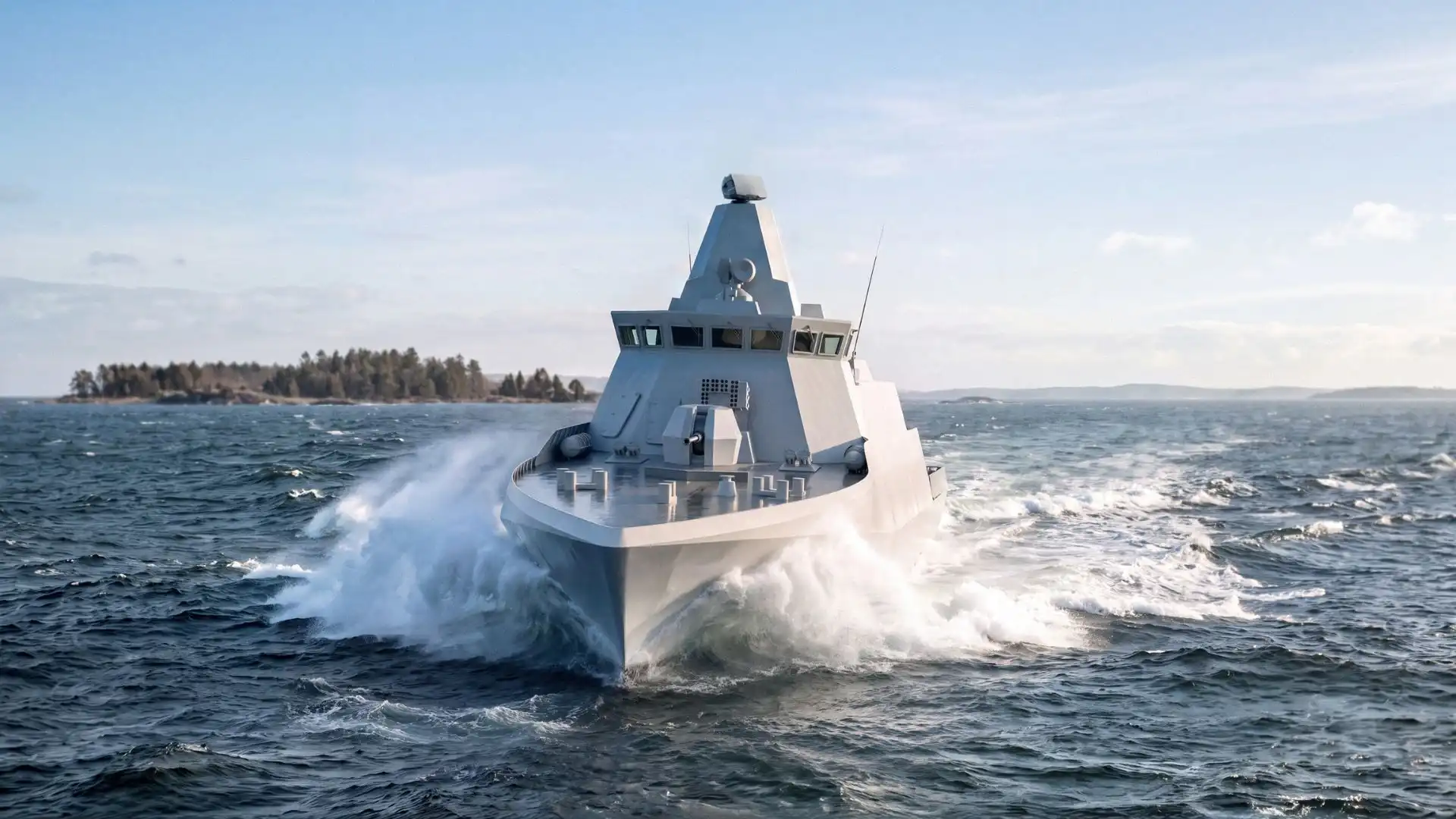
Saab unveiled the Sea Giraffe Agile Multi Beam D (AMB D) naval radar on October 27, 2026, the latest evolution of its Giraffe AMB family, offering 3D surveillance and tracking of air targets out to 250 km and surface targets out to 50 km. The Swedish company says the radar can detect, track, and classify aircraft, drones, missiles, and both crewed and uncrewed surface vessels, providing early warning and target data for distributed, multi-domain naval operations.
The launch takes to sea the architecture Saab introduced with the land-based Giraffe AMB D at the Eurosatory 2026 exhibition in Paris in June. The current Sea Giraffe AMB, first ordered for the US Navy in 2005, serves as the AN/SPS-77 aboard Independence-class Littoral Combat Ships (LCS), equips Sweden’s five Visby-class corvettes, and has been selected for the US Coast Guard’s Offshore Patrol Cutter and the Royal Canadian Navy’s Protecteur-class Joint Support Ships. A derivative, the AN/SPN-50, supports air traffic control aboard US carriers and amphibious ships. The new variant arrives as navies adapt to the drone, uncrewed surface vessel, and anti-ship missile threats seen in the Black Sea and Red Sea in recent years.
Sea Giraffe AMB D Range, Tracking, and ECCM Architecture
Air coverage is the headline gain. Publicly available specifications indicate the legacy Sea Giraffe AMB, a C-band (5.4 to 5.9 GHz) stacked-beam radar rotating at 30 or 60 rpm, offers an instrumented range of 180 km. A 250 km air range therefore represents a roughly 39 percent increase. The extra distance matters most against aircraft and missiles at altitude; against sea-skimmers, detection remains bound by the radar horizon and mast height, which no antenna upgrade changes.
Saab states that the AMB D pairs Active Electronically Scanned Array (AESA) hardware with a new software architecture and modern processing. The company describes the radar as software-defined, allowing capability upgrades as requirements evolve rather than through hardware replacement. That is relevant to the classification of small uncrewed aerial systems, where performance depends heavily on signal processing and target libraries that can be refreshed over a ship’s service life. Saab also cites advanced Electronic Counter-Countermeasures (ECCM) against jamming and a modular architecture designed for integration with other naval systems.
Several key parameters remain undisclosed for the naval version: operating band, track capacity, rotation rate, topside weight, and power draw. Company data for the land-based Giraffe AMB D cite C-band operation, up to 2,000 simultaneous tracks, and 60 rpm rotation, compared with about 600 tracks for the previous AMB generation. Saab has not confirmed whether those figures carry over to the maritime variant.
From AN/SPS-77 to Visby: Where Saab’s New Naval Radar Could Fit
Saab did not name a launch customer in its October 27 announcement. At Eurosatory, however, a company executive cited Visby-class integration as an example of the Sea Giraffe AMB D’s naval application. The corvettes are already in a modernization cycle: Saab received a contract valued at approximately SEK 1.6 billion in May 2025 to integrate MBDA’s Sea Ceptor air defense system across the class, with modification work starting in early 2026. A sensor offering longer-range cueing would fit that upgrade logic, though no radar replacement has been announced.
Carl-Johan Bergholm, head of Saab’s business area Surveillance, framed the radar around growth margin: “Sea Giraffe AMB D takes a proven naval radar capability to the next level, combining increased performance with a low footprint and an architecture built for continuous development.” The low-footprint claim targets corvettes, offshore patrol vessels, and auxiliaries that cannot carry the weight or power load of larger fixed-array systems.
The US fleet is the largest potential retrofit pool. Independence-class LCS and Offshore Patrol Cutters both rely on Sea Giraffe-derived radars, and a common lineage could ease integration. Neither the US Navy nor the US Coast Guard has announced plans to adopt the AMB D, and the new radar carries no US designation.
Analysis: Sea Giraffe AMB D is an evolutionary step, but it strengthens Saab’s offer for the mid-tier ships that increasingly carry frontline air defense duties in contested waters. A 250 km air picture from a compact rotator would bring smaller hulls closer to the surveillance envelope of larger combatants, while the software-defined design answers a central lesson of recent drone campaigns: threat signatures evolve faster than hardware procurement cycles. Competitors such as the Hensoldt TRS-4D and Thales NS50 already field AESA rotators in this class, and buyers will judge the AMB D on figures Saab has not yet released: track capacity, small-target detection range, and integration cost.
The next milestones are a launch customer, publication of naval-specific performance and weight data, and confirmation of whether the radar will enter the Visby-class modernization. An upgrade decision by existing AN/SPS-77 operators would be the clearest commercial signal.