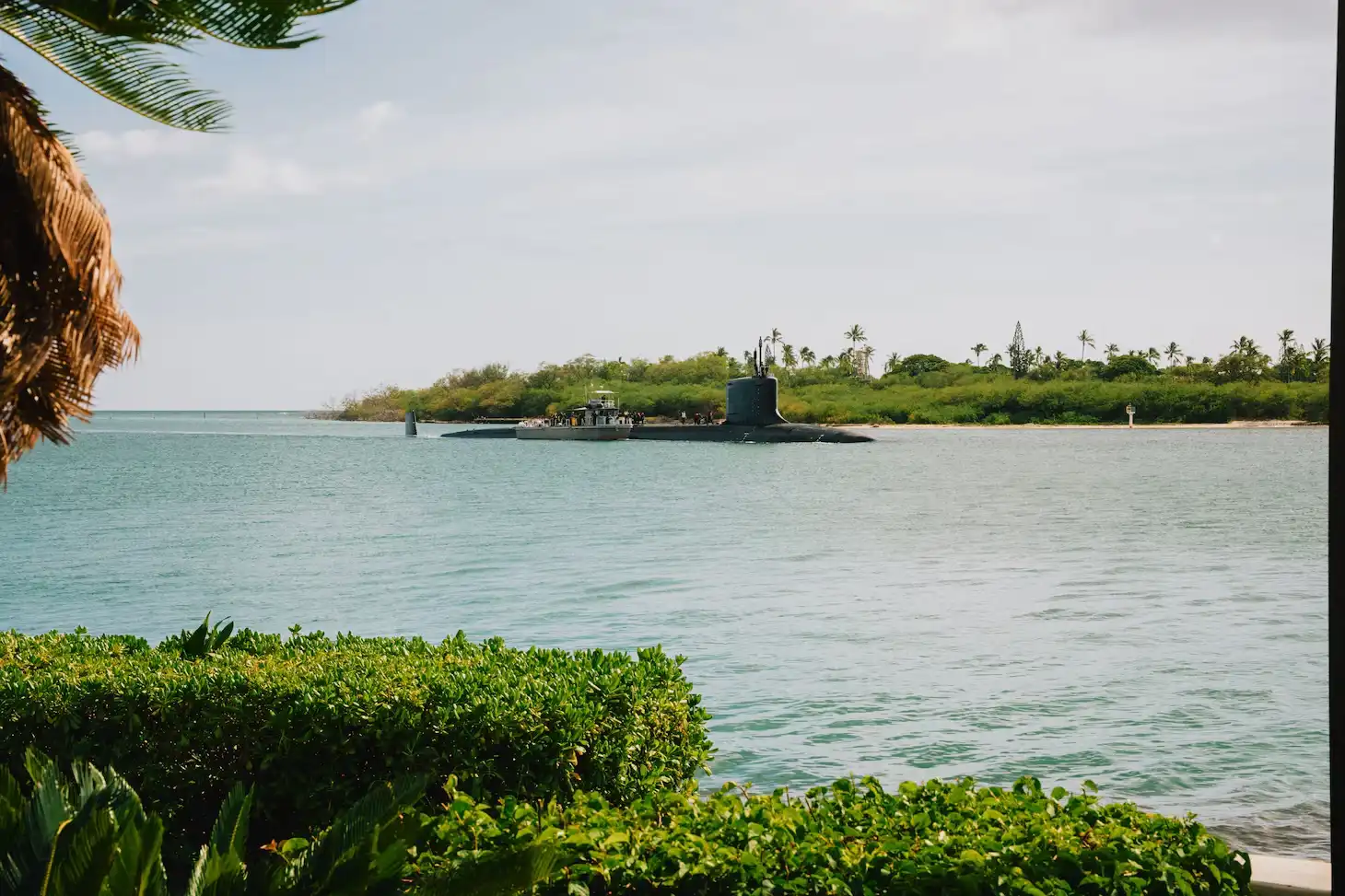
The United States, Australia and the United Kingdom have designated USS Colorado (SSN 788) as the first U.S. Navy Virginia-class fast-attack submarine assigned to Submarine Rotational Force-West (SRF-West), with operations from HMAS Stirling in Western Australia beginning in late 2027. U.S. Secretary of War Pete Hegseth, Australian Deputy Prime Minister and Defence Minister Richard Marles, and UK Defence Secretary Wes Streeting announced the designation in a joint statement on October 26, 2026.
SRF-West marks a significant milestone for AUKUS Pillar I, the trilateral program to give Australia a sovereign, conventionally armed, nuclear-powered submarine capability. The force is projected to rotate up to four U.S. Virginia-class boats and one Royal Navy Astute-class boat through the Royal Australian Navy base near Perth. It follows a Pentagon review, completed in late 2025, that endorsed the planned sale of at least three Virginia-class submarines to Australia from 2032; the joint statement repeated President Donald Trump’s line that AUKUS is moving “full steam ahead.”
USS Colorado Block III Capabilities After Pearl Harbor Overhaul
Commissioned on March 17, 2018, at Naval Submarine Base New London in Groton, Connecticut, Colorado is the fifth Block III Virginia-class submarine and was built by General Dynamics Electric Boat. Publicly available specifications for the class indicate a length of 377 feet, a submerged displacement of about 7,800 tons and a speed above 25 knots, with an S9G pressurized water reactor designed to last the life of the boat without refueling.
Block III introduced two defining changes. Two large-diameter Virginia Payload Tubes, each holding six Tomahawk land-attack missiles, replaced the 12 individual vertical launch tubes of earlier hulls while preserving a 12-missile strike load. A water-backed Large Aperture Bow array replaced the legacy spherical sonar to cut lifecycle costs. Four 21-inch torpedo tubes handle Mk 48 heavyweight torpedoes. Mission sets include anti-submarine, anti-surface and strike warfare, special operations support, and intelligence, surveillance and reconnaissance.
Colorado shifted homeport from Groton to Joint Base Pearl Harbor-Hickam in April 2024 for a two-year Extended Dry-Docking Selected Restricted Availability at Pearl Harbor Naval Shipyard and Intermediate Maintenance Facility (PHNSY & IMF). The yard completed the work on June 10, 2026, 29 days ahead of schedule. Colorado will therefore reach Stirling with a recently overhauled hull and systems.
How HMAS Stirling Maintenance Periods Built the Path to SRF-West
The designation precedes the next U.S. Submarine Maintenance Period at Stirling, which begins this week as the third annual U.S. submarine availability at the base. The partners have not named the submarine involved.
Each availability has expanded the Australian share of the work. In 2024, USS Hawaii (SSN 776) completed the first tendered maintenance period at Stirling alongside the tender USS Emory S. Land (AS 39). USS Vermont (SSN 792) arrived on October 29, 2025, for the first period conducted without a tender, during which a blended workforce led by PHNSY & IMF completed more than 200 maintenance tasks. The Royal Navy’s HMS Anson (S123) followed in February 2026 as the first UK nuclear-powered submarine maintained in Australia.
The U.S. Navy established Naval Support Activity Stirling on May 30, 2026, to serve personnel assigned to SRF-West. The force will operate under the U.S.-Australia Force Posture Agreement and within the partners’ obligations under the Nuclear Non-Proliferation Treaty and the South Pacific Nuclear Free Zone Treaty.
Analysis: Selecting a boat fresh from a two-year dry-docking at PHNSY & IMF lowers risk for the first rotation. The same yard leads Virginia-class maintenance at Stirling and trains the Australian workforce, so Colorado’s material condition is known to the teams that will sustain it at a site that has so far handled only scheduled availabilities. SRF-West also gives U.S. attack submarines a sustainment point on the Indian Ocean, closer to the Sunda and Lombok straits than Pearl Harbor or Guam. For Washington, that extends forward presence without new hulls; for Canberra, it builds the workforce its own Virginia-class boats will need.
The immediate test is this week’s maintenance period, billed as further proof of Australia’s sustainment capacity. Undisclosed so far: the length of Colorado’s rotation, the timeline for the remaining three U.S. boats and the UK submarine, and the crewing model. Australia’s first Virginia-class transfer remains scheduled for 2032.