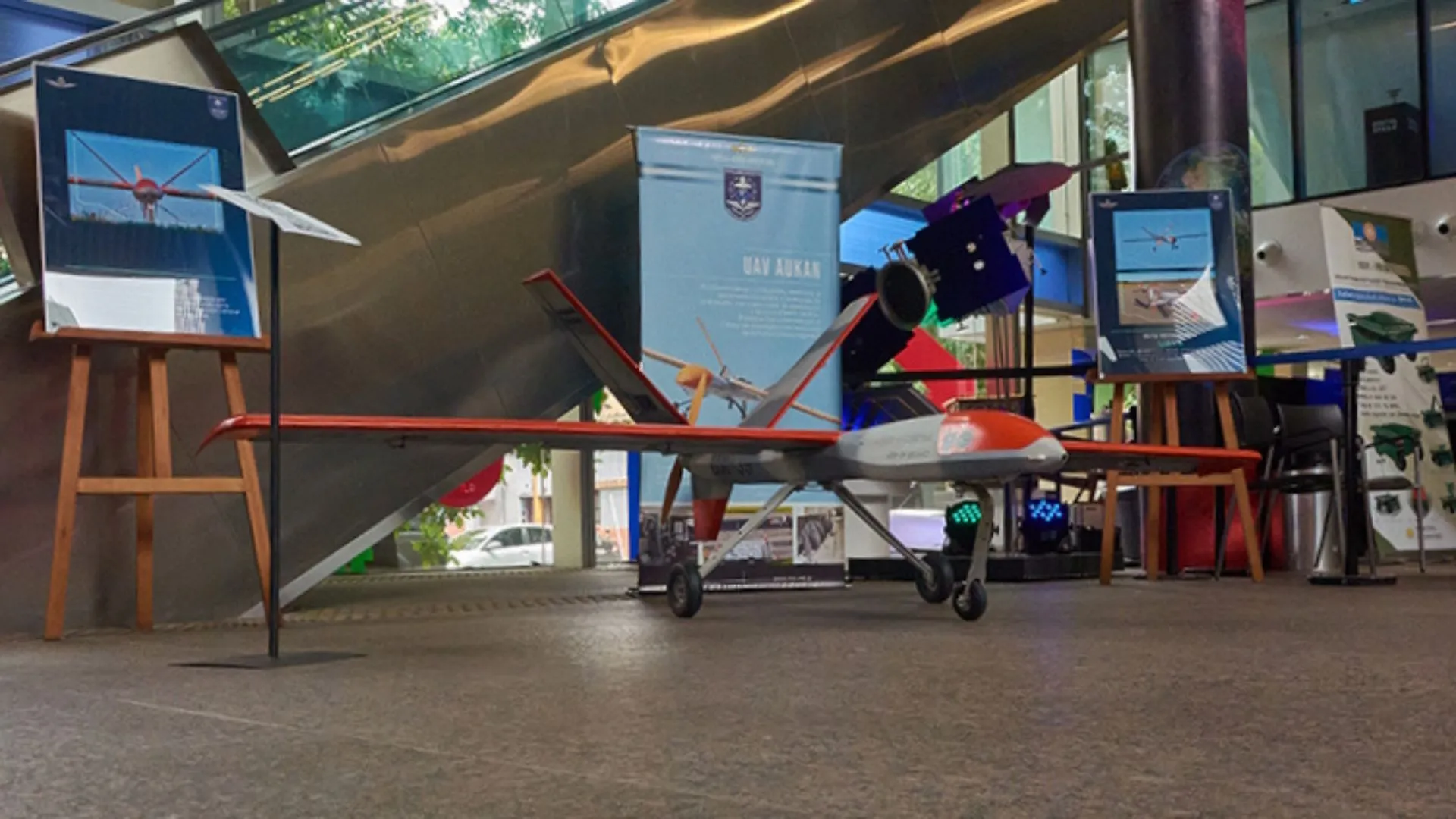
The Argentine Air Force (Fuerza Aérea Argentina, FAA) displayed its AR-1F Búho electric unmanned aerial vehicle (UAV) at the 8th Conference on Science, Technology, Innovation and Development for Defense (CTID+I) in Buenos Aires on October 21, 2026. The FAA presented it as the first electrically powered Class I military UAV designed and built in Argentina to receive official certification from the General Directorate of Joint Military Airworthiness (DIGAMC), which reports to the Joint General Staff of the Armed Forces. Program officials said the certification follows NATO’s STANAG 4703 airworthiness standard.
The event, organized by the Ministry of Defense at the Cultural Center of Science (C3), focused on uncrewed air, surface and ground systems. For the FAA, it was a status report on a national UAV effort launched under a 2010 Ministry of Defense resolution and in continuous operational use since 2017. Argentina chose to develop airframes, ground stations and doctrine domestically rather than import turnkey systems, a slower path that leaves the force with full design authority.
How the Argentine Air Force Drone Program Reached STANAG 4703
The Búho was designed and built entirely by the Center for Applied Research (Centro de Investigaciones Aplicadas, CIA) in Córdoba, part of the FAA’s General Directorate of Research and Development. According to project director Commodore Horacio Larrosa, the aircraft uses an electric motor, reaches a maximum speed of 70 knots and has a range in the tens of kilometers, depending on the datalink fitted. The ministry’s 2021 delivery notice gave initial figures of 40 minutes’ endurance and a 10 km range; weight and wingspan have not been released.
An autopilot supports radio control, first-person view and fully autonomous flight. The ground control station fits in a suitcase-sized case, so a small detachment can deploy without vehicle-mounted infrastructure.
STANAG 4703 is NATO’s airworthiness standard for light fixed-wing uncrewed aircraft; publicly available documentation indicates it covers systems with a maximum takeoff weight below 150 kg. The Ministry of Defense describes the result as national and NATO-level certification; under STANAG 4703, the certificate is issued by a national military airworthiness authority, here DIGAMC, which assesses the design against the allied benchmark. The practical consequence is a type design documented to a level that allows reproduction, which is why the Ministry of Defense links the certification directly to a planned pre-series production run.
The aircraft is not new to service: Búho systems have been delivered since September 27, 2021, to Chamical Military Air Base in La Rioja province, where they train remotely piloted aircraft crews.
From Búho to Aukan: Endurance, Payload and AI Recognition Plans
The Búho belongs to a family that also includes the Vigía and Aukan systems. The Aukan shares the Búho’s autopilot and control system, with a geometry close to the original prototype, but uses a reciprocating engine, which gives it greater payload capacity and an endurance of about four hours. It carries gyrostabilized cameras that stream real-time video or store imagery for later download. Earlier published descriptions of the program give the Aukan a maximum takeoff weight of 100 kg, real-time command and control at distances of up to 150 km, and operations at 5,000 ft.
Officials describe the Búho certification as the baseline for combustion-powered models such as the Aukan. The ground control station has been flown aboard C-130 Hercules transports on several operations, and both systems have taken part in combined exercises and a nuclear emergency drill alongside other branches of the armed forces.
Larrosa also disclosed a ground trainer for Class 2 UAV crews now operational at Chamical, and an artificial intelligence system able to identify and track aircraft on the ground, vehicles and dismounted personnel.
Analysis: The Búho is a training and short-range intelligence, surveillance and reconnaissance (ISR) asset, not a combat system, and its performance sits well below the tactical drones now shaping the war in Ukraine. Its value lies in process. By taking a domestic design through formal military airworthiness certification against a NATO benchmark, the FAA has built the regulatory and engineering pipeline it will need for heavier platforms such as the Vigía 2B. It also fits Buenos Aires’ Western alignment as a Major Non-NATO Ally since 1998 that requested NATO global partner status in April 2024.
The ministry has not disclosed pre-series quantities, a production schedule or funding. The next indicators to watch are the first pre-series deliveries, whether the Aukan follows the Búho through DIGAMC certification, and how quickly the AI recognition software moves from demonstration to fielded capability.