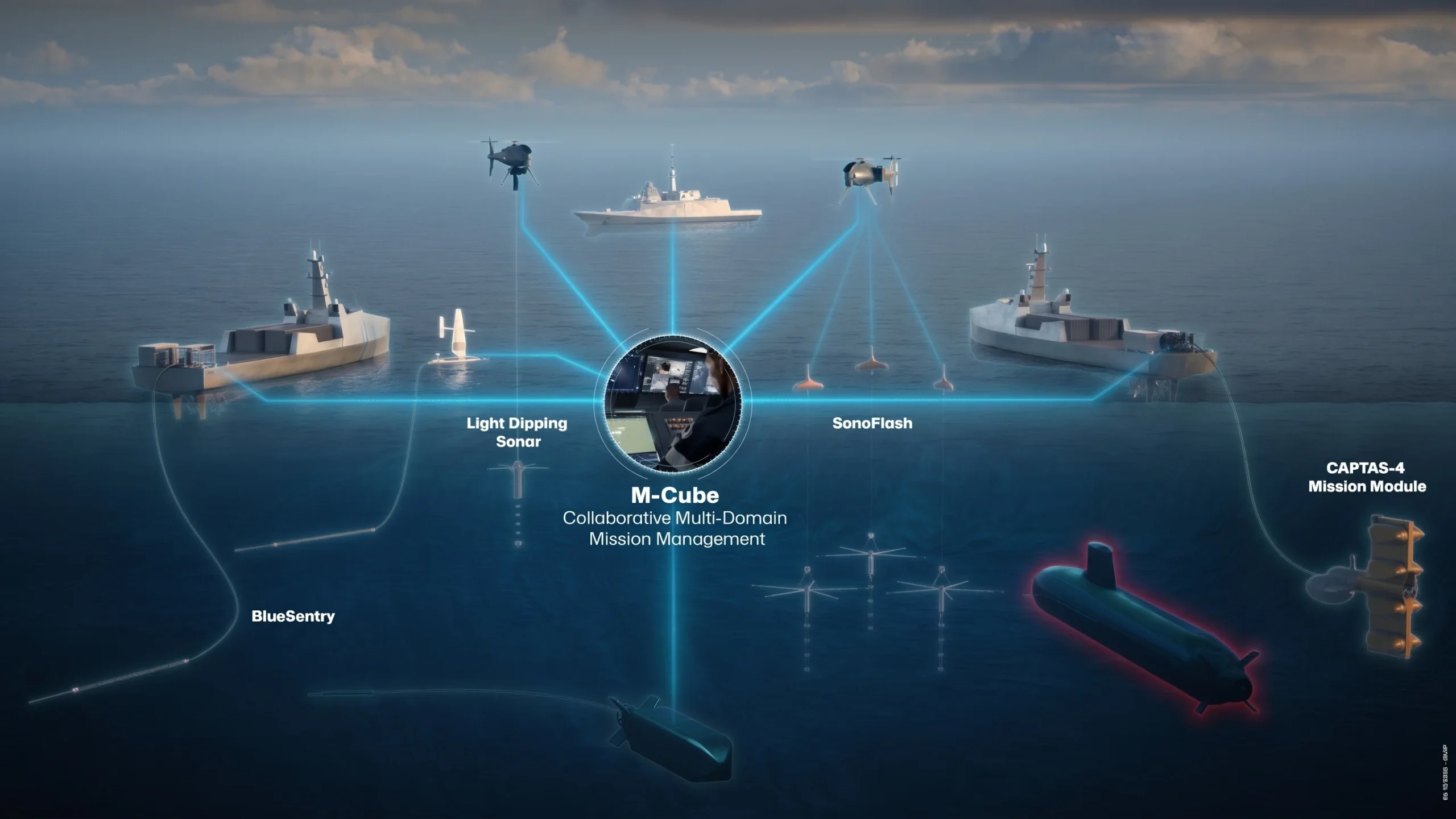
Thales presented three anti-submarine warfare (ASW) building blocks at Euronaval 2026 on November 3, 2026: an expanded version of its M-Cube mission management system, a new Lightweight Dipping Sonar (LDS) for uncrewed and lightweight platforms, and the CAPTAS-4 Mission Module (C4MM), a modular, cross-deckable package of its flagship variable-depth sonar. The trio underpins a Hybrid Fleet concept networking crewed ships, helicopters and uncrewed systems into one ASW force.
The pitch lands as allied navies face a widening gap between the number of quiet submarines they must track and the number of dedicated ASW frigates they can afford to build and crew. Thales already leads the low-frequency sonar segment: the CAPTAS family passed its 100th order in October 2025, and the company completed its 500th FLASH helicopter dipping sonar in 2017. The new offer moves from selling sensors hull by hull to selling a distributed sensing architecture.
Thales Hybrid ASW Network Built Around M-Cube and Dipping Sonar
M-Cube is the command-and-control layer of the concept. The software lets operators plan, task and supervise ships, helicopters, uncrewed surface vessels (USVs) and other autonomous assets from a single mission environment. M-Cube already supports operators in the Franco-British Maritime Mine Counter Measures (MMCM) program, and Thales was contracted in December 2025 to build it into portable mine countermeasures command centers for the Royal Navy. The company now extends it to ASW, intelligence, surveillance and reconnaissance (ISR) and above-water warfare, with an architecture it describes as aligned with NATO operational requirements.
The port is demanding: mine countermeasures involve deliberate search for static objects, while submarine hunting requires fusing moving contacts across multistatic sensor fields at operational tempo. Thales has not disclosed whether the ASW variant of M-Cube is under contract with any navy or remains at demonstration stage.
The Lightweight Dipping Sonar addresses sensor density. Thales says LDS brings dipping sonar detection to autonomous and non-traditional platforms, allowing them to hunt submarines further forward and for longer periods without exposing crews or high-value units. The company has released no figures on weight, frequency band, immersion depth or detection range. For reference, publicly available specifications indicate the helicopter-borne FLASH detects at depths of up to 750 meters, while the AN/AQS-22 Airborne Low Frequency Sonar (ALFS) variant fitted to the MH-60R weighs about 600 pounds. Fitting comparable performance onto a USV or drone implies a sharp reduction from that baseline.
CAPTAS-4 Mission Module Brings Frigate-Class Sonar to Non-ASW Hulls
The C4MM is the most mature element. CAPTAS-4, the largest member of the Combined Active Passive Towed Array Sonar family, pairs a four-ring low-frequency active transmitter in a variable-depth towed body with a passive receive array. It equips French, Italian, Moroccan and Egyptian FREMM frigates and Royal Navy Type 23 frigates under the Sonar 2087 designation, and it is specified for Spain’s F-110 frigates. A CAPTAS-4 Compact version, selected for the French Navy’s Frégate de Défense et d’Intervention (FDI), delivers the same detection performance with 20% less weight and roughly half the footprint.
Packaging the sensor as a deployable module lets a navy install frigate-grade low-frequency sonar on patrol vessels, auxiliaries or vessels of opportunity, then move it between hulls as tasking changes. Thales and Danish firm Cubedin first showed a modular CAPTAS-4 for Royal Danish Navy Absalon-class frigates in 2023. Thales has not published the module’s weight, dimensions, power requirements or installation time, all of which determine which hulls can carry it.
The portfolio also includes BlueSentry, a Thales Australia thin-line towed array sized for uncrewed craft. In an Office of Naval Research trial off California announced in April 2025, a BlueSentry-equipped Saildrone Surveyor USV operated continuously for 26 days, detecting and classifying surface and underwater contacts.
“The future of Anti-Submarine Warfare is not about a single platform,” said Sébastien Guérémy, Vice-President, UnderWater Systems at Thales. “It is about the ability to connect ships, autonomous systems and advanced sensors into a coordinated operational ecosystem.”
Analysis: Navies short of frigates are the target, since they can buy ASW capacity in modular form: CAPTAS-4 for long-range low-frequency search, LDS and BlueSentry on uncrewed craft for persistent forward coverage, and M-Cube to fuse the picture. The US Navy’s November 2025 decision to end the Constellation-class (FFG-62) program after two hulls left only two of the six CAPTAS-4 systems on contract destined for warships, making a hull-agnostic module attractive in Washington as well as Europe. The open question is whether M-Cube can deliver ASW-grade multistatic fusion at the speed submarine hunting demands; mine warfare credentials do not transfer automatically.
The milestones to watch are a first customer for the C4MM, at-sea trials of LDS from an uncrewed platform, and a live multi-platform ASW exercise coordinated by M-Cube within a NATO framework. Thales has given no timeline for any of the three.