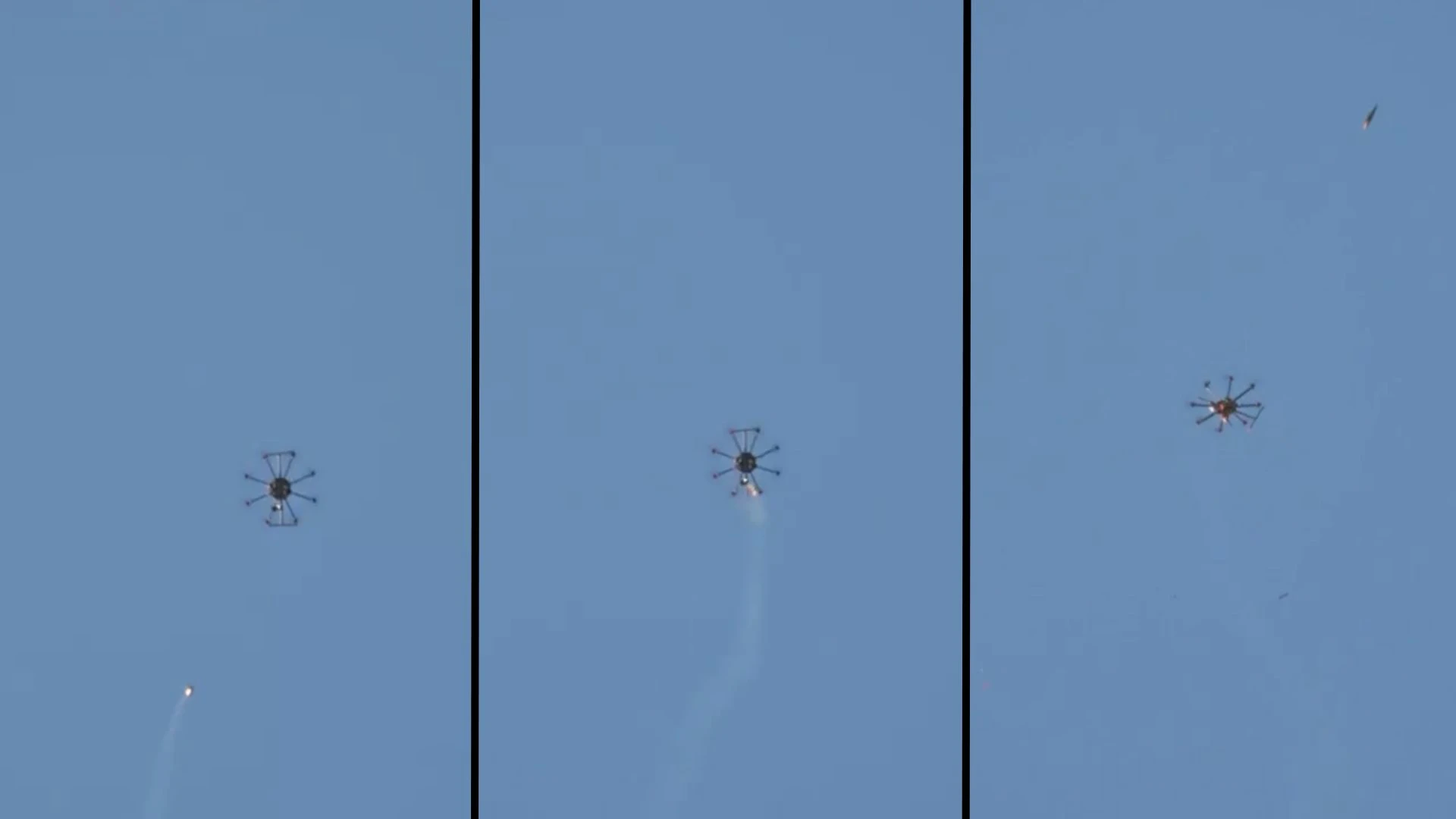
Perseus Defense has released video of its Harpe interceptor striking a hovering multirotor drone, a shot that co-founder and chief executive Jason Cornelius described as the first drone kill achieved by an attritable missile. Cornelius posted the eight-second clip on social media on November 2, 2026.
The Texas-based startup is building a guided micro-missile aimed at a costly mismatch in counter-unmanned aircraft systems (C-UAS) defense: militaries frequently fire interceptors costing $100,000 or more at drones worth a few hundred or a few thousand dollars. Attritable weapons are cheap enough to be fired in large numbers and lost, the premise behind an interceptor sized and priced for Group 1 and Group 2 drones.
Perseus Defense Harpe Interceptor Size, Range, and Cost Targets
According to company figures, Harpe is a guided interceptor about 61 cm (24 inches) long with a stated range of 2 km (1.2 miles). Perseus is targeting a unit price below $10,000 per shot. Publicly available information does not specify its seeker, propulsion system, warhead configuration or data link, and the performance figures are the company’s own.
The weapon uses a kinetic hit-to-kill approach, destroying the target through physical impact rather than jamming or spoofing its control link. Perseus argues this method holds up better than electronic warfare against drones flying preprogrammed routes or controlled over fiber-optic links, which emit no radio signal to disrupt.
The company has not explained how the November 2 shot differs from earlier tests. During the U.S. Army’s Golden Shield exercise, a live-fire trial led by the 1st Cavalry Division at Fort Hood, Texas, in April, Perseus said it achieved radar-cued multi-missile launches and fully active guidance intercepts. The exercise, the company’s first military-hosted live-fire demonstration, combined radar, command-and-control software and counter-UAS effectors. Other inexpensive guided weapons, including laser-guided rockets, have also destroyed drones, so the “first” label reflects the company’s own framing.
Falcon Peak 26.2 Puts the Mk-III on an Eight-Round Launcher
In September, Perseus fired its Mk-III interceptor from an eight-round launcher at Cibola Range Site 17, Yuma Proving Ground, Arizona, during Falcon Peak 26.2. The counter-small UAS experiment, held from August 31 to September 25, 2026, by U.S. Northern Command (NORTHCOM), the North American Aerospace Defense Command (NORAD) and the Pentagon’s Joint Interagency Task Force 401 (JIATF-401), was the fourth in the series and the first at Yuma, with a focus on drone threats along the southern border.
Perseus said each Mk-III cost about $2,500 to build. The launcher weighs less than 36 kg (79 pounds), light enough to move without heavy vehicles, and can take targeting data from external sensors or command-and-control networks. Northern Command evaluated the system alongside other short-range options for protecting U.S. bases.
The Pentagon stood up JIATF-401 in August 2025 to accelerate C-UAS acquisition and fielding. The Army’s three permanent counter-UAS test lanes at Yuma, used during Falcon Peak 26.2, remain available for further testing by military units and industry.
Cornelius, a former NASA engineer who worked on the Dragonfly rotorcraft for Saturn’s moon Titan, founded Perseus in 2025 with chief technology officer Steve Messinger, a former Boeing engineer. The two met as aerospace engineering graduate students at Penn State. The company went through Y Combinator’s summer 2025 batch and has raised $6.5 million in seed funding.
Analysis: The value of the November 2 video lies less in the “first” claim than in the cost logic it is meant to illustrate. If Perseus can hold Mk-III production near $2,500 and Harpe below $10,000 per shot, a short-range kinetic layer would cost roughly an order of magnitude less per engagement than legacy interceptors, making salvo fire against Group 1 and Group 2 drones affordable for base defense. That proposition still rests on unpublished data: probability of kill, performance against fast or maneuvering targets, and the ability of a seed-stage company to scale manufacturing.
Perseus has not announced a production contract or a program of record. The next markers are formal results from Falcon Peak 26.2, follow-on testing on the enduring Yuma lanes, independent verification of the company’s cost and performance figures, and whether NORTHCOM or the Army moves Harpe from experimentation toward procurement.