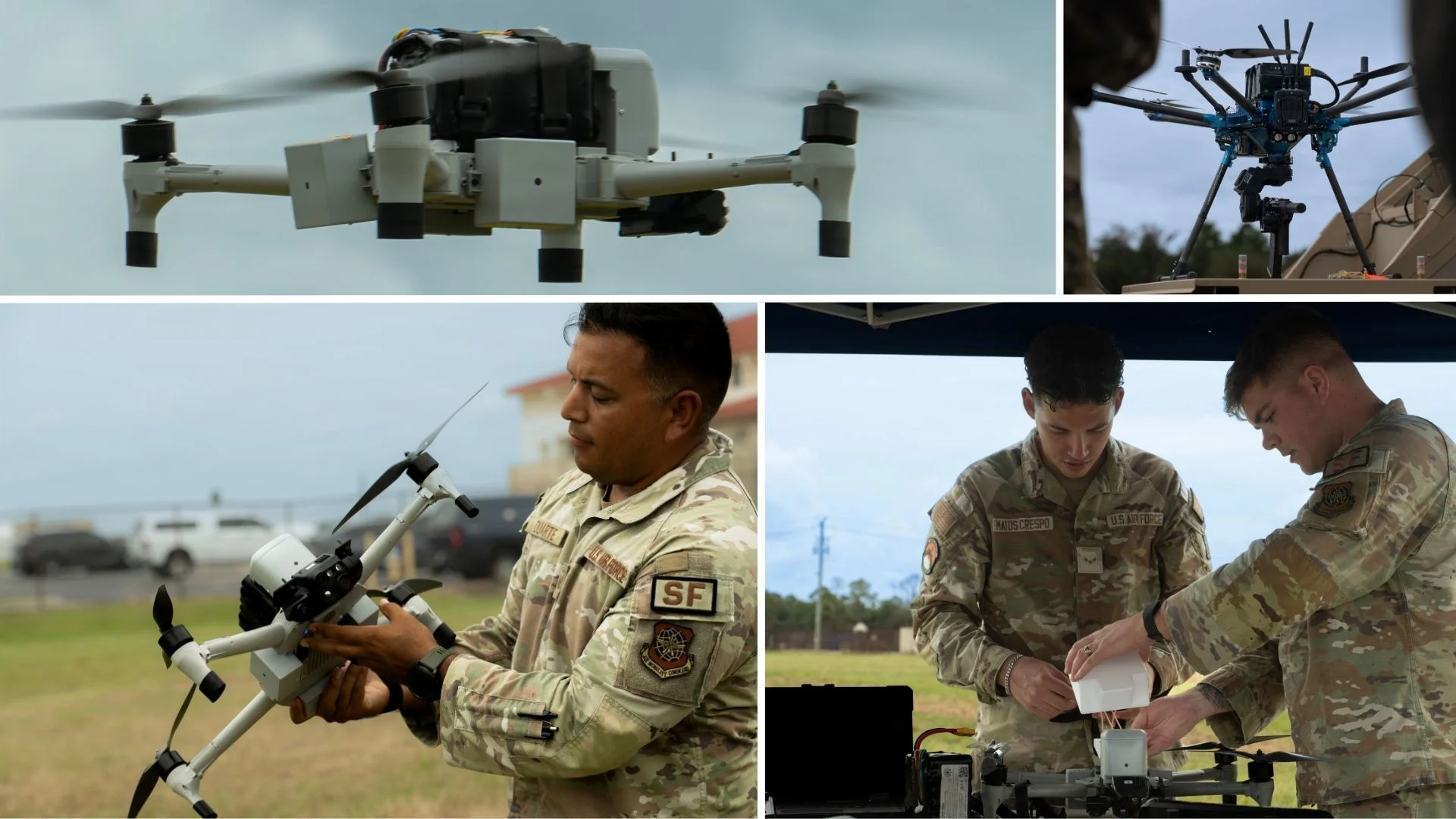
Joint Interagency Task Force 401 (JIATF 401) trained U.S. Air Force security forces and U.S. Secret Service agents on two drone interceptors, the Bumblebee V2 and the Paladin, at MacDill Air Force Base, Florida, in October 2026. The Department of War disclosed the training on November 5, 2026, framing it as hands-on preparation to defend critical installations and infrastructure against small unmanned aircraft systems (UAS).
The event placed airmen of the 6th Security Forces Squadron, which defends MacDill, in the same drills as a federal protective agency. The base hosts the headquarters of U.S. Central Command and U.S. Special Operations Command alongside the 6th Air Refueling Wing. JIATF 401 dates to an August 27, 2025, memo from Secretary Pete Hegseth that dissolved the Joint Counter-small Unmanned Aircraft Systems Office and consolidated Pentagon-wide counter-small UAS development under a director with acquisition and procurement authority.
How JIATF 401 Pairs Bumblebee V2 Collision Kills With Paladin Nets
The two systems defeat drones in different ways. The Bumblebee V2, built by Perennial Autonomy, is a first-person-view multirotor that destroys its target by direct collision, sacrificing itself in the process. JIATF 401 bought it under a $5.2 million agreement awarded January 30, 2026, with deliveries beginning in March. Army descriptions indicate the airframe meets National Defense Authorization Act sourcing standards, carries wide-angle and narrow-angle cameras, and flies up to one hour on a single battery. Its automated target recognition lets the interceptor lock onto and engage a hostile drone with limited operator input, reducing reliance on operator skill. Its unit cost has not been publicly disclosed.
The Paladin employs a net-based interceptor, according to the release. Zone 5 Technologies markets it as a Group 2 Low Collateral Effects Interceptor (LCEI), and Air Force Research Laboratory (AFRL) documentation describes it as built to defeat Group 1 and Group 2 drones. It is cued by any counter-UAS tracking sensor, follows the target with onboard radar and computer vision, then requests operator approval before the defeat. Control runs through the WinTAK ground control station over an encrypted MPU5 datalink. AFRL’s counter-UAS technical director has cited an effective net range of about 20 meters in the air.
The split matters operationally. A collision kill is fast and largely autonomous but leaves debris wherever the engagement occurs; a human-authorized net capture gives defenders more control over where a disabled drone comes down. The release did not specify which Paladin configuration was used at MacDill.
Counter-Drone Training Moves From Army Units to Installation Defenders
“Getting new technology into the hands of operators is only part of the solution,” said Army Maj. Jeremy Kelly, JIATF 401 assistant capability manager, adding that training with installation defense personnel helps refine the systems and build the skills to employ them.
MacDill follows two Army events. On April 22, 2026, 20 paratroopers of the 82nd Airborne Division ran the first operational test of Bumblebee V2 prototypes at Fort Bragg, North Carolina. From July 6 to 10, 2026, the 3rd Battalion, 75th Ranger Regiment completed a five-day Bumblebee V2 exercise at Fort Benning, Georgia. In May, the task force also gathered feedback from security forces at Whiteman Air Force Base, Missouri, on systems bought to protect critical assets and power projection platforms.
“Just like a golfer needs different clubs for different shots, defending the homeland requires a range of layered, counter-drone capabilities,” said Army Brig. Gen. Matthew Ross, JIATF 401 director. He added that options for defeating drones must keep expanding while minimizing risk to people and infrastructure.
Official photos of the training are dated October 8, 2026. The release did not state how many airmen or agents took part, which Secret Service element participated, or whether either system will remain at MacDill.
Analysis: MacDill marks a shift from proving interceptors with Army maneuver units to embedding them in homeland installation defense, with federal law enforcement in the loop. Military defenders and Secret Service agents act under separate legal authorities for drone mitigation, so shared training on the same effectors builds common tactics before both meet at a protected site or event. Low-collateral defeat is the enabling condition: kinetic options inside a city such as Tampa are usable only if debris and risk to bystanders can be controlled. The harder question is scale, since training defenders on prototypes differs sharply from equipping hundreds of installations.
The next markers are procurement and fielding decisions. On May 19, 2026, JIATF 401 awarded Perennial Autonomy a three-year indefinite delivery/indefinite quantity contract with a $500 million ceiling for enterprise-wide procurement of counter-UAS systems, covering its Merops interceptor, Bumblebee quadcopter, and Hornet strike drone, which gives the task force a vehicle to buy at volume. Whether the Bumblebee V2 and Paladin become standard kits at Air Force bases, and at what unit cost, remains undisclosed. The task force itself faces a sunset review at its 36-month mark, in 2028.