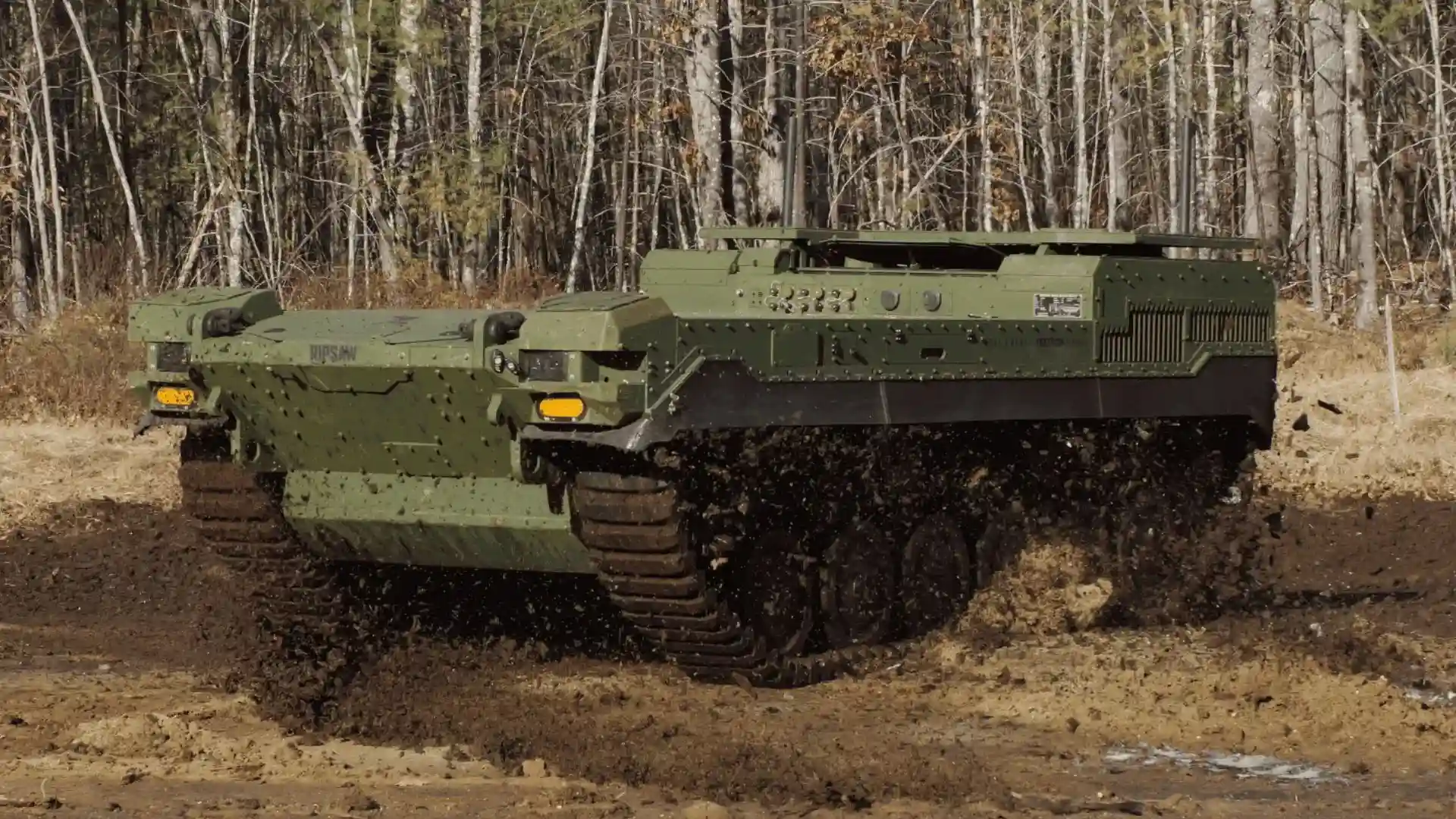
The U.S. Marine Corps has made an award to Textron Systems and its subsidiary Howe & Howe for two Ripsaw M3 robotic ground vehicles, which will go to the Marine Corps Warfighting Laboratory (MCWL) in Quantico, Virginia, the company announced on November 5, 2026. The vehicles will serve as experimentation and integration testbeds, allowing Marines to integrate payloads and sensors, demonstrate mission sets and refine future robotics requirements.
The award was placed through Other Transaction agreement W15QKN-17-9-1025 with the National Advanced Mobility Consortium, a prototyping pathway outside conventional Federal Acquisition Regulation contracting. Textron did not disclose the award value or a delivery schedule. The order gives the M3 a second U.S. outlet after a difficult 2025: the vehicle competed in Phase I of the U.S. Army’s Robotic Combat Vehicle (RCV) program and was reportedly selected in March 2025, before the Army halted RCV development that spring, amid its Army Transformation Initiative. Sweden became the first European customer on December 2, 2025.
Ripsaw M3 Specifications: Payload, Power, and Hybrid Mobility
The Ripsaw M3 is the newest member of the Howe & Howe Ripsaw family and sits below the larger Ripsaw M5, the platform the Army used for its earlier RCV-Medium experimentation. Textron describes the M3 as a smaller but mission-capable variant that folds in lessons learned from soldier experimentation with the M5.
According to Textron, the M3 carries more than 5,000 pounds (2,268 kilograms) of payload on a flat open deck and reaches speeds above 30 miles per hour (48 kilometers per hour). Manufacturer product literature lists a gross vehicle weight rating of 18,000 pounds (8,165 kilograms), 14 inches (355.6 millimeters) of ground clearance, a composite rubber track system and a range of more than 180 miles (about 290 kilometers). Those figures mark clear growth over the 2023 technology demonstrator, which Textron rated at 3,000 pounds of payload and 140 miles of range.
Propulsion is a hybrid-electric powertrain with full platform mobility in electric-only mode and a range extender to stretch endurance. Textron cited more than 12 hours of silent watch for its RCV prototype submission, and the company says the vehicle’s 80-inch width allows internal transport in a CH-47 Chinook. Electric-only movement and silent watch reduce acoustic and thermal signatures, a direct benefit for reconnaissance and screening tasks.
The M3 also provides 10 kilowatts of offload power. That matters as much as payload weight: sensors, communications relays, electronic warfare kits and counter-drone systems can draw from the vehicle rather than carrying their own generators, freeing deck space and mass for the mission package.
How MCWL Will Use the M3 to Shape Marine Robotics Requirements
The M3 is built on a modular open systems architecture (MOSA), which Textron says simplifies the integration of new payloads, controllers and autonomy suites. Company literature lists lethality, reconnaissance, surveillance and target acquisition (RSTA), combat engineering and logistics among the payload families the deck can host. For MCWL, the service’s experimentation arm, that flexibility is the point: two vehicles can rotate through multiple configurations rather than validating a single mission.
Sara Willett, Textron Systems’ vice president of programs, said pairing the M3 with the MCWL mission “will enable the Marine Corps to advance uncrewed force design and battlefield utility.” Michael Howe, senior vice president at Howe & Howe, said the M3 “will be a great fit for the Marine Corps and its demanding environmental requirements.”
Neither Textron nor the Marine Corps has identified which payloads, autonomy software or operating concepts MCWL will test first, or whether the experiments feed a specific program. The M3 also differs in scale from the service’s most visible ground robotics effort, the Remotely Operated Ground Unit for Expeditionary Fires (ROGUE-Fires), a wheeled carrier based on the Joint Light Tactical Vehicle that launches the Navy Marine Expeditionary Ship Interdiction System (NMESIS). A tracked, deck-based testbed opens a separate inquiry into off-road logistics, reconnaissance and engineering support.
Analysis: Two vehicles is an experimentation buy, not a procurement signal. Its value lies in cost and timing. The Marine Corps gains a platform matured through Army-funded RCV prototyping without carrying the development bill; Textron said in October 2024 that the Ripsaw family had logged more than 4,700 miles of durability testing since 2019. For Textron, the Marine Corps and Swedish orders give the M3 a customer base beyond the Army. The harder test for MCWL will be expeditionary fit: a tracked robot rated at up to 18,000 pounds gross must justify its share of amphibious shipping and lift against the lighter uncrewed systems that Force Design favors.
Key milestones remain undisclosed, including delivery dates and the first MCWL experiment cycle. Three signals matter: whether MCWL results translate into a formal Marine Corps requirement for a medium robotic ground vehicle, whether additional European buyers follow Sweden, and whether the Army returns to a tracked RCV-class effort under its reworked uncrewed ground strategy.