EDGE Group has signed a contract with Morocco’s Administration of National Defence (ADN) to supply the Royal Moroccan Air Force (RMAF) with Desert Sting 16 (DS-16) guided-glide weapons and Thunder P-31 precision guidance kits, and to integrate both across the service’s unmanned combat aerial vehicle (UCAV) fleet. The Abu Dhabi-based group announced the deal on October 9, 2026, at the Marrakech Air Show. Contract value, quantities, and delivery schedule were not disclosed.
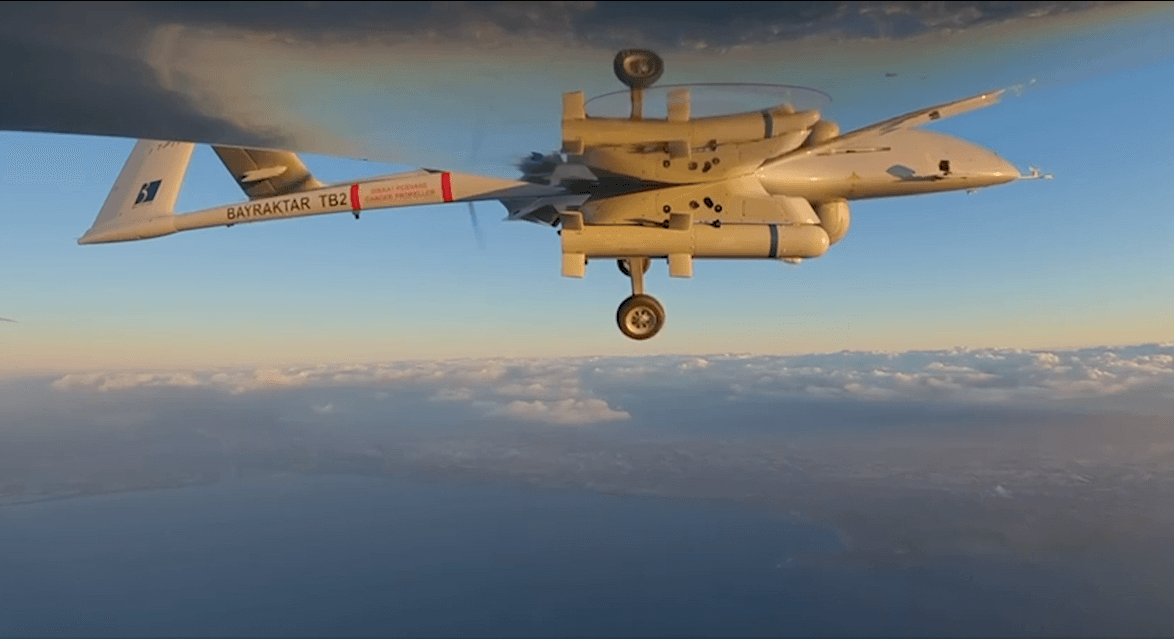
The award arms a drone force Rabat has assembled quickly. Morocco reportedly received three or four Chinese-built Wing Loong I UCAVs from the United Arab Emirates in 2020, ordered 13 Bayraktar TB2s from Türkiye in April 2021 for an estimated $70 million, and began receiving the heavier Bayraktar Akinci in early 2025. Open-source reporting credits the RMAF with more than 20 TB2s, and satellite imagery reported in June 2026 placed Akinci aircraft at the Sixth Air Base in Ben Guerir. Since the Polisario Front abandoned the 1991 ceasefire in November 2020, Rabat has relied heavily on these aircraft for strikes east of the Western Sahara berm.
Desert Sting 16 and Thunder P-31: Weight, Range, and Guidance Compared
The DS-16, produced by EDGE’s smart weapons house Halcon, is a 23 kg unpowered glide weapon carrying a 15 kg warhead with an impact or height-of-burst fuze. Company data describe a 1,000 mm body, a 129 mm diameter, a 323 mm wingspan, and four rear control fins. EDGE quotes a range of up to 15 km; earlier company literature broke the envelope down as 16 km downrange, 13 km cross-range, and 7 km back-range from a release altitude of about 9,100 m. That off-axis reach lets an operator engage targets to the flank or rear without repositioning, a real advantage for slow drones orbiting a fixed area.
The Thunder P-31 converts the 250 lb Mk 81 general-purpose bomb into a precision-guided munition, which EDGE lists at 140 kg gross weight with a 110 kg warhead. Range depends heavily on release conditions: EDGE cites up to 10 km from unmanned aircraft and 20 km from high-speed, high-altitude platforms, while older product sheets advertised 27 km from 40,000 ft. Medium-altitude UCAVs should plan around the lower figure.
Both weapons share GNSS-assisted inertial navigation (GAINS) as standard, with an optional semi-active laser (SAL) seeker. EDGE publishes a circular error probable of 10 m for GAINS alone and 3 m with SAL, the seeker enabling attacks on moving or relocatable targets under laser designation. The pairing gives the RMAF two distinct effects: a light, low-collateral round for personnel, light vehicles, and point targets, and a heavier blast-fragmentation option for fortified positions and logistics sites. Both are developed and manufactured in the UAE.
How EDGE Will Integrate Both Weapons on Moroccan UCAVs
Under the contract, EDGE will deliver the aircraft modifications and software required to carry and employ both weapons operationally. Neither party named the platforms, but the RMAF inventory narrows the field. EDGE and Baykar announced the DS-16’s integration on the TB2 in January 2024, which should shorten the path for Morocco’s largest UCAV fleet. Publicly available specifications put the TB2’s total payload at about 150 kg, enough for multiple DS-16s but impractical for a 140 kg Thunder P-31.
The heavier kit points toward the Akinci, which publicly available specifications credit with roughly 1,500 kg of payload and a ceiling near 40,000 ft, closer to the release conditions that unlock Thunder’s longer ranges. Integration on Chinese-built Wing Loong airframes would likely require the original manufacturer’s cooperation; the contract’s scope on that point is not disclosed.
The SAL option also depends on the targeting chain. Both the TB2 and Akinci carry electro-optical turrets with integrated laser designators, allowing self-designation, while buddy-lasing from a second drone or a ground team would let one aircraft mark targets for another and sustain attacks on moving targets in broken terrain.
Saif Al Dahbashi, President of Missiles & Weapons at EDGE, said every system the company delivers is “backed by assured supply and long-term sustainment,” a pointed message to a customer whose drone fleet spans Turkish, Chinese, and Israeli designs. Halcon’s production record supports the claim: it has supplied Desert Sting and Thunder under UAE Armed Forces contracts worth AED 3.6 billion in 2019 and AED 3.2 billion in 2021.
Analysis: The contract matters less for any single capability than for what it does to Morocco’s supply chain. By buying munitions from a vendor that builds none of its airframes, Rabat reduces the dependence of its strike magazine on export decisions in Ankara and Beijing and adds a second production line for the consumables a sustained campaign burns through. Glide weapons and bolt-on kits for legacy Mk 80-series bombs are generally far cheaper per round than powered missiles, which suits a low-intensity, high-tempo mission in Western Sahara, while 10 to 15 km of standoff keeps drones outside much of the man-portable air defense envelope. For Abu Dhabi, the deal deepens a defense relationship with Rabat that dates to the reported 2020 Wing Loong transfer.
Key unknowns remain the value, the number of weapons ordered, the delivery timeline, and which airframes will be cleared first. The next observable milestones are integration flight trials and live releases from Moroccan aircraft. Whether Rabat follows with the larger Desert Sting 25 or EDGE’s longer-range Al Tariq kits will show if this is a single buy or the start of a broader munitions partnership.