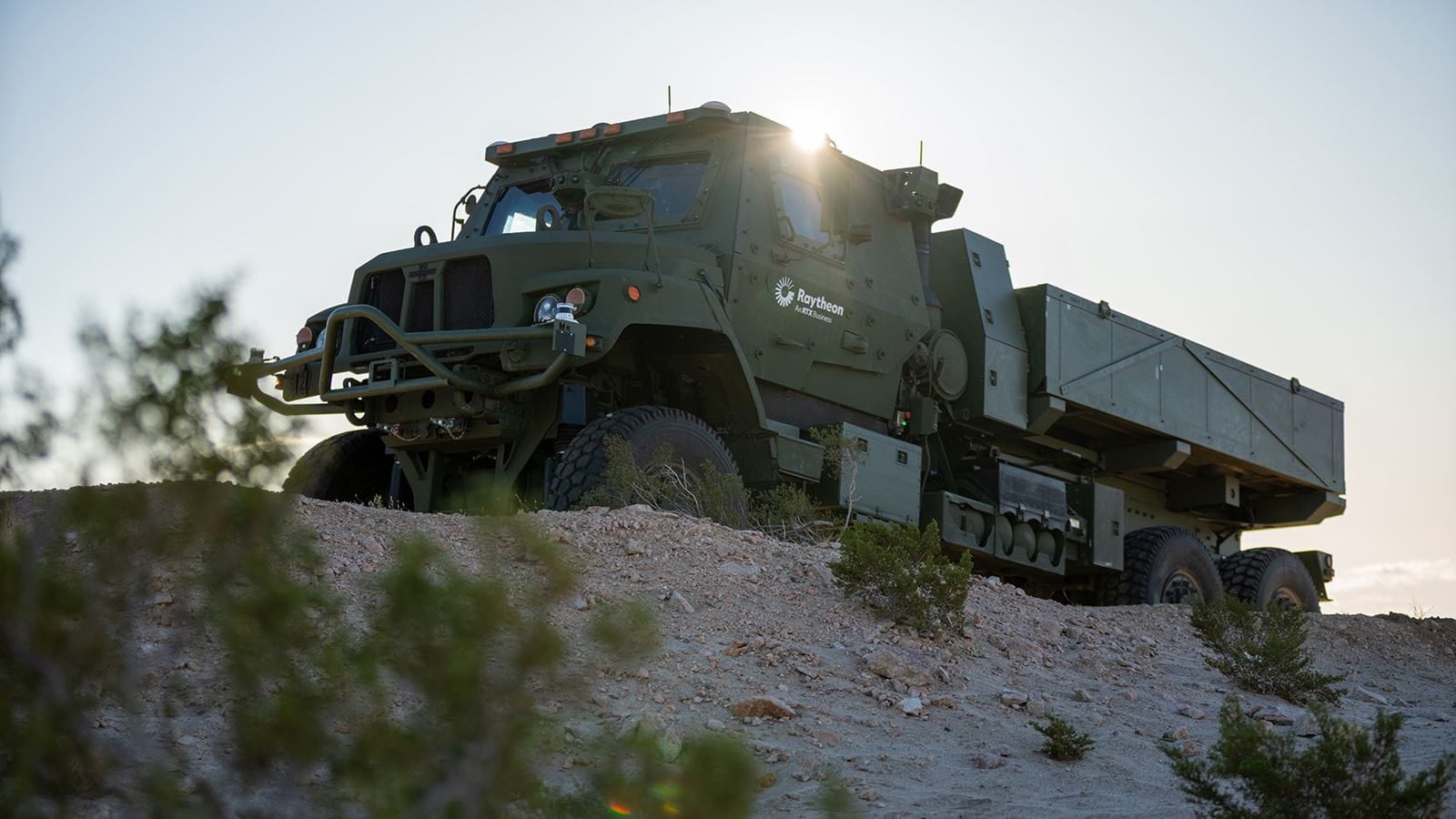
U.S. Army artillerymen have operated Raytheon’s DeepFires autonomous launcher for the first time, RTX said on August 17, 2026. Soldiers from the 2nd Battalion, 18th Field Artillery Regiment, 75th Field Artillery Brigade, ran the modular missile launcher, built on an Oshkosh Defense Family of Medium Tactical Vehicles (FMTV) A2 6×6 truck, in a leader-follower convoy during Project Convergence Capstone 6 (PCC6), held July 20 to July 29, 2026, at the National Training Center, Fort Irwin, California.
DeepFires answers two Army problems. The first is survivability: persistent drone surveillance, satellite tracking and counter-battery radar have turned crewed launchers and their resupply trucks into priority targets. The second is size. Army leaders have acknowledged that the Typhon Mid-Range Capability, whose trailer-mounted Mk 70 launchers fire Tomahawk and Standard Missile-6 (SM-6) rounds, proved too large for dispersed operations after deployments to the Philippines and Australia. Raytheon’s answer is a smaller, optionally crewed launcher that a C-130 can carry.
DeepFires Autonomous Launcher Design, Payloads and Command Architecture
Raytheon built the first prototype in six months from a new medium tactical vehicle: engineers cut away the roof, wired in an autonomy kit and integrated a Tomahawk cruise missile launcher, according to RTX. Company investment funded the prototypes entirely. Forterra supplies the self-driving software, Oshkosh Defense the chassis and vehicle electronics, Collins Aerospace the secure command-and-control communications, and Corvid Technologies additional engineering.
The rear of the truck carries a containerized, elevating launcher module that crews can reconfigure between offensive and defensive missions. Raytheon lists Tomahawk and Patriot as compatible effectors and has cited the AIM-9X Sidewinder for air defense. Company imagery shows the vehicle with two containerized Tomahawk rounds, while a prototype displayed at the Association of the U.S. Army (AUSA) annual meeting in October 2025 carried four Patriot interceptors. Publicly available specifications indicate a Tomahawk range exceeding 1,600 kilometers, giving a C-130-transportable truck strike reach comparable to Typhon, though with fewer rounds than a four-cell Mk 70 launcher. Raytheon has not published definitive loadouts per configuration.
Two features came directly from soldier feedback: onboard vehicle power, which removes the need for a separate generator and supports reloading, and 360-degree infrared cameras for optionally manned operation. Raytheon says one operator can manage one to six vehicles, either dispatching each to a firing point by waypoint navigation or leading a string of uncrewed launchers from a crewed lead vehicle, over a network-agnostic link that includes satellite communications.
From Project Convergence Capstone 5 to Soldier Trials at PCC6
The lineage dates to March 2025, when a driverless Raytheon FMTV A2 launcher, then marketed as DeepStrike, fired three times at Project Convergence Capstone 5 using a missile developed for the Army’s Joint Reduced Range Rocket (JR3) program. Two DeepFires prototypes appeared at AUSA 2025, and the system completed autonomous demonstrations and simulated live-fire activity during the Army’s 2026 Concept Focused Warfighting Experiment in February and March.
Preparing for PCC6 meant compressing a six-to-nine-month communications authorization process into about six weeks, after a Collins Aerospace team assessed Forterra-equipped Oshkosh vehicles in Oshkosh, Wisconsin, in January 2026. At Fort Irwin, a crewed Joint Unmanned Autonomous System Multi-Payload System Command and Control (JUMPS C2) vehicle led two robotic followers: a DeepFires launcher configured for the Multiple Launch Rocket System Family of Munitions (MFOM) and an Autonomous Resupply Vehicle. Crews in the JUMPS C2 shelter steered the followers across open desert while keeping targeting and engagement decisions under human control. The Army says a single command vehicle should eventually control up to four launchers and multiple resupply vehicles.
“And every day, they changed how they would fight,” said Jessie Polanco, Raytheon’s DeepFires program manager. Neither the Army nor Raytheon has said whether missiles were fired during PCC6.
Contracts and Funding: Where DeepFires Fits in the Army CAML Program
No DeepFires-specific development or production contract has been announced. The system’s route to a program of record runs through the Common Autonomous Multi-Domain Launcher (CAML), the Army’s planned family of optionally crewed, air-transportable launchers intended to take on the Typhon mission. On August 21, 2026, the Army awarded the Georgia Tech Research Institute a prototype Other Transaction Agreement worth up to $33,399,920 to act as Weapon Systems Integrator over roughly 36 months, leading to CAML Increment Zero prototypes.
The award reflects a deliberate shift. Lt. Gen. Frank Lozano, the Army’s Portfolio Acquisition Executive for Fires, has said he did not want one vendor delivering the entire system. The Army is instead buying the Autonomous Mobility Platform and modular munitions pallets separately; solutions briefs for a 36,000-pound mobility platform variant, a leader prototype and autonomy command and control were due September 1, 2026. Earlier planning envisioned a medium variant firing MFOM rounds and AIM-9X interceptors, and a heavy variant for Tomahawk and Patriot Advanced Capability-3 Missile Segment Enhancement (PAC-3 MSE). Raytheon has said it is pursuing CAML without confirming whether DeepFires itself will be offered; Oshkosh Defense is pitching its own Family of Multi-Mission Autonomous Vehicles.
Analysis: DeepFires is a vertically integrated answer to a program the Army has structured to prevent vertical integration. Raytheon brings the launcher, Tomahawk and AIM-9X effectors, Patriot integration and, through Collins Aerospace, the command link. The Army’s modular approach separates truck from munitions pallet and hands integration to a university-affiliated research institute. That rewards Raytheon where it is hardest to replicate, pallet integration and missile qualification, but weakens the case for buying DeepFires whole. Its most consequential claim is Tomahawk-class reach on a C-130-transportable medium truck, which would blur the line between CAML’s medium and heavy variants if loadout and launch stability hold up in Army testing.
The next decision points are the Autonomous Mobility Platform and munitions pallet awards the Army expects to issue in the coming months. Raytheon says engineers are refining autonomy behaviors and prioritizing investment based on PCC6 results ahead of further exercises. Open questions remain: confirmed round counts, unit cost, a live Tomahawk or Patriot launch from the vehicle, and whether Raytheon bids DeepFires whole or as CAML components.