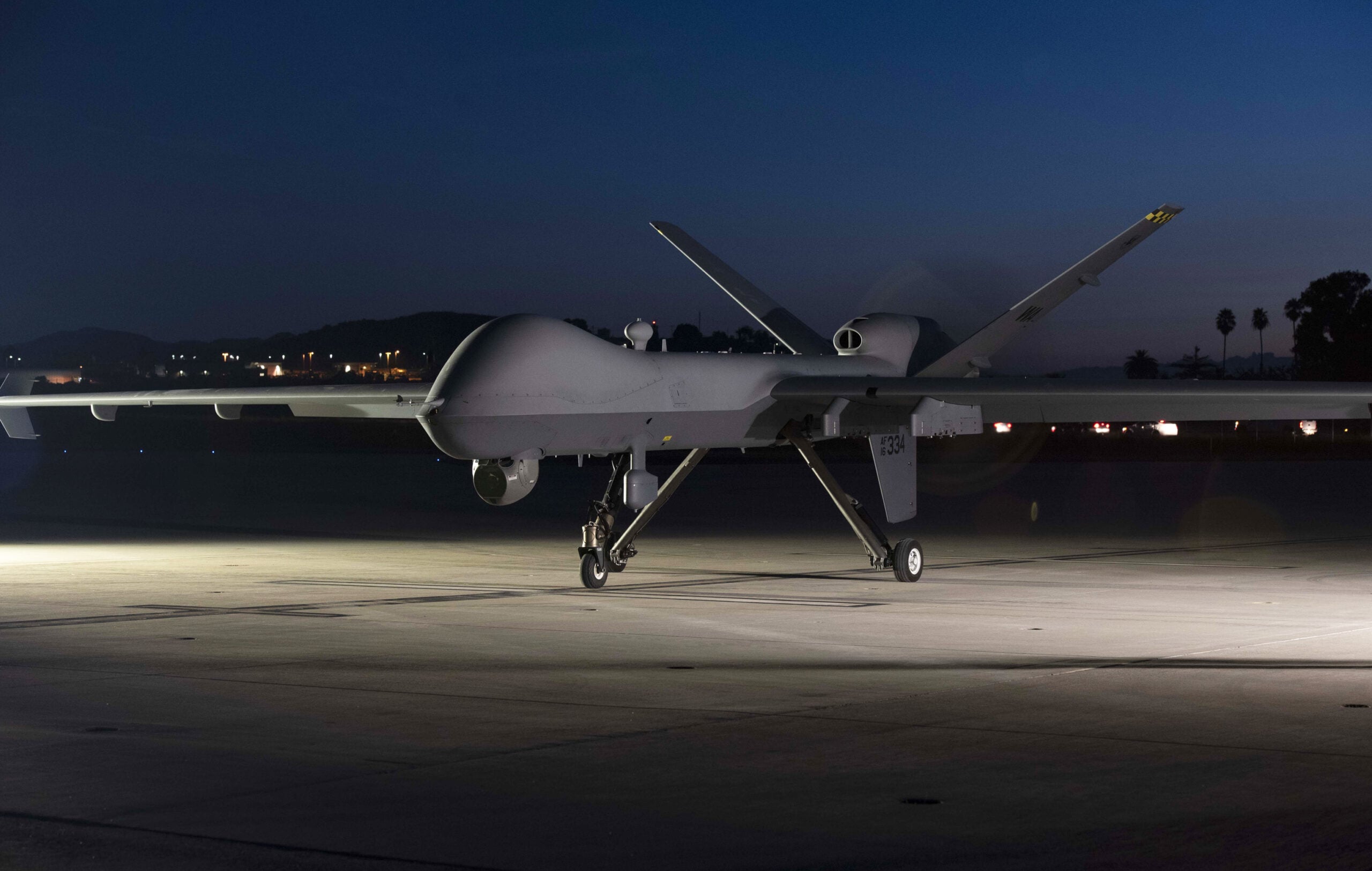
The U.S. Coast Guard has ordered four General Atomics MQ-9B long-range unmanned aircraft systems (UAS), ground control stations and supporting equipment for $247.8 million, the service announced October 9, 2026. The Coast Guard placed the order on September 25, 2026, through an existing U.S. Customs and Border Protection (CBP) contract. It is the service’s first purchase of large remotely piloted aircraft.
Until now, Coast Guard aircrews have flown long-range unmanned missions only on aircraft owned by CBP. Since 2008, the two Department of Homeland Security (DHS) agencies have run a Joint Program Office, with Coast Guard pilots and sensor operators now assigned to CBP’s National Air Security Operations Center in San Angelo, Texas. The fiscal 2025 budget reconciliation law, signed in July 2025, set aside $266 million for Coast Guard long-range UAS out of nearly $25 billion for the service. The Coast Guard says it has ordered about $16.3 billion in assets against that total.
Coast Guard MQ-9B Order: Contract Vehicle, Funding, and Fleet Size
The service used CBP’s sole-source agreement with General Atomics Aeronautical Systems Inc. (GA-ASI) instead of running its own competition. CBP awarded that contract in March 2022 with a potential value of $585 million, covering aircraft, spares, operations and maintenance. On March 31, 2026, CBP added a $265.5 million modification for additional MQ-9B aircraft and associated equipment, according to a federal award notice. The Coast Guard order follows the same route, which keeps both DHS fleets on a common airframe, ground segment and supply chain.
Divided evenly, the order works out to $61.95 million per aircraft. That figure includes ground control stations and support equipment, so it is not a flyaway unit cost. The Coast Guard did not disclose how many ground stations it bought, the sensor fit, a delivery schedule or basing sites. Coast Guard program officials said in 2025 that the service wants to operate its own aircraft from East Coast and West Coast locations while continuing joint work with CBP.
The service attributes the funding to both fiscal 2025 reconciliation and fiscal 2026 appropriations, without giving a split. The compromise fiscal 2026 Homeland Security bill that lawmakers negotiated in January 2026 carried $98 million for two additional MQ-9Bs and barred DHS from arming the aircraft with missiles. If the Coast Guard buys those two, the fleet would reach six unarmed aircraft.
MQ-9B Endurance, Sensors, and Airspace Access Compared With MQ-9A
The MQ-9B is GA-ASI’s redesign of the MQ-9A Reaper family, built to the NATO STANAG 4671 airworthiness standard so it can be certified for civil airspace. Manufacturer specifications list a 79-foot (24-meter) wingspan, a length of 38 feet (11.7 meters), a maximum gross takeoff weight of 12,500 pounds (5,670 kilograms) and 6,000 pounds of fuel. A single Honeywell TPE331-10 turboprop powers the aircraft. Nine hardpoints, eight under the wings and one on the centerline, carry up to 4,750 pounds of external payload, with another 800 pounds internal.
The MQ-9A that CBP flies is smaller. U.S. Air Force data for the baseline Reaper list a 66-foot wingspan, a 10,500-pound maximum takeoff weight and 4,000 pounds of fuel. Coast Guard officials have cited about 24 hours of endurance for CBP’s MQ-9A, against roughly 14 hours for an HC-130J patrol. GA-ASI lists more than 30 hours for the MQ-9B in its maritime SeaGuardian configuration and more than 40 hours for the SkyGuardian. Across 4.5 million square miles of exclusive economic zone, that fuel margin means longer time on station.
Three design features matter for the maritime mission. The MQ-9B carries a detect and avoid system, which addresses the see-and-avoid limits that have restricted unmanned flights in domestic airspace. It adds de-icing and lightning protection, and it has an automatic takeoff and landing capability. GA-ASI’s SeaGuardian kit pairs a 360-degree maritime surface-search radar and an Automatic Identification System receiver with an electro-optical and infrared sensor and the Lynx multi-mode radar. The Coast Guard has not said whether its four aircraft carry that kit.
The service lists offshore surveillance, border and critical infrastructure protection, search and rescue, counter-drug patrols and enforcement against illegal fishing as missions for the new aircraft. In fiscal 2026, CBP MQ-9A aircraft flying for Joint Interagency Task Force South contributed to the seizure of about 60,700 pounds of illegal drugs valued at $306 million and the apprehension of around 20 smugglers, according to the Coast Guard. Anthony Antognoli, the Coast Guard’s program executive officer for robotics and autonomous systems, said the MQ-9B will help crews detect threats earlier.
Analysis: The order’s weight lies in ownership more than in numbers. Four aircraft will not provide persistent coverage of the Caribbean, the Eastern Pacific and both coasts at once, but they let the Coast Guard set its own tasking priorities instead of drawing maritime hours from a CBP fleet that flies mostly customs and land border missions. Buying through CBP’s contract trades competition for speed and commonality, and it concentrates the DHS long-range UAS enterprise on one supplier. The sensor question matters most: without a maritime surface-search radar, the MQ-9B is a much weaker ocean surveillance asset.
The next markers are the delivery schedule, the basing decision and the sensor configuration, none of which the Coast Guard has released. Congress will also watch whether the service orders a fifth and sixth aircraft. In the interim, the joint program with CBP at San Angelo remains the Coast Guard’s only long-range unmanned capability.