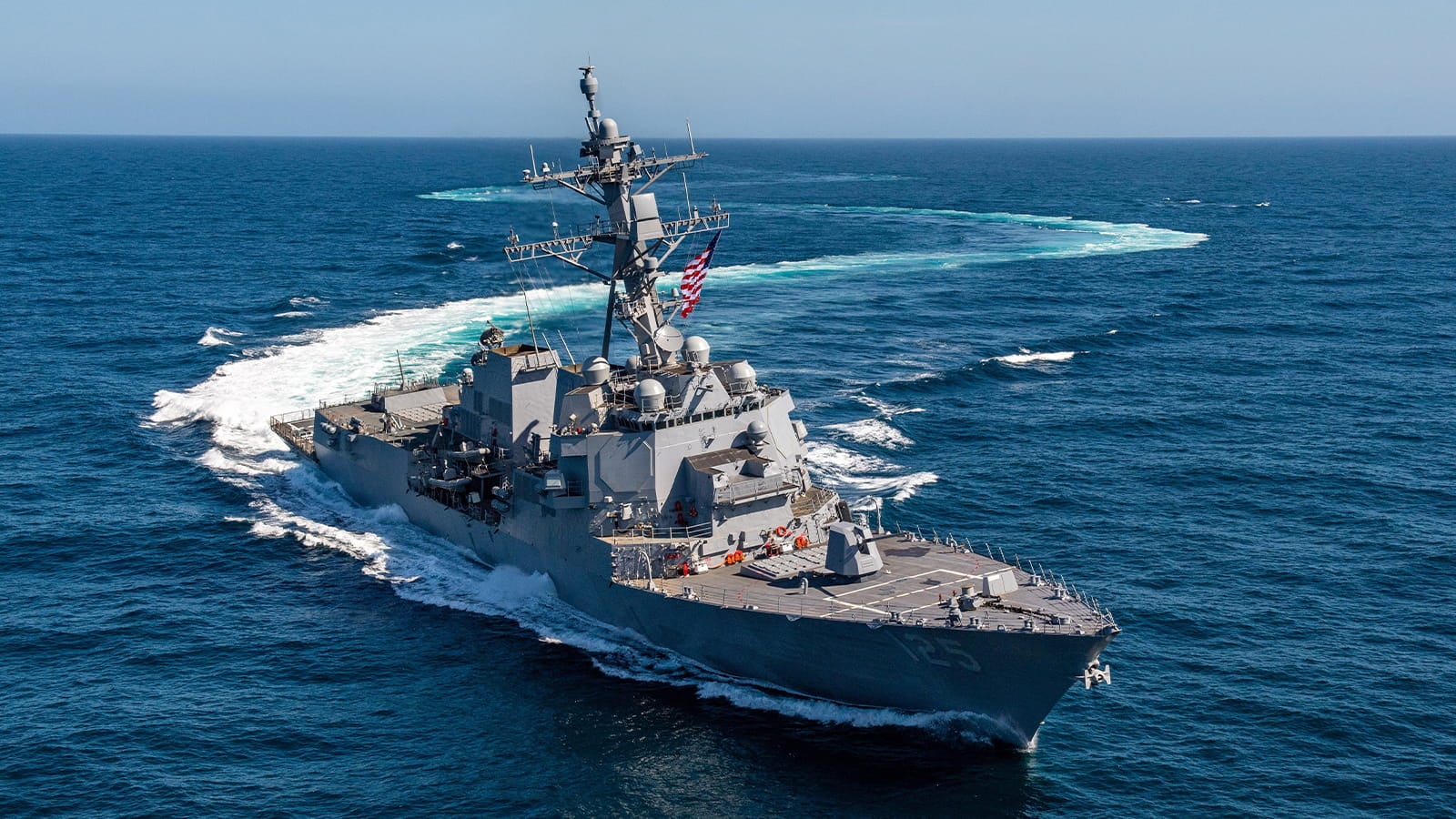
Raytheon, an RTX business, has won an Office of Naval Research (ONR) contract to develop advanced target-detection capabilities for U.S. Navy radars, the company announced on October 12, 2026. The work covers new signal- and data-processing algorithms and targeted software upgrades meant to extend detection range, raise sensitivity and improve efficiency, with the AN/SPY-6 family as the primary transition path.
The award arrives as the Navy accelerates SPY-6 fielding across the surface fleet. In July 2026, Naval Sea Systems Command (NAVSEA) extended Raytheon’s SPY-6 hardware production and sustainment contract by $1.8 billion, with options that could lift its cumulative value to $3.3 billion through October 2031. Neither Raytheon nor the Pentagon has disclosed the value of the new ONR award. Work will take place at Raytheon facilities in Portsmouth, Rhode Island, and Andover, Massachusetts, through 2031.
How ONR Software Upgrades Aim to Extend SPY-6 Radar Detection Range
Raytheon’s Advanced Technology team will develop and evaluate the algorithms, then integrate them as targeted software upgrades. Laboratory and field testing will validate performance and operational use before transition into SPY-6 and other future naval radars. The company has not identified the detection modes, waveforms or threat sets involved, nor published quantified range or sensitivity goals.
“Modernizing fielded radar systems with software-first upgrades is one of the fastest and most cost-effective ways to deliver mission-ready capability,” said Colin Whelan, president of Advanced Technology at Raytheon. “These enhancements will enable naval operators to detect smaller objects at greater distances and classify targets more quickly, providing the fleet with faster, more informed decision-making.”
The hardware baseline is already demanding. SPY-6 is an S-band active electronically scanned array (AESA) built from Radar Modular Assemblies (RMAs), self-contained 2-foot cubes that each function as a standalone radar with gallium nitride (GaN) transmit/receive electronics. The AN/SPY-6(V)1 on Arleigh Burke-class Flight III destroyers uses four fixed faces of 37 RMAs, and the Navy rates it at SPY+16 dB sensitivity over the legacy AN/SPY-1. The AN/SPY-6(V)4, with 24 RMAs per face for the Flight IIA backfit led by USS Pinckney (DDG 91), is rated at SPY+11 dB. The rotating, single-face AN/SPY-6(V)2 Enterprise Air Surveillance Radar uses 9 RMAs for amphibious ships and Nimitz-class carriers, while the three-face AN/SPY-6(V)3 is specified for Ford-class carriers beginning with John F. Kennedy (CVN 79).
Because every variant shares the same RMA building block and a common processing foundation, algorithm gains validated on one array can propagate across the family. Range matters most at the margins. Low radar cross-section threats such as one-way attack drones, sea-skimming cruise missiles and maneuvering hypersonic glide vehicles compress engagement timelines, and every additional mile of firm track gives the Aegis Combat System more time to commit Standard Missile interceptors.
From ASPIRE to STORM: Raytheon’s Software-Defined Aperture Roadmap
The new contract extends a sequence of ONR science and technology investments. In 2022, ONR awarded Raytheon a contract worth up to $46.3 million under Agnostic Signal Processing for Increased Radar Efficiency (ASPIRE), funding studies on flexible digital beamforming, advanced signal processing, new signal synthesizer architectures and smaller digital receiver-exciter designs to cut radar size, weight and power. In May 2023, a separate ONR award funded new SPY-6 signal-processing hardware built on commercially available heterogeneous computing.
ONR followed in May 2026 with a $22.6 million contract for Subarray Transmit Orthogonality for Receive Multiplexing (STORM). STORM treats each RMA as its own software-defined aperture, letting a single array run multiple missions simultaneously and share crowded spectrum with commercial 5G networks. That effort is scheduled to conclude in April 2029.
Together, the programs form a layered stack: ASPIRE addressed the processing back end, STORM the control of individual subarrays, and the October 2026 award the detection algorithms running on top. The premise, which Raytheon calls the software-defined aperture, is that capability growth arrives through code drops rather than array redesigns.
The installed base is expanding. As of July 2026, SPY-6 was operational on two commissioned ships and installed on 11 more undergoing testing, and Raytheon projects the family will equip more than 50 ships over the next decade. The company says an $800 million manufacturing investment positions it to double SPY-6 output by 2028. One planned host has shrunk: the Navy cut the Constellation-class frigate, slated to carry SPY-6(V)3, to two hulls in November 2025.
Analysis: The award signals where the Navy now expects radar advantage to come from. With SPY-6 arrays in full-rate production, the next increment of detection performance is cheaper to buy in processing than in aperture, especially for the Flight IIA backfit, where the (V)4 starts 5 dB below the Flight III radar. Software cannot add array area, but better coherent integration and clutter rejection could narrow that gap without touching deckhouse weight, power or cooling. The constraint is certification: any change to track quality feeds directly into Aegis engagement logic, so each upgrade must clear combat-system testing before reaching the fleet.
Raytheon has not released a test schedule, transition date or contract value, and ONR has not named the SPY-6 variant that will host the first upgrades. Milestones to watch include publication of the contract terms, STORM demonstration results ahead of its 2029 end date, and whether the new detection algorithms enter a future Aegis baseline before this effort concludes in 2031.