The Naval Surface Warfare Center Dahlgren Division (NSWCDD) has asked industry to comment on a hybrid Firm-Fixed-Price (FFP) and Cost-Plus-Fixed-Fee (CPFF) structure for the next engineering support task order covering its Gun Weapon Systems (GWS) work, according to a Request for Information (RFI) published on October 9, 2026. Responses are due by 5:00 p.m. EDT on October 29, 2026.
The notice arrives five months after Executive Order 14402, signed on April 30, 2026, made fixed-price contracting the default across federal agencies and required contracting officers to justify any cost-type award in writing. The draft Performance Work Statement (PWS) cites that order directly. NSWCDD’s E Department states that predecessor task orders ran predominantly on a CPFF basis, and it now wants FFP line items for mature, repetitive and deliverable-based efforts while keeping cost-type coverage for research, development and live-fire work.
How the Gun Weapon Systems Contract Splits Fixed and Cost-Type Work
The draft PWS sorts nine task areas by predictability. Configuration Management (CM) and technical writing are proposed as fully FFP: a monthly fixed rate for Change Control Boards, Engineering Change Proposal processing and repository administration under SAE ANSI/EIA-649C, and discrete deliverables for manuals written to MIL-STD-40051. The other seven areas are hybrids.
Within those hybrids, the line follows technical uncertainty. Scheduled Model-Based Systems Engineering (MBSE) baseline releases, Preliminary and Critical Design Review packages, build-to-print drawings, firing countdown checklists and planned pier-side weapon integration surveys would be fixed-price. Analyses of Alternatives, Reliability, Availability, Maintainability and Cost (RAM-C) failure investigations, iterative submissions to the Weapon System Explosives Safety Review Board (WSESRB), live-fire range execution, real-time telemetry reduction and underway fleet support would remain CPFF. The PWS argues that range windows, maritime traffic, gun anomalies and weather make live-fire effort impossible to price in advance.
Training follows a third model, with unit-priced FFP for scheduled operator courses and simulator availability and CPFF reserved for custom threat scenario coding and integration of experimental weapon logic into simulators. Travel and direct materials stay cost-reimbursable with no fee. The Navy has also removed software from the scope: software design, AI code review, DevSecOps and software test tasks from the original statement of work are marked as excised, to be competed under a separate software contract.
Dahlgren Gun Engineering Workforce Grows 40 Percent Over Five Years
The labor attachment estimates 1,082,880 hours over a base year and four option years, rising from 180,480 hours to 253,440, an increase of about 40 percent. At a standard 1,920-hour work year, that equates to 94 full-time staff at the start and 132 at the end.
Systems Engineers form the largest block at 128,640 hours, followed by Configuration Management Analysts at 86,400 and Program Analysts at 82,560. Four categories are key personnel: Program Manager, Senior Systems Engineer, Senior Hardware Engineer and Senior Program Scheduler. The Program Manager needs five years on minor, medium and large caliber gun and ammunition systems.
The Senior Operations Engineer requires 15 years of active-duty Navy service, including five years as a Fire Controlman on the MK 160 or a Gunner’s Mate on the MK 45. The table also lists a Control Engineer with gimbal rate-loop tuning experience and an Embedded Systems Engineer for FPGA, printed circuit board and ARM or RISC-V processor work.
Despite the software excision, the labor table still carries 36,480 DevSecOps Engineer hours and 57,600 Automation Test Engineer hours, together nearly 9 percent of the total. The table is dated August 31, 2026, and the RFI explicitly asks industry whether the labor mix aligns with the PWS.
Why MK 45 Gun Support Matters After Red Sea Drone Engagements
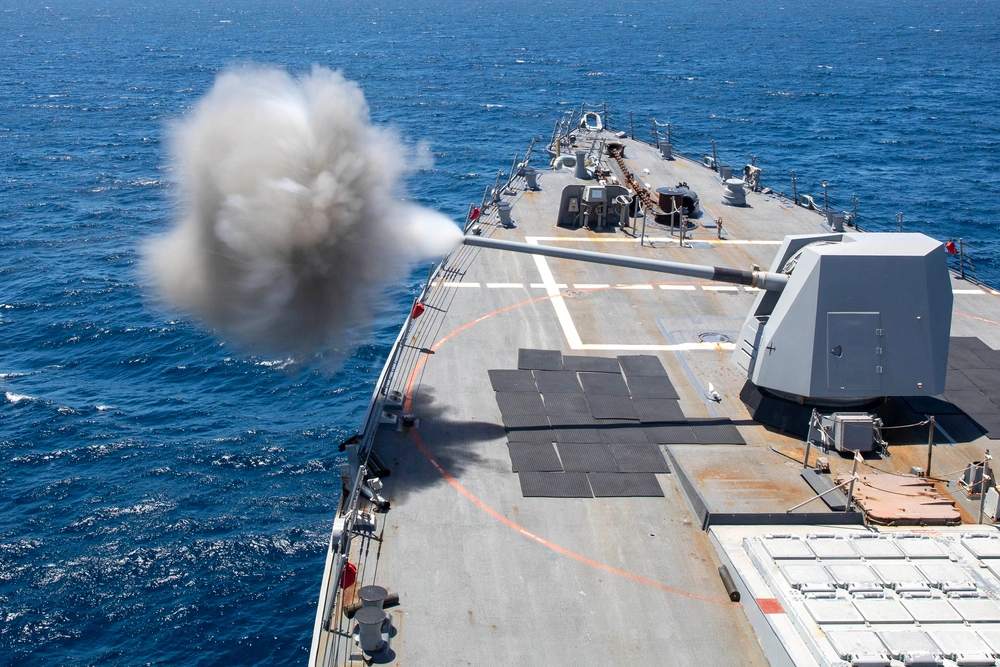
The RFI does not name the systems in scope, but the labor qualifications point to the MK 45 5-inch gun mount and its MK 160 Gun Computer System. Publicly available Navy specifications indicate the MK 45 fires 16 to 20 rounds per minute from a 20-round automatic loader drum, reaches 13 nautical miles with conventional ammunition and draws on a 600-round magazine aboard Arleigh Burke-class destroyers. The MK 45 Mod 4, with a 62-caliber barrel, equips DDG 81 and later hulls.
Those guns took on an air defense role during the Red Sea campaign against Houthi forces between October 2023 and January 2025. The Navy reported firing 160 five-inch rounds over 15 months, alongside 120 SM-2 and 80 SM-6 interceptors. In November 2024, USS Stockdale (DDG 106) used its 5-inch gun to destroy a low-flying Houthi drone that was detected late, according to U.S. Central Command.
The PWS tasks map onto that experience: ballistics and barrel wear studies, projectile and fuze interface analysis, design of fuze setters and telemetry units, and safety submissions to the Fuze and Initiation System Technical Review Panel. Training tasks also reference terminal defense weapons, the innermost layer of ship self-defense.
Analysis: The structure tests how far Executive Order 14402 can reach into engineering services that sit close to live weapons. Dahlgren is not converting the work wholesale; it draws the boundary at the deliverable level, shifting documentation and administrative risk to contractors while the government keeps the risk on range days, anomalies and fleet emergencies. The exposure lies in hybrid tasks, where the same engineers may charge an FFP drawing package and a CPFF redesign loop in the same week. The RFI’s own questions on cost commingling and auditability show the Navy sees that risk. FFP toolchain integration with Government networks, flagged in the RFI, adds access risks contractors do not control.
Only active SeaPort-NxG prime contract holders will be eligible to bid on any follow-on solicitation, and NSWCDD has not yet decided whether to set the requirement aside for small business. Bowhead Program Management & Operations, LLC, holds the current task order, N0017822F3019, and the Navy states the RFI does not alter its period of performance. The notice discloses no contract value, solicitation date or award target. Responses will shape whether the hybrid model reaches the final request for proposals.