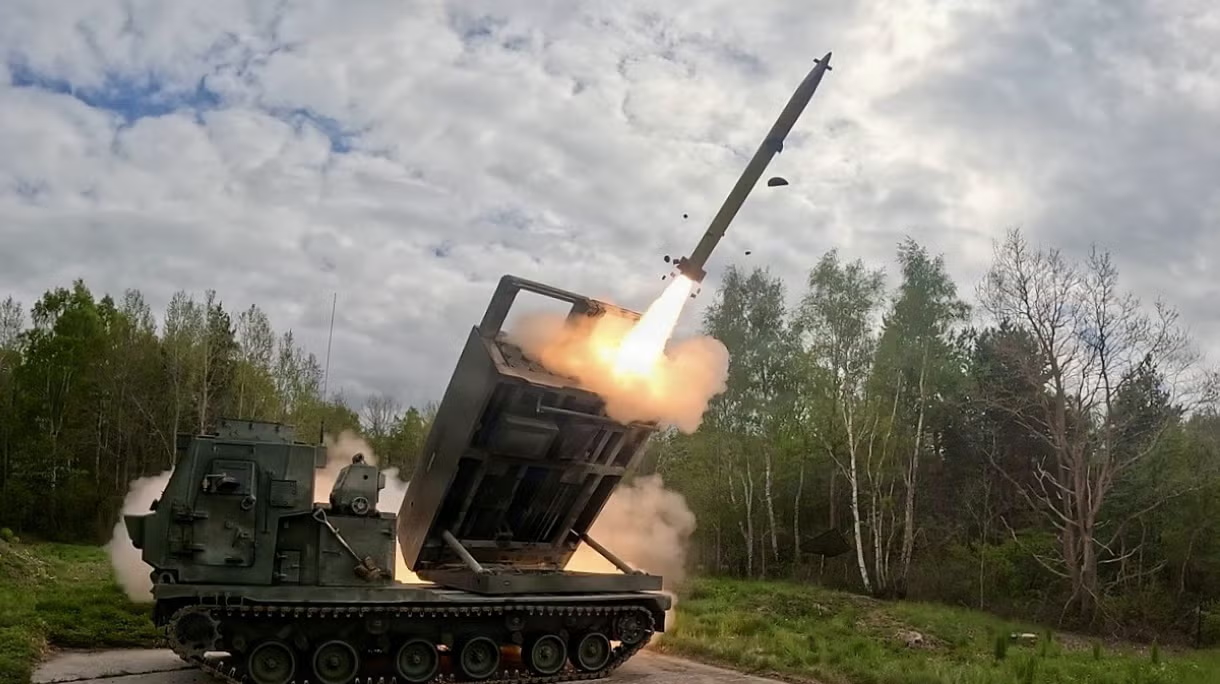
L3Harris Technologies has received a $250 million follow-on contract from Lockheed Martin to manufacture propulsion units for the standard-range Guided Multiple Launch Rocket System (GMLRS), the company announced on October 12, 2026. L3Harris says the order represents the highest GMLRS rocket motor quantity in program history, though it disclosed neither unit numbers nor a delivery schedule.
The award lands as the U.S. Army pushes GMLRS production well beyond peacetime rates. Prime contractor Lockheed Martin holds a $3 billion fiscal 2026 contract for standard and Extended-Range (ER) GMLRS rounds and has been ramping toward 14,000 rockets per year. In August 2026, the Army issued a sources-sought notice for 133,014 rockets through 2034, at 19,002 per year from 2028, roughly 36% above that capacity. Deliveries to Ukraine, where the rounds were fired from the M142 High Mobility Artillery Rocket System (HIMARS) and M270 Multiple Launch Rocket System (MLRS), drew down U.S. stocks.
How the GMLRS Rocket Motor Contract Fits L3Harris’ Camden Expansion
L3Harris will execute the order inside its new 60,000-square-foot Arsenal of Freedom facility in Camden, Arkansas, which the company says is scheduled to open later in 2026. It applies automation and robotics to each manufacturing stage. GMLRS production previously ran across three buildings; consolidation cuts motor travel distance by 80%, per the company. The facility was financed through a $215.6 million Defense Production Act Title III cooperative agreement signed in 2023, the year L3Harris acquired Aerojet Rocketdyne in a deal valued at roughly $4.7 billion.
The new award follows a December 10, 2025, contract valued at up to $200 million for GMLRS Insensitive Munition (IM) propulsion units, the first order slated for the Camden facility, which L3Harris said would lift annual capacity by more than 30%. The company now says it has doubled GMLRS motor output in recent years. Inert components come from its Huntsville, Alabama, plant; energetics work is concentrated in Camden.
“Securing this follow-on award at the highest quantity in program history demonstrates confidence in L3Harris’ missile propulsion expertise and our ability to deliver at scale,” said Scott Alexander, president of Propulsion Systems in the company’s Missile Solutions business. “With our investments to expand capacity ahead of need, we’re well-positioned to meet this surge while maintaining the quality our customers expect.”
Beyond the motor, L3Harris builds the GMLRS electronic safe-and-arm device and proximity sensor, and says it is the only producer of both steel- and composite-cased GMLRS motors, with more than 35,000 delivered. The GMLRS line is separate from the Arkansas Advanced Propulsion Facilities campus rising at the same site, a complex of more than 20 buildings for medium and large motors whose first buildings reach production teams in mid-2027.
Range, Warheads, and Guidance: What Standard-Range GMLRS Delivers
Publicly available specifications indicate the standard-range GMLRS round measures 227 millimeters in diameter and roughly 3.94 meters in length, with a launch weight of about 300 kilograms. Its solid rocket motor carries the round to engagement ranges of 15 to more than 70 kilometers, with Global Positioning System-aided inertial guidance and canard control delivering point-target accuracy.
Two warhead families share the same motor. The M31A1 and M31A2 Unitary carry a 200-pound-class blast-fragmentation warhead with a tri-mode fuze offering point-detonating, delay, and proximity settings. The M30A1 and M30A2 Alternative Warhead uses preformed tungsten fragments in place of cluster submunitions, delivering area effects without unexploded ordnance. The A2 variants adopt an insensitive munition propulsion system designed to resist unintended ignition from heat, shock, or adjacent detonations, a survivability gain for crews handling pods at forward ammunition points.
Each launch pod container holds six rockets; HIMARS carries one pod and the tracked M270A1 and M270A2 carry two, for 12 rounds per load. That commonality lets one motor line feed the Army, the Marine Corps, and a growing roster of allied operators.
The contract covers standard-range units only, not the ER GMLRS, which uses a larger motor and a redesigned airframe with tail control to push range beyond 150 kilometers. L3Harris is also not the sole motor source: Northrop Grumman builds IM-compliant GMLRS propulsion at Allegany Ballistics Laboratory in West Virginia and had delivered 15,000 motors by early 2023. Redundancy matters, since Russian GPS jamming in Ukraine degraded GMLRS effectiveness, which can raise the rounds needed per target.
Analysis: At $250 million, the award is modest next to the more than $6 billion THAAD propulsion contract L3Harris received on September 29, 2026, but GMLRS volume is a sharper test of industrial capacity. Reaching 19,002 rockets a year requires motor output to scale ahead of final assembly, and solid rocket motors, with long propellant cure cycles and a narrow pool of qualified energetics producers, remain the pacing item in U.S. munitions production. That logic drove the Department of War’s $1 billion investment in L3Harris’ Missile Solutions business, closed on April 23, 2026. The record order arrives before the facility built to fill it has opened, shifting the risk from funding to commissioning: any slip in qualifying the Camden line feeds directly into Lockheed’s delivery cadence.
The next milestone is the opening of the Arsenal of Freedom facility before year-end, followed by the first Arkansas Advanced Propulsion Facilities buildings in mid-2027. Industry responses to the Army’s August sources-sought notice will shape how the service structures future GMLRS buys. L3Harris has also pushed the planned Missile Solutions initial public offering to mid-2027, making GMLRS delivery performance a direct input to that valuation.