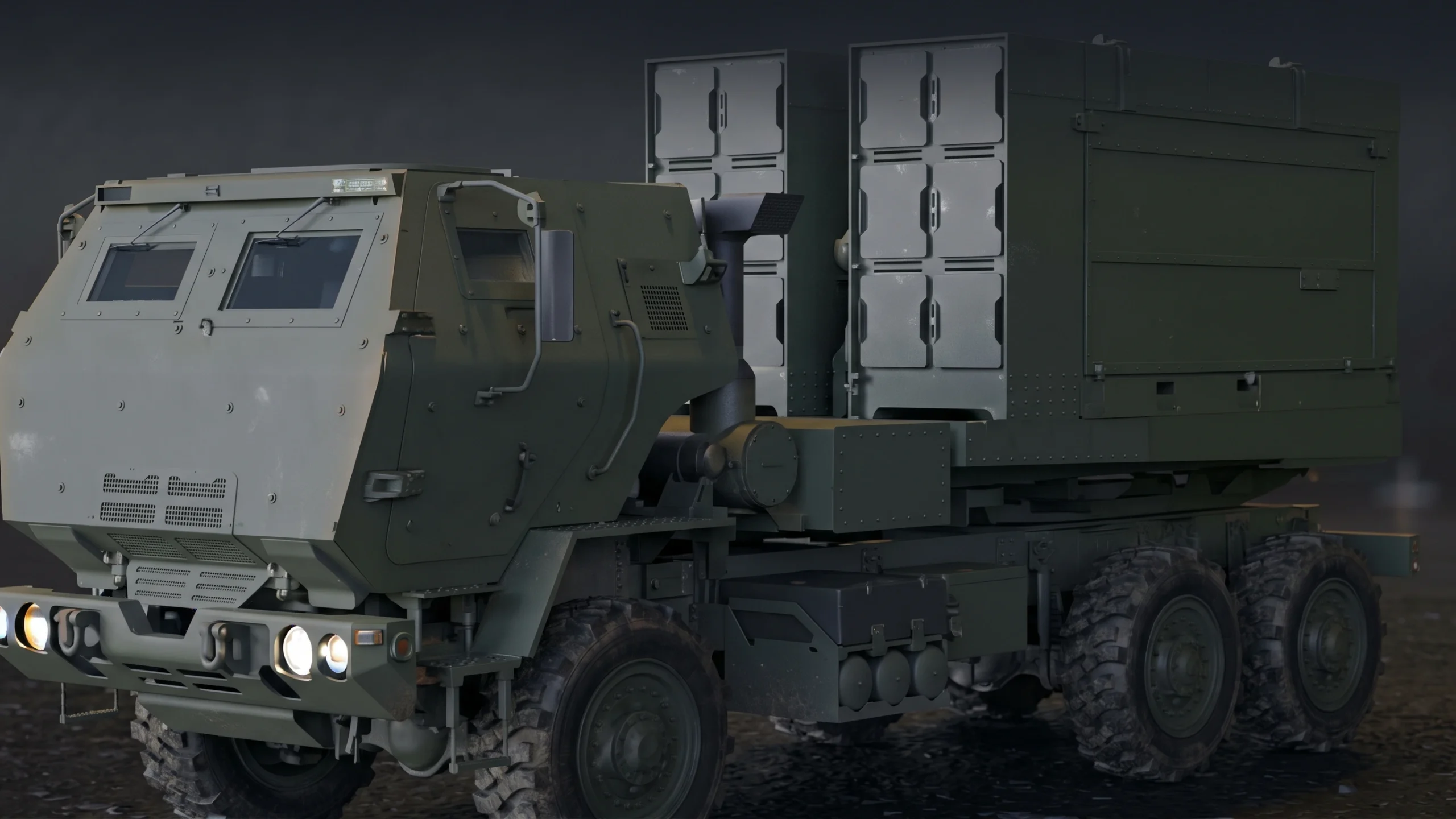
Lockheed Martin has named HIMARS FLEX, its dual-pod evolution of the M142 High Mobility Artillery Rocket System, as a planned launch platform for PAC-3 Edge, the Patriot-family interceptor it unveiled on October 9, 2026. The same day, the company released a video promoting “double the firepower,” and its latest messaging pitches FLEX as “one proven platform” with expanded munitions and autonomy options.
First shown at Eurosatory in Paris on June 16, 2026, HIMARS FLEX responds to two pressures. European armies are buying two-pod, multi-munition launchers such as Israel’s PULS and South Korea’s K239 Chunmoo, while demand for Patriot-family interceptors has pushed the Pentagon into an agreement to triple PAC-3 Missile Segment Enhancement (MSE) production over seven years. Lockheed says it has delivered more than 750 HIMARS launchers, over 540 of them in U.S. service, with more than 2.5 million operating hours logged worldwide.
HIMARS FLEX Dual-Pod Loadout: 12 GMLRS, Four PrSM, Eight PAC-3
The defining change is physical. The standard M142 carries a single launch pod holding six Guided Multiple Launch Rocket System (GMLRS) rounds, two Precision Strike Missiles (PrSM) or one Army Tactical Missile System (ATACMS). FLEX adds a second pod position. Carolyn Orzechowski, Lockheed Martin’s vice president for precision fires, launchers and missiles, said at Eurosatory that the loadout doubles to 12 GMLRS or Extended Range GMLRS (ER GMLRS), four PrSM or two ATACMS. In the air defense role, the same launcher carries eight PAC-3 interceptors or 12 or more Indirect Fire Protection Capability (IFPC) interceptors, according to the company.
That gives a wheeled, three-crew launcher the magazine of the tracked M270 Multiple Launch Rocket System, which has carried two pods since entering service in 1983. Publicly available specifications put GMLRS reach at roughly 70 km, ER GMLRS at about 150 km, ATACMS at up to 300 km and PrSM Increment 1 beyond 400 km, so the second pod doubles salvo weight from brigade close support out to theater-level strike.
The operational payoff is shot density per exposure. With reconnaissance drones and accelerated counterbattery chains covering the battlefield, crew survival depends on minimizing time at the firing point. Twelve rounds per displacement instead of six either halves the launchers pushed forward for a given effect or doubles the effect of each mission. The bill moves to logistics, with twice the pods to haul per resupply cycle. Lockheed has not disclosed dual-pod reload times, nor whether both positions can carry different munition types at once.
How PAC-3 Edge and IFPC Push HIMARS Into Air Defense
The more consequential shift is doctrinal. Through its FLEXFires technology suite, Lockheed is configuring the launcher to fire PAC-3 and IFPC interceptors, turning a long-range precision fires asset into a mobile air and missile defense effector. PAC-3 Edge builds on PAC-3 MSE with a new Lockheed-built seeker from the company’s Strigo Product Center, upgraded flight controls and a multi-pulse solid rocket motor supplied by Northrop Grumman. Lockheed says the interceptor is designed to engage air, missile and hypersonic threats at greater range and altitude, and to integrate with the Integrated Battle Command System (IBCS), the M903 Patriot launcher, containerized launchers and HIMARS FLEX.
PAC-3 Edge competes in the Army’s Future Interceptor program, where Lockheed is one of two firms advanced to the next stage. Flight testing is planned for 2027, with deployment targeted by 2031. Tim Cahill, president of Lockheed Martin Missiles and Fire Control, has said Edge would cost roughly the same as PAC-3 MSE and could reach about 2,000 units a year at full rate on the Camden, Arkansas, production line.
Hosting Patriot-family interceptors on HIMARS would spread lower-tier defense across a far larger fleet of air-transportable launchers than the semi-trailer M903. Lockheed has not said which PAC-3 variant fills the eight-round load or which IFPC interceptor its 12-round figure covers; the Army’s current Enduring Shield IFPC launcher fires the AIM-9X Sidewinder.
Chassis, Airlift, and Autonomy: What Lockheed Has Not Disclosed
Lockheed says FLEX remains C-130 transportable on the XM1140 chassis, the six-wheel Family of Medium Tactical Vehicles derivative that carries today’s HIMARS. Air mobility sits at the core of the concept: U.S. Army HIMARS Rapid Infiltration (HI-RAIN) drills routinely fly launchers into austere airfields aboard C-130 and C-17 transports to fire and re-embark. The company has not, however, published a combat weight for the dual-pod configuration, leaving open whether a fully loaded FLEX fits the C-130’s payload envelope or must fly with pods removed.
Autonomy is the least defined element. Lockheed lists optional autonomy and containerized variants alongside the single-pod baseline and dual-pod loadout as building blocks customers can select, but has not specified the level of autonomy on offer. The groundwork exists: the Army’s Autonomous Multi-domain Launcher (AML), an uncrewed M142 derivative, live-fired at Yuma Proving Ground in April 2024, and in June 2025 the Rapid Capabilities and Critical Technologies Office sought heavy and medium variants of a Common Autonomous Multi-Domain Launcher (CAML), a competition Lockheed said it would enter.
Analysis: HIMARS FLEX matters less as a heavier rocket launcher than as an attempt to make one wheeled chassis the common magazine for both offensive and defensive fires. The targeting dividend is real: an adversary can no longer treat a HIMARS signature as a purely offensive asset. The hardest problem is integration. Strike missions flow through the Advanced Field Artillery Tactical Data System, Patriot-family engagements through IBCS, and a dual-role launcher must sit credibly on both networks. Interceptor supply, not rails, remains the binding constraint. For European buyers weighing PULS and Chunmoo, FLEX’s strongest argument is munitions commonality with NATO GMLRS, PrSM, ATACMS and PAC-3 stocks.
Lockheed has announced no launch customer or U.S. Army contract for HIMARS FLEX, and both the dual-pod and air defense configurations remain developmental. The next markers are a live interceptor firing from the launcher, published weight and reload data, a first U.S. or export order, and PAC-3 Edge flight testing in 2027.