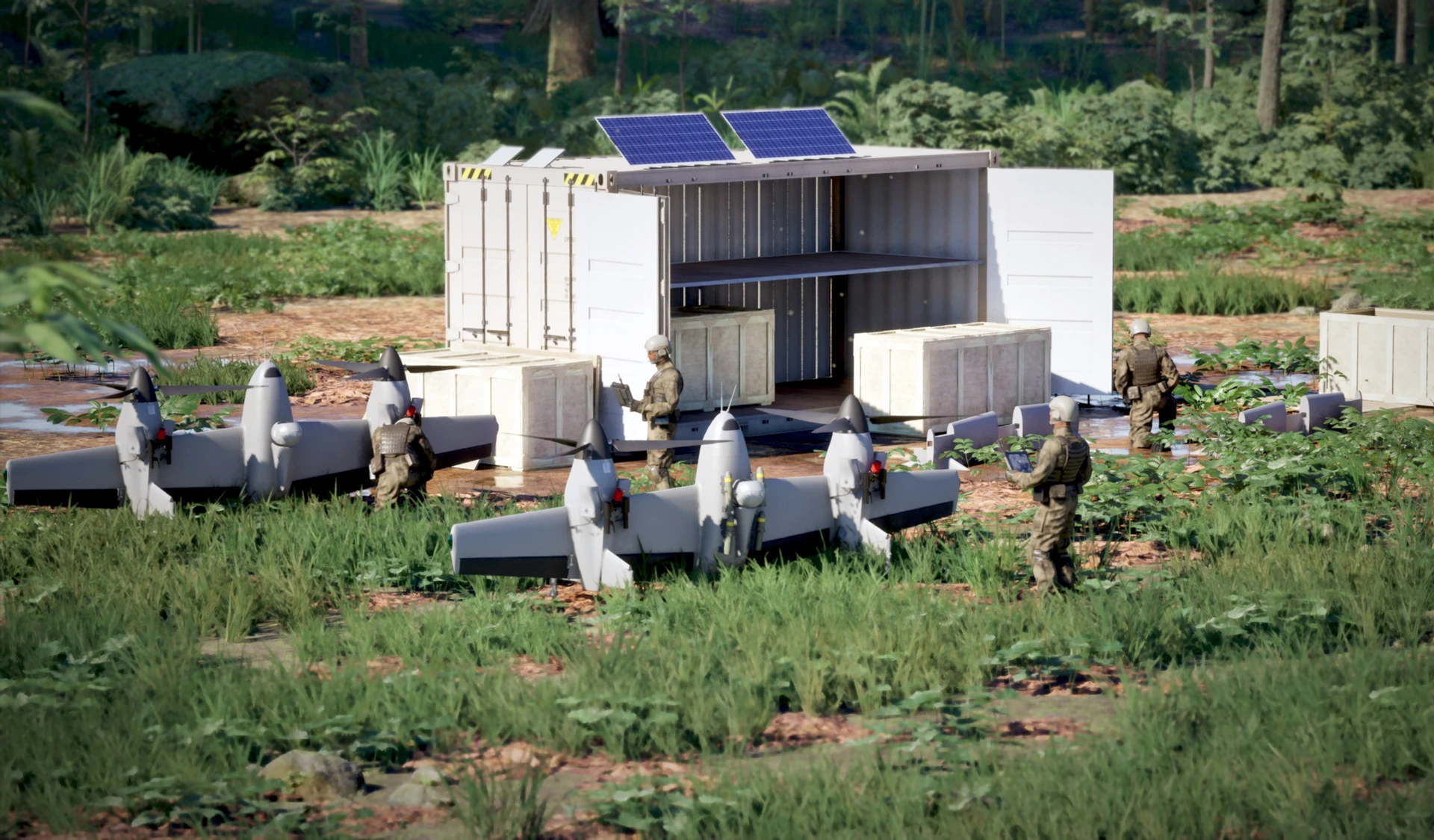
Sikorsky, a Lockheed Martin company, introduced the Nomad 100 fast pack on October 12, 2026, a containerized kit that houses four Nomad 100 vertical takeoff and landing (VTOL) uncrewed aerial systems (UAS), mission-command software, communications, power and sustainment equipment in a single 20-foot ISO container. In its planned configuration, two aircraft can be mission ready in less than 15 minutes, with the remaining two available within four to six hours, according to the company.
The announcement, issued in Washington on the opening day of the Association of the United States Army (AUSA) Annual Meeting, targets a market the Army has reshaped since 2024. The service retired the RQ-7B Shadow that year, cancelled the Future Tactical Uncrewed Aircraft System (FTUAS) competition in May 2025 under the Army Transformation Initiative, and has since pursued brigade-level Group 3 capability through a directed requirement favoring commercially available aircraft. Rich Benton, vice president and general manager of Sikorsky, framed the kit as an answer to military leaders “challenging industry to expand the inventory of uncrewed aircraft.”
How the Nomad 100 Fast Pack Deploys From a Single Container
The fast pack is built around mobility rather than a fixed site. Sikorsky says the container supports runway-independent launch from naval vessels, tactical vehicle staging areas and improvised landing zones, and that its integrated communications, power and sustainment equipment are designed to extend mission availability with reduced external support. Once a mission is complete, crews can repack the entire container, load it onto a compatible transport vehicle and move to a new site for follow-on operations. That profile mirrors characteristics the Army set for FTUAS before its cancellation: runway independence, on-the-move command and control and soldier-led field-level maintenance.
The staggered readiness timeline carries operational weight. Two aircraft ready in under 15 minutes would let a unit establish an initial intelligence, surveillance, reconnaissance and targeting (ISR-T) orbit shortly after arriving on site, while the second pair supports rotation for longer coverage. Sikorsky has not explained what drives the four-to-six-hour interval for the third and fourth aircraft, nor whether the 15-minute figure has been demonstrated or remains a design target.
Depending on customer configuration, the company lists ISR-T, light attack and contested logistics as fast pack missions. The release cites minimal personnel requirements but gives no operator or maintainer count, and it omits the container’s gross weight, approved transport vehicles, air-transportability and unit price. Rapid displacement matters because operations in Ukraine have shown that static drone launch points draw detection and counterfire; a kit that can be packed up and relocated addresses that risk, provided the repack cycle proves fast in practice.
Nomad 100 Rotor Blown Wing Design and DARPA EVADE Test Status
The Nomad 100 is a Group 3 aircraft with an 18-foot (5.5-meter) wingspan, built on Sikorsky’s rotor blown wing architecture. The tail-sitter takes off and lands vertically on two wing-mounted prop-rotors with an articulated rotor design, hovers like a helicopter, then pitches over to cruise on the wing. Sikorsky describes the Nomad family as predominantly hybrid-electric, with larger variants planned around a conventional drivetrain, but has not disclosed the Nomad 100’s engine, generator output or battery capacity.
Nor has the company published speed, endurance or payload figures. The aircraft was developed with Defense Advanced Research Projects Agency (DARPA) funding under the Early VTOL Aircraft Demonstration (EVADE) program, whose stated objectives call for aircraft under 330 pounds maximum gross weight achieving at least 12 hours of endurance at 100 nautical miles with a 60-pound payload. Those are program goals, not demonstrated Nomad 100 results. The design scales up from the Nomad 50, a 10.3-foot (3.1-meter) wingspan demonstrator whose extended flight testing Sikorsky announced in March 2025.
On July 22, 2026, Sikorsky said the Nomad 100 had completed initial ground and flight testing under EVADE and would move to an intensive flight test campaign at a government facility. AeroVironment, Griffon Aerospace, Karem Aircraft and Method Aeronautics also compete in EVADE, and DARPA selected Sikorsky’s MATRIX autonomy system for all five aircraft. According to Sikorsky, MATRIX interfaces with the Army’s Universal UAS Controller and the Marine Corps’ Marine Air-Ground Task Force (MAGTF) Agile Network Gateway Link (MANGL), easing integration with existing command and control. Company renderings have shown underslung stores and an electro-optical/infrared turret, but no integrated weapon has been identified.
Analysis: The fast pack shifts Sikorsky’s pitch from airframe performance, which remains unpublished, to deployability as a complete system. That framing tracks with what the Army sought after cancelling FTUAS: runway-independent Group 3 capability a brigade can field quickly and displace often, while the shipboard launch option and MANGL interface extend the case to Marine Corps distributed operations. The weakness is evidentiary. A container is only as valuable as the aircraft inside it, and until EVADE testing produces endurance and payload data, the fast pack competes on concept against designs such as Textron Systems’ Aerosonde and Griffon Aerospace’s Valiant, both invited in 2025 to compete for the Army’s brigade UAS requirement. Sikorsky’s hedge is MATRIX, which flies on every EVADE airframe regardless of which design transitions.
The next markers are results from the EVADE government test campaign, the first published Nomad 100 performance figures and any service order for a fast pack. Sikorsky has not named a launch customer or disclosed pricing, production rates or delivery timelines. Those numbers, more than the packaging, will determine whether the kit moves from a company rendering to a brigade motor pool.