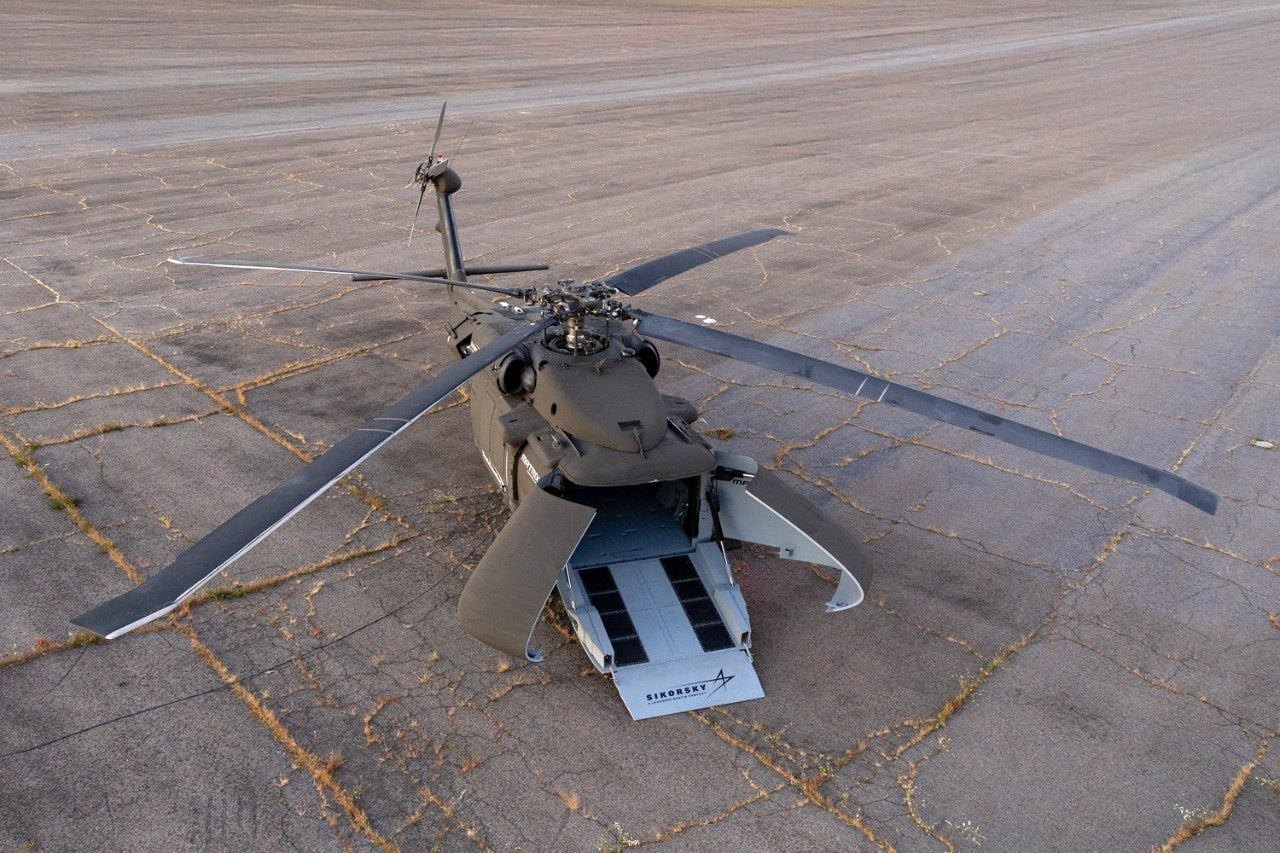
Sikorsky’s S-70UAS U-Hawk, the cockpit-less Black Hawk the Lockheed Martin subsidiary unveiled at the Association of the United States Army (AUSA) exposition on October 13, 2025, is still on the ground and without a publicly announced customer. The prototype, converted from a used UH-60L, is in Sikorsky’s innovations hangar in Bridgeport, Connecticut, for final fly-by-wire and autonomy integration, with first flight now planned before the end of 2026. AUSA 2026 opens today, October 12, and runs through October 14.
The timeline matters because Sikorsky sold the U-Hawk on speed. The company took the airframe from concept to prototype in 10 months on internal research funds, and in November 2025 officials pointed to flight testing by mid-2026, production by year-end and first deliveries in 2027. The mid-year flight target has passed. Meanwhile, the Army’s Black Hawk roadmap has shifted under the Army Transformation Initiative (ATI), with the service signaling its next UH-60M multiyear buy would be its last as the MV-75 long-range assault aircraft approaches fielding.
Sikorsky U-Hawk Design: Clamshell Nose, Fly-by-Wire and MATRIX Control
The conversion strips the cockpit, seats and crew stations and replaces the nose with actuated clamshell doors and a ramp, opening a hold with 25 percent more volume than a standard Black Hawk cabin. Conventional controls give way to a third-generation, low-cost fly-by-wire system running Sikorsky’s MATRIX autonomy suite, matured under the Defense Advanced Research Projects Agency (DARPA) Aircrew Labor In-Cockpit Automation System (ALIAS) program. One operator commands the aircraft from start-up to shutdown via tablet while MATRIX plans the route and handles navigation and obstacle avoidance.
Sikorsky rates internal payload above 7,000 lb (3,175 kg), retains the 9,000 lb (4,082 kg) external hook, and claims a self-deployment range beyond 1,600 nautical miles or 14 hours of endurance with internal auxiliary tanks. Advertised loads include a six-round High Mobility Artillery Rocket System (HIMARS) pod, two Naval Strike Missile canisters, a cabin-mounted quiver of launched effects, and uncrewed ground vehicles such as the HDT Hunter Wolf 6×6 driving on and off the ramp. Nothing in Sikorsky’s disclosures indicates a change to the twin T700-GE-701C turboshafts that publicly available specifications list for the UH-60L, so the prototype carries none of the power margin of the Army’s new engine. The design targets contested logistics: moving fuel, munitions and drones where the threat would otherwise expose a four-person crew.
Mid-2026 Target Missed: U-Hawk Flight Schedule and Contract Status
The schedule has moved right in steps. In March 2026, executives said they were completing the first aircraft, alongside the Nomad 100 drone and HEX hybrid-electric demonstrator, all aimed at 2026 flights. Last week, Jason Wrigley, Sikorsky’s director of business development for Black Hawk, said the team had spent the year adding fly-by-wire and MATRIX to the AUSA 2025 show aircraft, with first flight planned later this year.
No U-Hawk development or procurement contract has been publicly announced by the Army, another US service or a foreign government. Sikorsky’s pitch leans on supply: Wrigley pointed to Black Hawks now being divested as conversion candidates, and at the November 2025 Dubai Airshow the company offered Gulf operators conversions with local industry participation. Foreign conversions require an export license for MATRIX, which Sikorsky said it was pursuing; its status is undisclosed.
The Army’s Black Hawk autonomy funding has gone to a different configuration. The service accepted the UH-60MX on March 20, 2026, its first full-authority fly-by-wire, optionally piloted UH-60, which the Combat Capabilities Development Command (DEVCOM) is using to build tactics, techniques and procedures. Sikorsky says it has since won a contract for three more MX aircraft, value undisclosed. MATRIX has logged more than 1,000 flight hours across some 500 tests on over 20 platforms.
Black Hawk Next: T901 Engines, Modular Nose and Digital Backbone
The U-Hawk sits within Black Hawk Next, Sikorsky’s UH-60M follow-on built on four pillars: the GE Aerospace T901 from the Army’s Improved Turbine Engine Program (ITEP), airframe enhancements, a digital backbone, and MATRIX autonomy to host launched effects. The T901 delivers about 50 percent more shaft power than the T700. A twin-T901 UH-60M first flew in May 2025; by April 2, 2026, it had logged 22 flights, 29.7 flight hours and 39.7 ground test hours up to 17,000 ft, and Sikorsky now cites more than 50 flight hours. An ITEP Milestone C production decision is expected within about two years.
Airframe work includes metallic upgrades to raise maximum gross weight, a main fuel cell enlarged 30 percent for roughly 100 nautical miles of added range without shrinking the 11-troop cabin, and a modular nose with more than twice the original internal volume for sensors and drone-control hardware. Sikorsky puts the combined payload gain above 1,000 lb. The production line, meanwhile, received a $234.5 million undefinitized modification on September 17, 2026, for 16 UH-60Ms, bridging past the current multiyear contract ending in late 2027.
Analysis: The U-Hawk’s slip is modest on the calendar but telling in the market. A year after its debut, the only Army money publicly tied to Black Hawk autonomy funds the optionally piloted UH-60MX, which keeps the cockpit and lets commanders fly with two, one or zero pilots. The service appears to be buying autonomy first as a workload and risk tool, before committing to an airframe that cannot revert to crewed flight. The U-Hawk’s strongest argument is economic: divested UH-60A and L airframes with established sustainment chains could seed an uncrewed logistics fleet sized for Indo-Pacific distances. Until the prototype flies and Sikorsky discloses a conversion price, that case remains unproven.
First flight before December 31, 2026, is the near-term marker. Beyond it, watch for an Army experimentation contract or requirement for an uncrewed cargo Black Hawk, an export license decision on MATRIX, DEVCOM findings from the UH-60MX campaign, and the ITEP Milestone C decision. Conversion cost, production rate and a launch customer all remain undisclosed as AUSA 2026 opens.