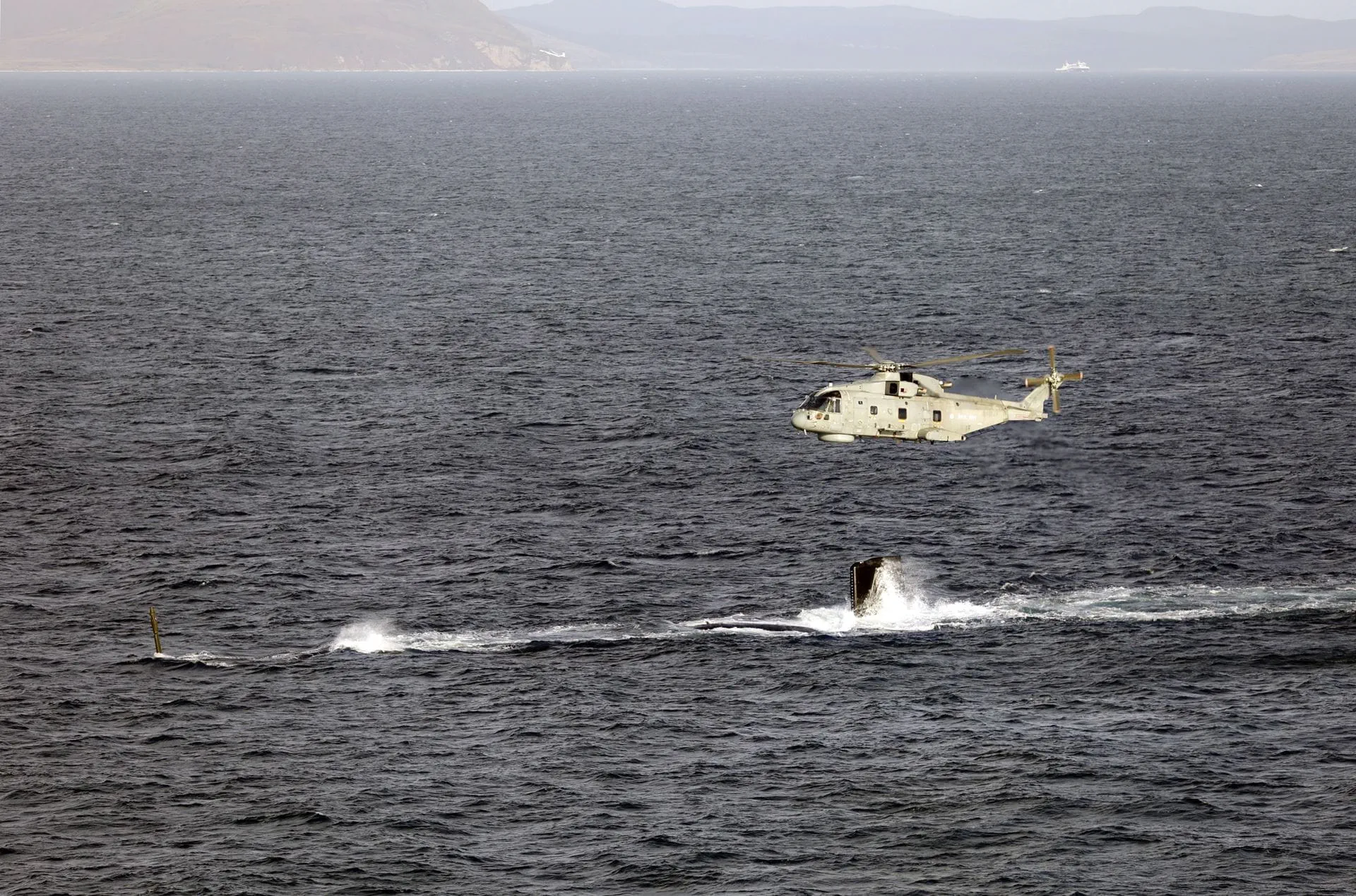
Four Royal Navy Merlin Mk2 anti-submarine helicopters and around 90 sailors deployed at short notice from Royal Naval Air Station (RNAS) Culdrose in Cornwall to HMS Gannet at Glasgow Prestwick Airport in Scotland under Operation Iceblast, a readiness test built around protecting the UK submarine force on the Clyde, the Royal Navy announced on October 14, 2026. Crews from 814 and 824 Naval Air Squadrons (NAS) escorted the new attack submarine HMS Agamemnon, supported a NATO exercise and flew North Atlantic surveillance tasks over roughly two weeks.
The surge comes as Russian naval activity around British waters keeps rising. The Ministry of Defence (MoD) says Royal Navy units were activated 116 times in 2025-26 to shadow 61 Russian warships and 28 merchant vessels in the UK Exclusive Economic Zone, and activations rose 25% year-on-year over the first seven months of 2026. HM Naval Base (HMNB) Clyde at Faslane hosts the Vanguard-class ballistic missile submarines carrying the UK nuclear deterrent, whose protection falls under Operation Ceto, the Navy’s standing anti-submarine mission in the North Atlantic. The Navy says deployments such as Iceblast keep its crews ready to support that deterrent.
Royal Navy Merlin Mk2 Dipping Sonar Tracks HMS Agamemnon Dive Trials
The crews oversaw Agamemnon’s first arrival at HMNB Clyde on October 2, 2026, a week after the sixth of seven Astute-class boats left BAE Systems’ Barrow-in-Furness yard to begin sea trials. They then tracked her with dipping sonar during dive trials, giving aircrew a live, modern nuclear-powered target while the boat worked up under airborne escort.
The Merlin Mk2 is the Navy’s dedicated anti-submarine warfare (ASW) helicopter, a Leonardo AW101 airframe with a Lockheed Martin UK mission system. Thirty HM1s were converted under the £750 million Merlin Capability Sustainment Programme, reaching initial operating capability in June 2014 with a digital cockpit, an electro-optical camera and multi-static sonar processing.
Publicly available specifications indicate the primary sensor is the Thales FLASH (Folding Light Acoustic System for Helicopters) active dipping sonar, paired with an AQS-903 acoustic processor for sonobuoy fields, the Blue Kestrel 5000 maritime surveillance radar and the Orange Reaper electronic support measures suite. The aircraft carries up to four Sting Ray lightweight torpedoes or Mk11 depth charges. Three RTM322 turboshafts rated at about 2,100 shp each for take-off give the 14,600 kg (maximum take-off weight) airframe a cruise speed of about 150 knots. On an active dipping mission at a 50-nautical-mile radius, internal fuel allows roughly 190 minutes on station with a 20-minute reserve.
That station time translates directly into coverage of the Clyde approaches, and the three-engine layout preserves a power margin if one engine fails in a low night hover over cold water, an edge over the twin-engine US Navy MH-60R Seahawk, whose AN/AQS-22 dipping sonar belongs to the same Thales product family as FLASH. The fleet’s out-of-service date now runs to 2040, backed by a planned radar replacement.
Operation Iceblast Tests Dispersed ASW From HMS Gannet During Strike Warrior
HMS Gannet has served as a Fleet Air Arm forward operating base since Royal Navy search and rescue flying there ended in 2016. It sits about 40 miles from Faslane, while Culdrose lies roughly 380 miles to the south. Captain James Hall, Commanding Officer of RNAS Culdrose, said the deployment assessed whether the air station could deploy and sustain ASW operations away from its home base near Helston, including the logistics and command-and-control load of a dispersed site in demanding conditions, while operating across several locations at once.
The detachment also flew in Exercise Strike Warrior, the UK Commando Force exercise that ran across Scotland from September 28 to October 9, 2026, with more than 2,000 personnel from the UK, the Netherlands, Canada, Germany, Norway and the United States, plus eight warships and 19 aircraft. The Merlins held search and rescue watch for Royal Marines practising boarding operations with the German Navy supply ship FGS Berlin, and worked alongside Norwegian and German units. Further sorties focused on continuous monitoring of strategic areas of the North Atlantic; the Navy has not disclosed sortie counts, flight hours or operating areas.
In parallel, a team from 700X NAS, the Navy’s remotely piloted air systems unit at Culdrose, flew drones to add a security layer around the Clyde; the Navy has not named the systems used. Hall said the operation showed the force can “deploy at short notice and deliver warfighting readiness from a forward location,” and that it reinforced support to NATO alongside Norwegian partners and to the nuclear deterrent.
What Operation Iceblast Reveals About Merlin Mk2 Fleet Capacity
Analysis: Iceblast committed four of the Navy’s 30 Merlin Mk2 airframes, about 13% of a fleet that also covers carrier ASW, frigate flights and the Crowsnest airborne surveillance role, and drew on crews from 824 NAS, the Merlin training squadron. The Navy can generate a credible homeland ASW surge, but partly by reaching into its training pipeline. Until Atlantic Bastion’s uncrewed sensors and the joint fleet of at least 13 Type 26 frigates the UK and Norway agreed to operate under the December 2025 Lunna House Agreement arrive in number, crewed helicopters flying from a base 40 miles from Faslane remain the fastest way to thicken the screen around the deterrent.
The Navy says lessons from Iceblast will feed future procedures and training but has not said whether the deployment will recur. Agamemnon now enters sea trials and operational preparation, while BAE Systems completes HMS Achilles, the last Astute-class boat. For the Merlin force, the next markers are obsolescence work under the Out of Service Date Extension Programme and the first Atlantic Bastion capabilities the MoD plans to put in the water in 2026.