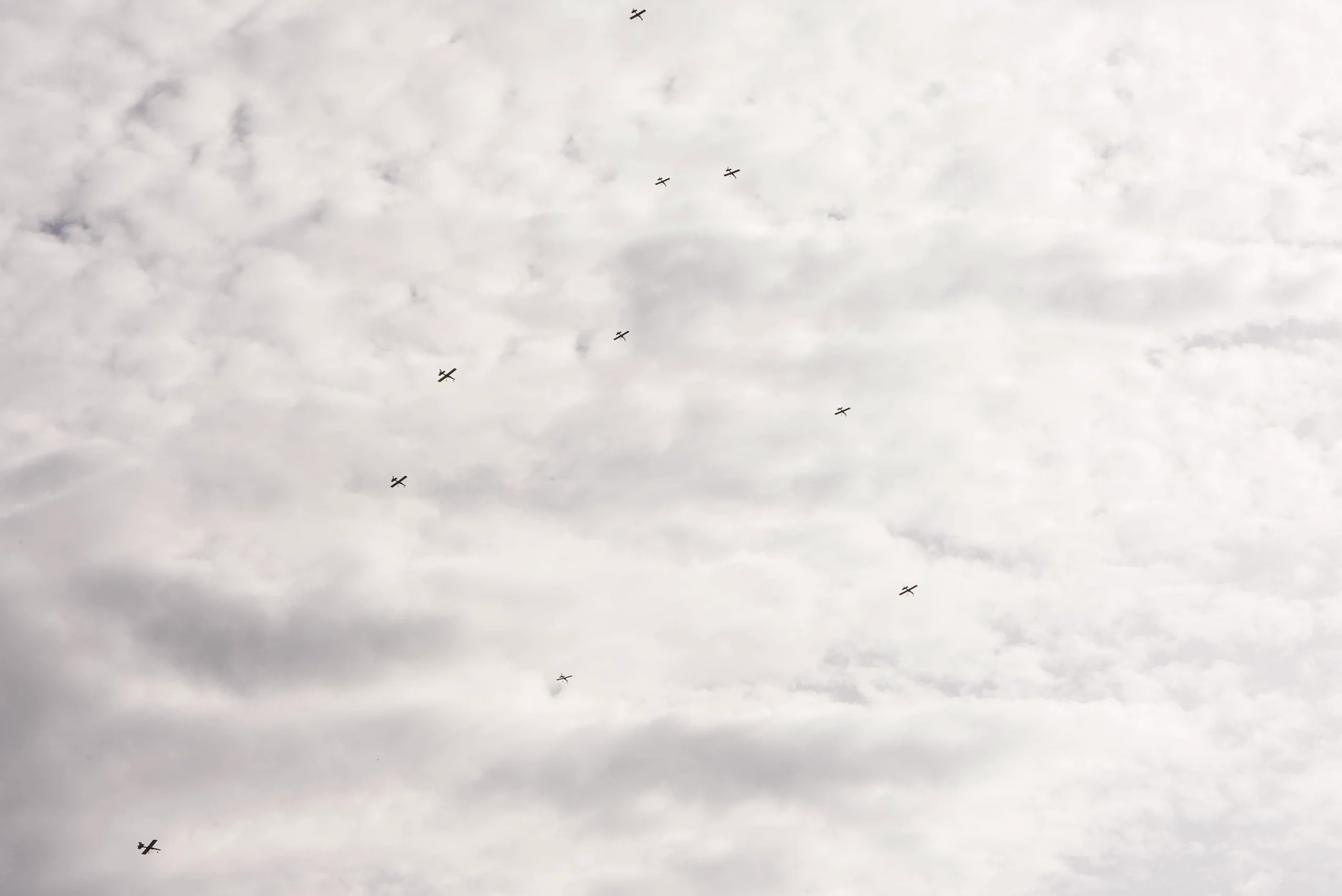
Baykar’s unmanned systems flew a coordinated swarm, sensor and precision-strike demonstration at Türkiye’s Ateş Serbest-2026 live-fire exercise near Polatlı, Ankara, on October 13, 2026. Five K2 Kamikaze unmanned aerial vehicles (UAVs) controlled a swarm of 20 Sivrisinek smart loitering munitions, 10 of which broke away and hit designated targets in a salvo dive, while two Akıncı unmanned combat aerial vehicles (UCAVs) and a Bayraktar TB2 conducted radar detection and guided-munition strikes.
Ateş Serbest is the Turkish Armed Forces’ firepower demonstration, held at the General Nahit Şenoğul Firing and Exercise Area. The 2026 edition opened on September 1 and runs to October 22. On the October 13 distinguished observers’ day, attended by Defense Minister Yaşar Güler, units from the Land, Naval and Air Forces and the General Staff Special Forces Command displayed 104 weapons and systems and fired 93, against 50 fired in 2025. Fifty-three were used for the first time in the exercise.
How K2 Relays Steered a 20-Munition Baykar Drone Swarm
According to Baykar, the five K2s provided in-flight control and coordination of the Sivrisinek swarm through a link established with the ground control station. The K2s served as airborne control nodes, not strike weapons.
That role extends reach. Baykar rates the fire-and-forget communication range of the Sivrisinek-UM above 10 km and that of the camera-equipped UMX above 80 km, and names the TB2, TB3 and Akıncı as relay aircraft. The K2 carries a line-of-sight datalink rated beyond 100 km plus an optional beyond-line-of-sight (BLOS) channel, shifting the relay function onto an airframe Baykar designed for low-cost mass production.
Publicly available specifications credit the 800 kg K2 with a warhead of up to 200 kg, a range above 2,000 km, more than 13 hours of endurance and visual navigation for flight without global navigation satellite system (GNSS) signals. Baykar unveiled it in March 2026; no Turkish Armed Forces order has been publicly announced.
The catapult-launched Sivrisinek carries a 20 kg warhead at a 55-knot cruise speed. The 76 kg UM version offers 1,000 km of range with GNSS terminal guidance, while the 78 kg UMX trades 100 km of range for an electro-optical (EO) terminal seeker. Baykar flew 10 Sivrisineks beneath a K2 formation at its Keşan test center earlier in 2026; Polatlı doubled that count.
The Bayraktar Kalkan vertical takeoff and landing (VTOL) UAV handled target detection, tracking and control with Baykar’s BG-180 3E three-axis stabilized EO system, used for the first time. The hybrid Kalkan, which pairs four electric lift motors with a combustion engine for cruise, offers six hours of endurance and a communication range of about 100 km, according to published specifications.
Akıncı Pairs MURAD AESA Radar With Four Precision Munition Types
The first of two Akıncı UCAVs, a Turkish Armed Forces inventory aircraft, struck designated targets with Roketsan’s TEBER guidance kit, ASELSAN’s TOLUN glide munition, and Roketsan’s TV-guided MAM-L and MAM-T. The second launched from Baykar’s Çorlu flight test facility in Thrace, roughly 400 km from Polatlı, and detected air and ground targets with ASELSAN’s MURAD active electronically scanned array (AESA) radar.
The loadout spans the Akıncı’s engagement envelope. TEBER converts Mk-81 and Mk-82 general-purpose bombs into dual laser- and GPS-guided weapons. The MAM-L TV replaces the laser or GNSS guidance of the 15 km baseline MAM-L with an optical seeker capable of fire-and-forget engagement, using the launch aircraft as a relay to the ground station; it offers a longer range than the baseline, though no figure has been published. The 95 kg MAM-T reaches beyond 30 km from UAVs, while TOLUN is rated beyond 110 km from fighter aircraft; its range from the slower Akıncı is unpublished. Baykar did not specify the MAM-T seeker variant.
The MURAD 100-A, a gallium nitride (GaN) AESA developed for the Turkish Air Force’s F-16 Özgür upgrade, first flew on the Akıncı in early 2025. ASELSAN has not published detection ranges. On a platform Baykar credits with a 1,500 kg payload, a 40,000 ft service ceiling and more than 20 hours of endurance, the radar adds wide-area cueing that narrow-field EO sensors cannot provide, particularly through cloud cover.
Kemankeş 1 Mini Cruise Missile Fired From an Inventory TB2
A Turkish Armed Forces TB2 launched a Kemankeş 1 artificial intelligence (AI)-based mini cruise missile that struck its target, one of the 53 systems used for the first time at the exercise.
Baykar lists the jet-powered Kemankeş 1 at a 45 kg maximum takeoff weight with a 10 kg payload, a 100 km operational range, 20 minutes of endurance and a maximum speed of 175 knots indicated airspeed (KIAS). An AI-assisted EO camera with 36x optical zoom supports terminal guidance by EO or GNSS, with a communication range above 70 km. Figures published in 2023 cited a 30 kg airframe, a 6 kg warhead, a range above 200 km and one hour of endurance, so the data remains manufacturer-reported and has shifted through development.
The operational payoff is standoff. The TB2’s standard laser-guided MAM-L engages at about 15 km, inside the reach of many short-range air defense systems. A 100 km weapon lets the TB2, which carries two Kemankeş rounds, hold targets at risk from far outside those envelopes.
Analysis: Polatlı showed Baykar marketing an architecture rather than an airframe: Kalkan for target custody, an AESA-equipped Akıncı for wide-area detection, a TB2 with a 100 km cruise missile, and an expendable K2 and Sivrisinek layer for mass. The K2 relay role is the doctrinally notable element because it sustains swarm control without exposing a TB2 or Akıncı in contested airspace. The limits are equally clear: a scripted range event, manufacturer-reported figures and no disclosed jamming against the swarm. Until a procurement decision follows, the K2 and Sivrisinek swarm remains a company demonstration rather than a fielded Turkish capability.
Ateş Serbest-2026 activities continue until October 22. The decision points to watch are a Turkish Armed Forces contract for the K2 or Sivrisinek, MURAD 100-A integration across the Akıncı fleet, Kemankeş 1 delivery quantities for TB2 units, and any swarm trial under active jamming. Baykar has not released specifications for the BG-180 3E system.