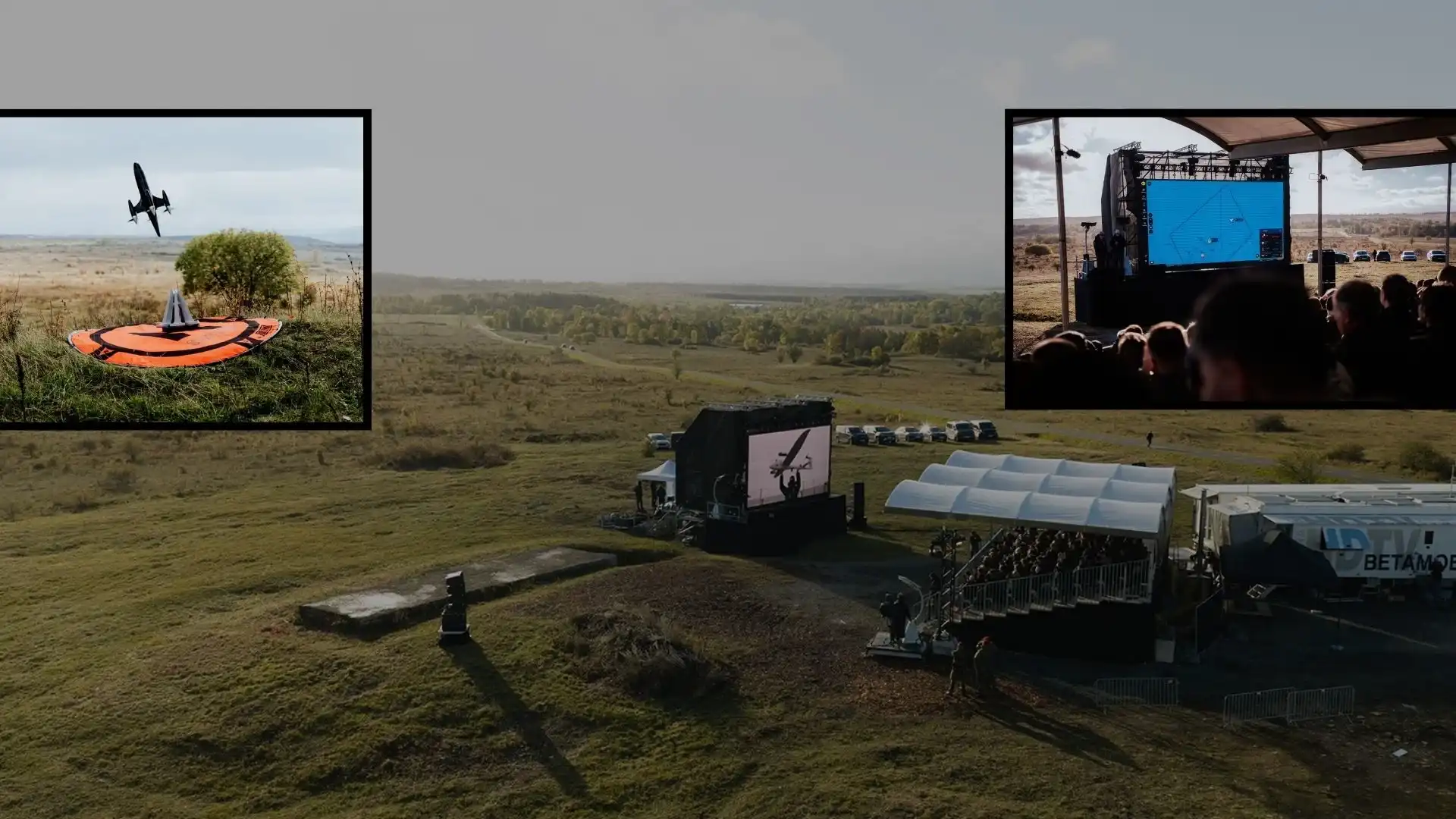
Quantum Systems has concluded Forward Edge 26, a two-week, company-run exercise at a military training area in central Germany that placed unmanned air, ground, maritime and counter-drone systems from the company, nine partner firms and two of its German-Ukrainian joint ventures under a single command layer, its MOSAIC UXS software suite. The Munich-based firm announced the results on October 22, 2026, including remote piloting of systems on three continents.
The exercise caps a year in which Quantum Systems, known for the Vector reconnaissance drone in Ukrainian service since 2022, has pushed into every other domain. It unveiled the Mandrill unmanned ground vehicle (UGV) at Enforce Tac in February 2026, launched the Seavex unmanned surface vessel (USV) and Subvex unmanned underwater vehicle (UUV) on the sidelines of the Portuguese Navy-led REPMUS exercise off Sesimbra, Portugal, on September 14, 2026, and secured German funding for Ukraine-built interceptor drones developed by Quantum WIY Industries, part of its German-Ukrainian production network. Forward Edge 26 served as a field test of whether that portfolio, plus third-party hardware, can operate as one force package.
Four Forward Edge 26 Scenarios, From Base Defense to Route Clearance
The first scenario, Unmanned Defence Operations, ran persistent surveillance over a defensive position. Sensors detected simulated enemy reconnaissance and attack elements, which counter-unmanned aircraft systems (counter-UAS), strike assets and UGVs then engaged. The second, Convoy and Force Protection, paired wide-area reconnaissance with route monitoring ahead of an unmanned convoy, covered by laser-based counter-UAS effectors whose supplier was not named.
Partner Daimler Truck already supplies the Zetros chassis that Quantum Systems fits with its MOSAIC Ground Autonomy Kit; 10 such trucks and 10 Mandrill UGVs are covered by a contract announced in July 2026 under Ukraine’s research and development program, for frontline trials with the National Guard. The company did not say which vehicles formed the convoy. Publicly available specifications for Mandrill list a top speed of 100 km/h, a payload above 750 kg and an electric range of up to 200 km.
Scenario Three, Sea and Port Protection, linked aerial and maritime systems for coastal surveillance, threat identification and coordinated response. Given the inland training area, the release leaves open where the maritime serials ran and whether Seavex and Subvex took part. Company figures give Seavex an endurance of up to two months and the ability to launch and recover drones, while Subvex is rated to 6,000 m depth. Scenario Four, Minelaying and Route Clearance, combined aerial overwatch, ground systems and effectors in sequences the company says reproduce real examples from its operations in Ukraine.
The exercise also included remote piloting of systems physically located in Ukraine, the United States and Australia, three countries where Quantum Systems runs production sites. The company has not disclosed the communications architecture, latency or control authority used for those links.
How MOSAIC UXS Connects Multi-Vendor Unmanned Systems
The central claim of Forward Edge 26 concerns software rather than airframes. Chief Revenue Officer Martin Karkour called it “an entirely unmanned exercise, software orchestrated through MOSAIC UXS.” Quantum Systems launched the suite on June 4, 2025. According to the company’s technical data sheet, it is free of International Traffic in Arms Regulations (ITAR) restrictions and uses a driver-based integration model with open gRPC interfaces. It supports PX4, ArduPilot and proprietary autopilots, Robot Operating System 2 (ROS 2) and MAVLink protocols, and radios from Silvus, DTC and Doodle Labs alongside satellite and 4G/5G links. The sheet lists connectors to SitaWare, the Android Team Awareness Kit (ATAK) and Palantir Maven, retains a human-in-the-loop override, and sets no fixed limit on systems managed simultaneously, a claim Forward Edge 26 did not quantify.
That driver model lets a manufacturer join the network without disclosing proprietary intellectual property, a point the company has stressed since launch. Forward Edge 26 put it to work with a partner list that also included Volkswagen, Frontline Robotics, Ground A, Planet, Wolf Radar, Reactive Dynamics, Tencore and XTEND. Some of that hardware is already in serial production. Quantum Tencore Industries is building 2,000 TerMIT tracked UGVs, each rated for up to 300 kg of payload, for Ukraine under a German Defense Ministry-funded order announced on June 19, 2026, and TerMIT is already integrated into MOSAIC UXS. Quantum Frontline Industries builds Frontline Robotics’ Linza and Zoom drones in Germany for Ukraine’s National Guard.
Analysis: Forward Edge 26 was a vendor-run demonstration against scripted, simulated opposition, with no engagement data, system counts or independent assessment released. By staging a multi-domain event under its own software layer, the company is positioning MOSAIC UXS as the integration backbone for European unmanned forces, consistent with the “neo-prime” label it now applies to itself. For the Bundeswehr and other NATO buyers, the operative question is whether a single command and control (C2) layer can absorb competing vendors’ hardware without lock-in. If the driver-based model holds up under military evaluation, ownership of the software stack, rather than any single platform, becomes the main competitive asset in the European drone market.
Quantum Systems says the results will feed further development, integration and operational validation. Nearer-term milestones are industrial, including a fivefold capacity increase at Quantum Frontline Industries for 2027 and TerMIT deliveries, scheduled over the 12 months following the order’s June 2026 announcement. The open question is whether any national armed force will put MOSAIC UXS through its own trials or adopt it as a program of record.