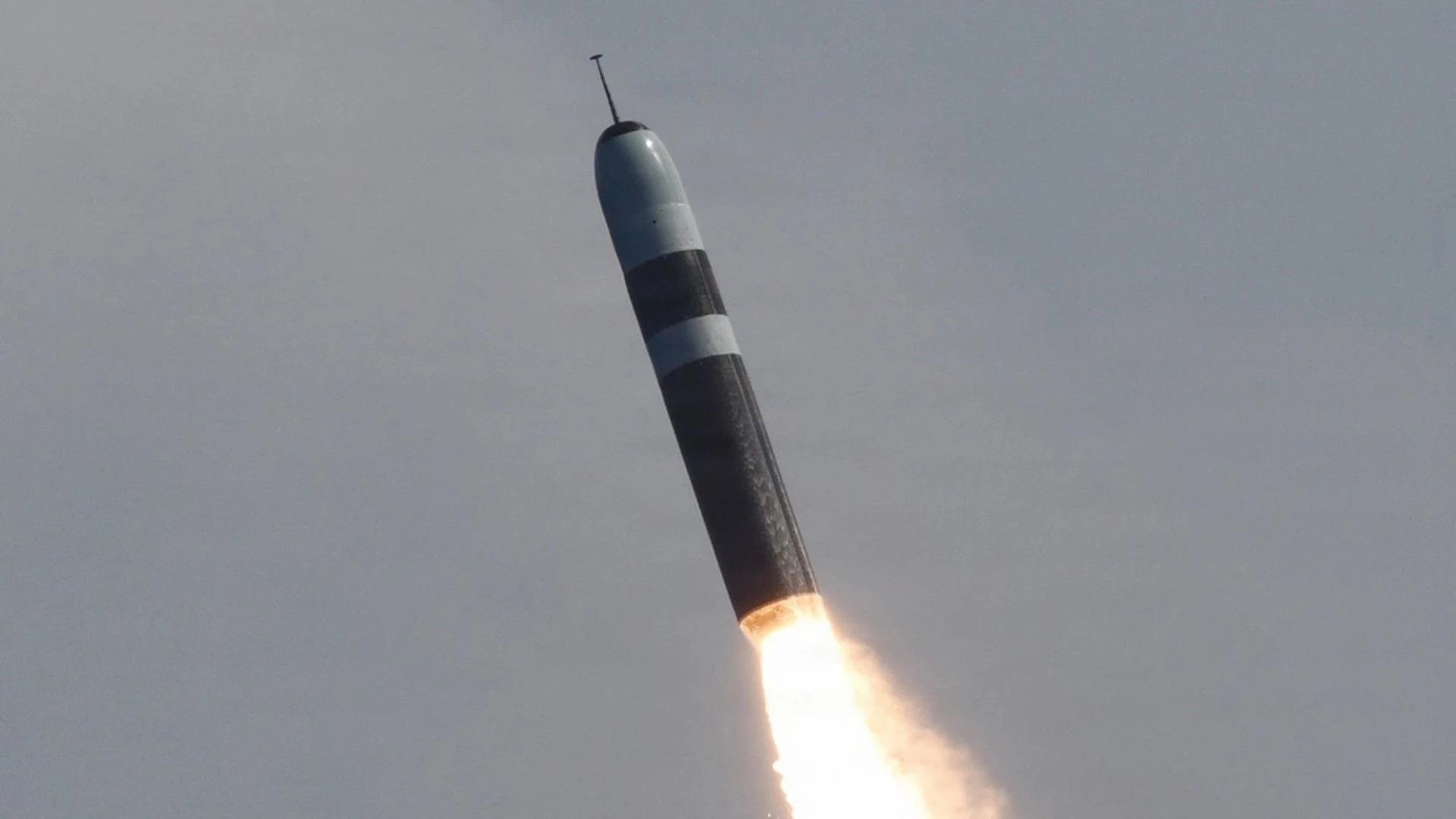
The U.S. Navy has awarded Northrop Grumman Systems Corp. a $43,856,500 firm-fixed-price contract (N00030-27-C-2002) to support the design of new rocket motor dry and grind production facilities and equipment at the Naval Industrial Reserve Ordnance Plant (NIROP) in Magna, Utah, the Pentagon announced on October 23, 2026. The work supports the Trident II D5 Strategic Weapon System, the submarine-launched ballistic missile (SLBM) that arms the Navy’s Ohio-class ballistic missile submarines (SSBNs), and runs through August 31, 2028.
The contracting activity is the Navy’s Portfolio Acquisition Executive Strategic Systems Programs (PAE SSP). Its predecessor organization, Strategic Systems Programs, announced in October 2025 its intent to negotiate a separate sole-source contract with Northrop Grumman for capital maintenance of the Navy-owned facilities at the plant. The new award lands as the Trident II D5 Life Extension 2 (D5LE2), past its Milestone B decision in mid-2025, moves through engineering and manufacturing development toward a planned fleet introduction in fiscal 2039.
How Dry and Grind Lines Feed Trident II D5 Rocket Motor Production
Dry and grind operations sit at the front of the solid rocket motor production chain. In composite propellant manufacturing, crystalline oxidizer, principally ammonium perchlorate, is dried to strip residual moisture, then milled to controlled particle sizes before it is mixed with fuel and binder and cast into motor cases. Particle size governs propellant burn rate, which sets the thrust-time profile of each stage. Grinding fine oxidizer is also among the most hazardous steps in an energetics plant, driving remote operation, blast-rated construction and explosive safety separation distances.
The announcement does not specify which ingredients the new lines will process, their planned throughput, or whether they replace existing equipment. The contract also covers design only; construction and equipment procurement would require separate funding actions that have not been announced.
Those lines feed a three-stage, solid-propellant, inertially guided missile that is ejected from its launch tube by expanding gas and ignites its first stage once it broaches the surface. Navy figures put the Trident II D5 at 44 feet long, 83 inches in diameter and 130,000 pounds, with a range of 4,000 nautical miles. Publicly available descriptions of the D5 motors cite a nitrate ester plasticized polyether (NEPE) propellant loaded with HMX, ammonium perchlorate and aluminum.
Northrop Grumman builds all three stages under subcontract to prime Lockheed Martin, casting and assembling them at its Bacchus campus, which includes the Navy-owned NIROP. The company reported in 2023 that it had delivered more than 2,000 D5 motors and cast nearly 87 million pounds of propellant since production began in 1985. All of that propellant passes through ingredient preparation first, which makes dry and grind capacity a throughput limit on every stage at once.
Recapitalizing NIROP Magna Ahead of D5LE2 Fleet Introduction in FY2039
The NIROP is government-owned and contractor-operated: the Navy owns the facilities and much of the equipment, while Northrop Grumman has custody of the property and runs production. That is why PAE SSP contracts directly with Northrop Grumman for facility work even though finished motors reach the Navy through Lockheed Martin’s prime contract. The announcement cites 10 U.S. Code 2304(c)(1), the only-one-responsible-source exception, as the basis for the sole-source award.
The full $43,856,500 comes from fiscal 2026 Weapons Procurement, Navy funds and was obligated at award. None of it expires at the end of the current fiscal year.
The timing tracks the D5LE2 schedule. Vice Adm. Johnny Wolfe, then director of Strategic Systems Programs, has said D5LE2 will be neither identical to today’s D5 nor a completely new missile, with trade studies determining which components carry over. He told Congress in 2021 that the missile must be ready to deploy on the ninth Columbia-class SSBN in fiscal 2039. PAE SSP says the first eight hulls will be backfitted with D5LE2 during routine maintenance, while the current D5LE serves as Columbia’s initial loadout and remains in service into the 2040s. Lockheed Martin received an $850 million modification, announced in April 2026, to continue D5LE2 design and development. This announcement ties the Magna award to the Trident II D5 weapon system without naming D5LE2, and the Navy has not disclosed how much of the current motor design the new missile will retain.
Magna is one node in a wider recapitalization. PAE SSP brought its Strategic Weapons Systems Ashore test facility online in November 2025, while Strategic Weapons Facility Atlantic at Kings Bay, Georgia, is expanding missile production capacity for the Columbia era.
Analysis: The award shows the binding constraint on the sea-based deterrent is industrial rather than technical. Every Trident II D5 boost motor comes from one operator at one Utah site, and ingredient preparation upstream of casting is a single point of failure for all three stages. Funding design now, with completion in August 2028, leaves roughly a decade before D5LE2 reaches the fleet, a workable window to build, permit and qualify energetics facilities. It also deepens concentration: Northrop Grumman’s Utah propulsion operations support the Air Force’s LGM-35A Sentinel ICBM as well, placing boost propulsion for two of the triad’s three legs with one company in one state.
The design effort is due to conclude on August 31, 2028. The next markers are a follow-on construction and equipment award, its funding line in upcoming budget requests, and any disclosure of the new lines’ capacity. The lead Columbia-class boat, District of Columbia (SSBN 826), which the Navy said in February 2026 it aims to deliver in 2028, will carry the current D5LE, while D5LE2 continues development toward its fiscal 2039 fleet introduction.