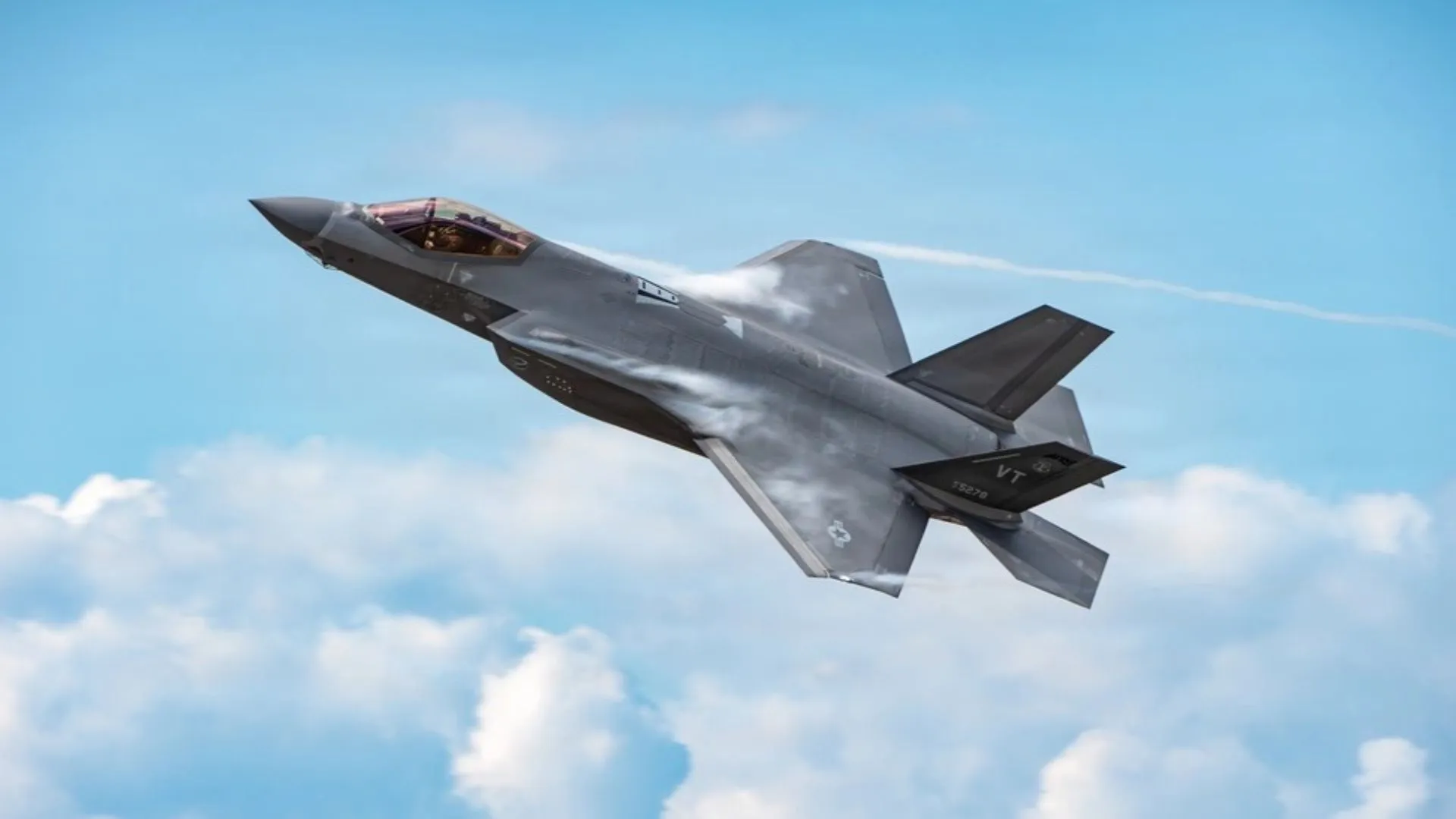
Naval Air Systems Command (NAVAIR) has awarded Lockheed Martin Aeronautics an $18,789,801 contract modification to carry an F-35 Lightning II variant tailored for an unidentified Foreign Military Sales (FMS) customer into system development, demonstration, and integration, the Pentagon announced on October 15, 2026. The sole-source action, designated P00011, modifies contract N0001922C0015 and runs through December 2030.
The contract has drawn speculation since December 27, 2021, when NAVAIR first awarded Lockheed Martin $49,059,494 for engineering supporting the design and development of a Joint Strike Fighter variant for an unnamed FMS buyer, with completion then set for December 2026. The new award arrives as the F-35 enterprise balances record output of 191 deliveries in 2025, a delayed Technology Refresh 3 (TR-3) hardware baseline, and an export roster that may soon include Saudi Arabia.
F-35 Variant Work Shifts From Design to Integration Through 2030
The contract vocabulary has changed. The 2021 award funded engineering for design and development; P00011 adds system development, demonstration, and integration, the language of a configuration moving from drawings toward hardware and software that must be built, tested, and certified. The vehicle has also shifted from a pure cost-plus-incentive-fee instrument to a hybrid that now includes firm-fixed-price elements, a structure usually applied once requirements are stable enough to price part of the work.
The customer pays for all of it. The full $18,789,801 comes from FMS customer funds obligated at award, so no US appropriations are involved. Including P00011, announced actions on the contract total about $134.2 million, more than two and a half times the original award, after modifications worth $53.4 million in August 2022 (P00003) and $12.9 million in August 2025 (P00006). Federal procurement records still list an end date of December 15, 2028, two years short of the completion date now attached to P00011.
The industrial footprint has moved twice. The 2021 award distributed work across Fort Worth, Texas (77%); Redondo Beach, California (14%); Orlando, Florida (6%); and three 1% sites in Baltimore, Maryland, Owego, New York, and Samlesbury, United Kingdom, where BAE Systems builds the F-35 aft fuselage. Modifications P00003 and P00006 then placed most of the effort in El Segundo, California (56%), with Fort Worth at 43% and Tempe, Arizona, at 1%. P00011 brings 80% of the work back to Fort Worth and assigns the remaining 20% to undisclosed locations in the continental United States, with no overseas share.
How Israel’s F-35I Adir Set the Template for Tailored Jets
The Pentagon has not named the customer, and no official source ties P00011 to a specific country. The best-documented model for a national F-35 configuration remains Israel’s F-35I Adir, derived from the conventional takeoff and landing F-35A. In February 2018, Lockheed Martin received $147.96 million for Israel-unique upgrades within the Block 3F+ software package, covering national weapons certification, modification kits, and electronic warfare (EW) analysis. In November 2020, the Israeli Air Force received a dedicated F-35I test aircraft at its Flight Test Center at Tel Nof Air Base, the first F-35 test asset based outside the United States.
That arrangement has produced operational results. The Israeli Air Force says its Flight Test Center, working with Lockheed Martin and the F-35 Joint Program Office, developed wing-mounted carriage of external Joint Direct Attack Munitions (JDAM) during the war that began in October 2023. In May 2026, Israel’s Ministry of Defense also contracted Cyclone, an Elbit Systems subsidiary, for more than $34 million to develop and integrate an extended-range capability for the F-35I.
Those efforts define what tailoring usually means on the F-35: national weapons, EW systems and mission data, stores carriage, and range. The core platform stays fixed. Publicly available specifications indicate an F135-PW-100 engine in the 43,000-pound-thrust class with afterburner, a Mach 1.6 top speed, 18,000 pounds of weapons capacity, the AN/APG-81 active electronically scanned array (AESA) radar, the AN/AAQ-37 Distributed Aperture System, and the AN/AAQ-40 Electro-Optical Targeting System. What a customer changes is what the jet carries, how far it flies, and what its mission data tells it to hunt.
Saudi F-35 Approval and Israel’s Qualitative Military Edge Constraints
The timing invites a second reading. On September 17, 2026, four weeks before P00011, the State Department approved a possible $24.3 billion FMS case for Saudi Arabia covering 48 F-35As, 49 F135-PW-100 engines including one spare, EW database support, secure communications, simulators, and training. The notification states the sale will not alter the military balance in the region, a finding bound to US legal requirements to preserve Israel’s qualitative military edge (QME). It does not indicate whether Riyadh would receive a modified configuration, and a congressional notification is not a signed contract.
Nothing in the October 15 announcement links the two. Because P00011 modifies a vehicle opened in December 2021 and draws on an existing FMS case, the simplest reading is that the original buyer is still paying. Other candidates remain plausible: Lot 19 alone includes 52 F-35As and 12 F-35Bs for FMS customers, and NAVAIR awarded $154 million in June 2026 for long-lead parts for 11 F-35s bound for another unnamed FMS buyer.
Analysis: The dollar value is minor by F-35 standards; the 2030 horizon is not. Any national configuration integrated over the next four years must land on the TR-3 hardware baseline and the Block 4 software path, both behind schedule. The Director, Operational Test and Evaluation reported that no combat-capable TR-3 aircraft had been delivered to US services through fiscal 2025, and the Government Accountability Office now projects Block 4 completion no earlier than 2031, five years later than first planned. Each customer-unique branch adds regression testing to every software release. FMS funding covers the engineering, but not the schedule pressure that bespoke configurations place on a program whose value rests on a common baseline.
Lockheed Martin and NAVAIR have not disclosed the customer, the scope of the variant, or any flight-test plan. The next indicators are further modifications to N0001922C0015, a signed Letter of Offer and Acceptance in the Saudi case, and TR-3 combat certification, which sets the baseline any tailored F-35 must integrate against before December 2030.