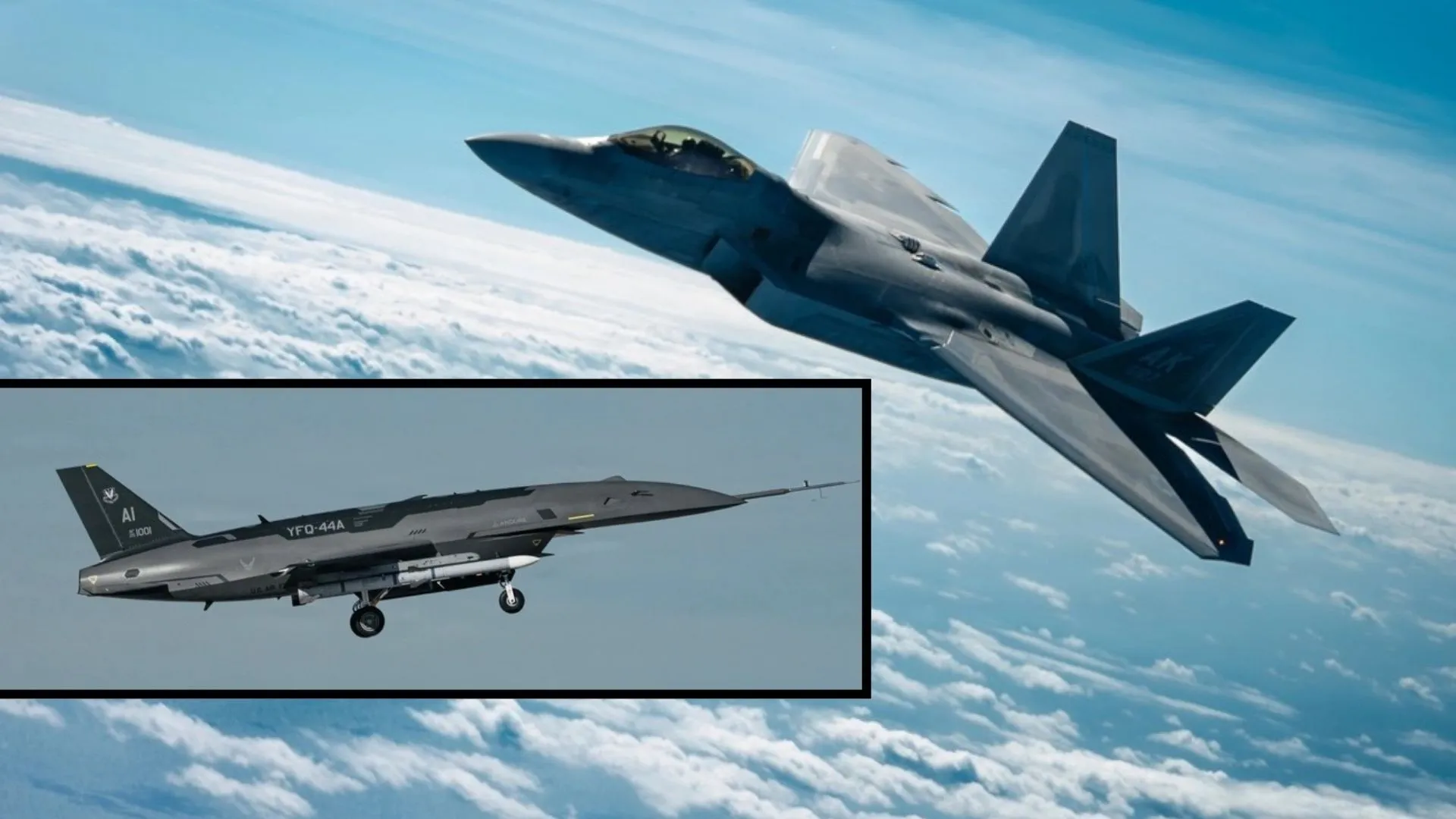
An F-22 Raptor pilot has exercised airborne tactical command and in-flight control of an Anduril YFQ-44A Fury Collaborative Combat Aircraft (CCA), the Department of the Air Force announced on October 16, 2026. During the test, flown earlier this month, the pilot acted as an airborne “quarterback,” issuing high-level tactical directives that the uncrewed aircraft’s onboard autonomy software interpreted and executed in real time through dynamic flight maneuvers and simulated combat tasks.
Anduril confirmed the flight was a first for both the F-22 and a pre-production YFQ-44A. The flight comes four months after the June 17, 2026, award of engineering and manufacturing development and production contracts for the General Atomics FQ-42A Vengeance and the Anduril FQ-44A Fury. It also advances the Raptor’s assigned role: the fiscal 2026 budget request included a Crewed Platform Integration line to fit F-22s with CCA control kits. A Lockheed Martin Skunk Works-led demonstration on October 21, 2025, had linked an F-22 to a General Atomics MQ-20 Avenger standing in for a CCA; this test replaces the surrogate with a production-bound airframe.
How the F-22 Directed the YFQ-44A Fury in Flight
According to Anduril, both aircraft took off from Edwards Air Force Base, California, and joined up in flight. The Raptor pilot then sent an updated mission plan to the Fury over a tactical data link and commanded it through operationally relevant maneuvers. The pilot did not fly the drone; the pilot assigned tactical intent, and the YFQ-44A’s mission autonomy determined how to execute it.
That division of labor is the core of the CCA control model. A single-seat fighter pilot already managing sensors, weapons and a threat picture cannot also hand-fly a wingman. Tasking at the level of intent keeps cockpit workload manageable and leaves moment-to-moment flying to software. The test involved one CCA; the Air Force did not describe multi-ship control.
The cockpit interface, datalink waveform and autonomy software flown remain undisclosed. The F-22’s native Intra-Flight Data Link was built for Raptor-to-Raptor exchange. The 2025 MQ-20 trial instead used a tablet-based Pilot-Vehicle Interface connected through the jet’s Government Reference Architecture Compute Environment (GRACE) module and L3Harris software-defined radios. The service has not said whether the same chain supported this event.
The test drew on the 412th Test Wing, the 422nd Test and Evaluation Squadron, the 309th Software Engineering Group, the Experimental Operations Unit, the F-22 System Program Office and the CCA Software Autonomy and Teaming Branch. Pairing developmental testers, operational testers and software engineers with an operator-led unit reflects the program’s practice of writing tactics alongside the hardware. Data from the flight will feed software integration, developmental testing and future CCA concepts.
“This flight shows the power of crewed-uncrewed teaming and the advantage it provides our warfighters,” said Air Force Chief of Staff Gen. Ken Wilsbach. “We must test often, learn fast and give commanders what they need, when they need it.”
Fury Airframe, AMRAAM Testing and the Increment 1 Production Path
The Fury began as an aggressor-training design at Blue Force Technologies, which Anduril acquired in 2023, before being reworked as an uncrewed fighter for the CCA competition. Publicly available specifications indicate a single Williams FJ44-4M turbofan rated at roughly 4,000 pounds of thrust, a maximum gross takeoff weight near 5,000 pounds, a length of about 20 feet (6.1 meters), a top speed around Mach 0.95, a ceiling near 50,000 feet and a 9g maneuvering limit. Anduril has not confirmed production dimensions. The commercial business-jet engine trades supersonic performance for an established supply chain and a unit cost compatible with fleet-scale buys.
The YFQ-44A first flew on October 31, 2025. In a test announced on July 15, 2026, it performed the Air Force’s first CCA live fire, launching an inert AIM-120 Advanced Medium-Range Air-to-Air Missile (AMRAAM) at a digital target over the Mojave Desert under the 412th Test Wing’s Air Dominance Combined Test Force. The Air Force maintains that CCAs will not decide to engage on their own. The F-22 test supplies the missing piece of that construct: a human decision-maker in the air, close to the fight, rather than at a ground station.
In late July 2026, the Experimental Operations Unit took both CCA types to Creech Air Force Base, Nevada, for a multi-day Agile Combat Employment exercise focused on operating from remote, forward-deployed locations with a reduced logistical footprint. The June awards cover the first three production lots, with at least 150 FQ-42A and FQ-44A aircraft planned for Increment 1 by the end of the decade; contract values remain undisclosed. The service separated autonomy from airframes, forming a six-vendor mission autonomy pool of Anduril, General Atomics, Lockheed Martin, Northrop Grumman, RTX Collins Aerospace and Shield AI under the government-owned Autonomy Government Reference Architecture (A-GRA), with Anduril, Collins Aerospace and Shield AI selected for the first competitive round. A primary Increment 1 autonomy provider is due by summer 2027. The Air Force targets 500 combat-ready, semi-autonomous CCAs by 2032 within a planned fleet of 1,000.
Secretary of the Air Force Troy Meink said the goal is to “turn promising technology into combat capability at the pace the threat demands.”
Analysis: The flight validates the control concept, not yet the operational scheme. One Raptor directing one CCA over a test range is the minimum viable case; the program envisions crewed fighters tasking multiple uncrewed aircraft in airspace contested by long-range surface-to-air missiles, advanced adversary fighters and dense electronic attack. Pilot workload and link resilience under jamming, more than airframe performance, will set how many wingmen a single pilot can employ. The split autonomy model adds a constraint: the F-22 interface must stay vendor-agnostic, since the software a pilot commands today may not be the one selected in 2027. The Raptor is the bridge; the tactics written in its cockpit will shape how the F-35 and the future F-47 employ CCAs at scale.
Next milestones include multi-ship control from a single cockpit, F-22 teaming with the FQ-42A Vengeance and the close of the first six-month autonomy evaluation period, which precedes a second competitive round. The Air Force has not said when control kits will reach operational F-22 squadrons, how many Raptors will receive them or when Increment 1 aircraft will reach initial operational capability.