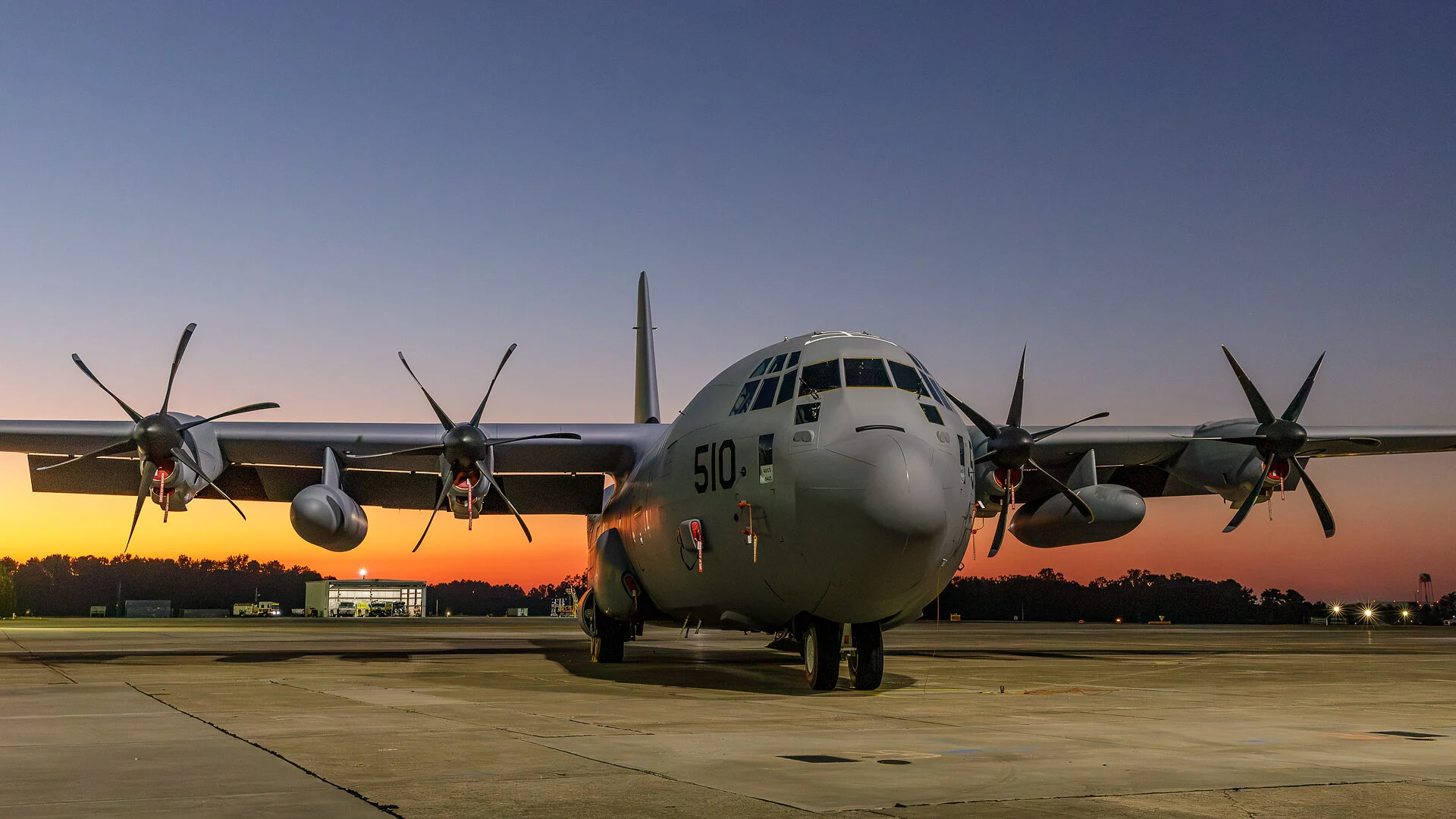
Lockheed Martin delivered the first C-130J-30 Super Hercules destined to become the E-130J Phoenix II to the U.S. Navy at its Marietta, Georgia, facility on October 15, 2026. The airframe now passes to Northrop Grumman, the program’s mission systems integrator, for conversion into the Navy’s next-generation Take Charge and Move Out (TACAMO) aircraft, the airborne relay that carries emergency action messages from national leadership to the ballistic missile submarine fleet.
The handover moves the TACAMO Recapitalization Program from contracts to hardware. On December 18, 2024, the Navy awarded Northrop Grumman a $3,459,276,000 contract covering three Engineering Development Models (EDMs), with options for up to three System Demonstration Test Articles and up to six aircraft in the first production lot. A Pentagon Modernized Selected Acquisition Report dated April 21, 2026, sets the program of record at 31 aircraft, six pre-production and 25 production, to replace 16 Boeing 707-based E-6B Mercury aircraft in service since 1989. The choice also returns TACAMO to the Hercules family: EC-130 variants flew the mission from 1963 until 1993.
How the C-130J-30 Becomes the E-130J Phoenix II TACAMO Platform
“Lockheed Martin’s delivery of this battle-proven airframe provides the structural and performance backbone our mission requires as we transition into mission systems integration to field the E-130J Phoenix II,” said Capt. Roger Davis, who leads the Navy’s Airborne Strategic Command, Control and Communications Program Office (PMA-271).
Publicly available specifications indicate the C-130J-30 is the stretched Super Hercules, 15 feet longer than the baseline C-130J at an overall length of 112 feet, 9 inches, with a maximum takeoff weight of 164,000 pounds. Four Rolls-Royce AE 2100D3 turboprops, rated at about 4,700 horsepower each in U.S. Air Force data and driving six-blade composite propellers, deliver a cruise speed of 356 knots at 22,000 feet and a range of 2,100 nautical miles with a 35,000-pound load. That margin must absorb the communications suite, survivability systems and mission crew stations.
The core of the conversion is the Collins Aerospace Very Low Frequency (VLF) system. TACAMO aircraft reel out a trailing wire antenna, roughly five miles long on the E-6B, and fly a tight orbit that pulls the wire close to vertical, allowing VLF signals to penetrate seawater and reach submerged submarines without forcing them to surface. The E-130J is expected to retain a similar antenna architecture along with hardening against electromagnetic pulse effects; the Navy has not disclosed transmitter power or antenna length for the new aircraft.
Northrop Grumman leads an industry team that includes Lockheed Martin, Collins Aerospace, RTX’s Raytheon, Crescent Systems and Long Wave. The E-6B fleet it replaces flies with Strategic Communications Wing 1 at Tinker Air Force Base, Oklahoma, home of squadrons VQ-3, VQ-4 and VQ-7.
E-130J vs E-6B Mercury: Trade-Offs in Speed, Altitude and Basing
Moving the mission from a four-engine jet to a four-engine turboprop costs performance. The E-6B, powered by four CFM International CFM56-2A-2 turbofans, is credited with a 40,000-foot service ceiling and a 455-knot cruise speed. The C-130J-30 cruises at 356 knots at 22,000 feet and reaches 26,000 feet with a 44,500-pound payload. The E-130J will therefore take longer to reach its orbit and will operate lower, with less margin to climb above weather or extend line of sight for its communications.
The Navy is buying dispersal and sustainability in exchange. The Super Hercules can use far more runways than a 707-derived jet, including shorter and austere strips, which complicates any attempt to target the TACAMO force on the ground. It also remains in production, backed by a global fleet of more than 570 aircraft, while the 707 line closed decades ago. Fielding 31 aircraft instead of 16 points to a posture built on numbers and basing flexibility rather than individual platform performance.
Program risk has not gone away. The Government Accountability Office warned in June 2025 that the C-130J, selected four years before E-130J development began, may not meet operational availability requirements, and the April 2026 acquisition report lists operational availability as a risk, with details held at the classified level. A July 2026 GAO assessment found those integration concerns had become realities: contractors are now reworking existing mission systems to reduce weight, and the low-rate production decision has slipped by roughly a year.
Analysis: Airframe supply was never the bottleneck; mass and integration are. The Navy has already narrowed the mission, leaving the E-6B’s Looking Glass airborne command post role off the new aircraft, and it still faces a weight problem on a smaller platform. Because the Navy will retire E-6Bs only as Phoenix II aircraft enter service, every integration slip extends the life of a fleet delivered between 1988 and 1992, while the Air Force has yet to field a Looking Glass successor. The sea-based leg of the nuclear triad now depends on that bridge holding.
The immediate milestone is Northrop Grumman’s conversion of this first air vehicle, followed by developmental testing. GAO expects a critical design review at the end of 2027 and now projects the low-rate production decision for April 2029. Initial operational test and evaluation is not set to begin before June 2033, and the initial operational capability date remains classified.