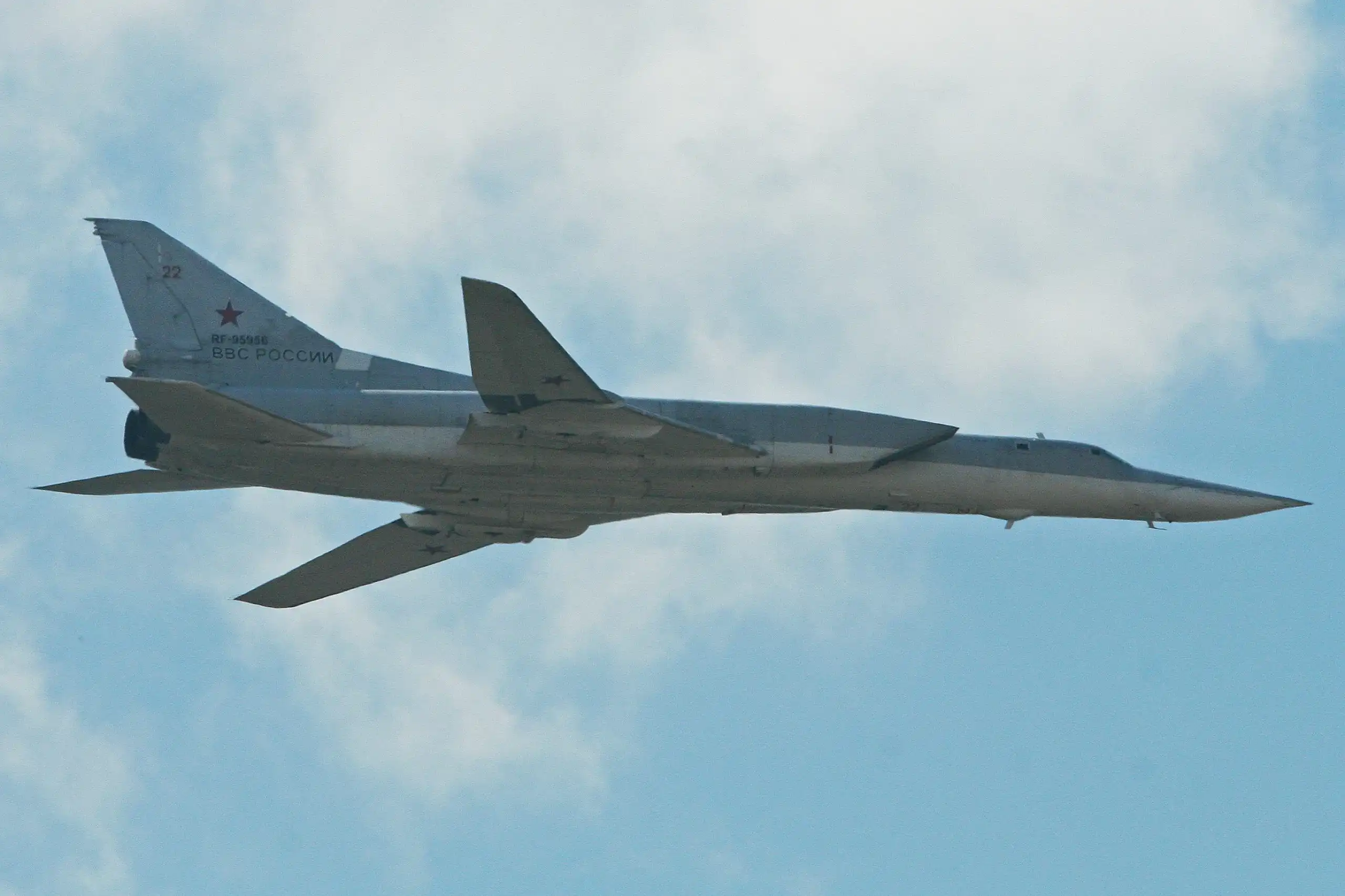
Russia’s Ministry of Defense said on October 16, 2026, that Tupolev Tu-22M3 long-range bombers of the Russian Aerospace Forces (VKS) flew a planned mission of more than four hours over neutral waters of the Baltic Sea. Sukhoi Su-35S and Su-30SM fighters escorted the bombers, and the ministry said fighter jets from unnamed foreign states accompanied the formation at certain stages of the route.
The sortie came 16 days after a Russian diplomatic note to NATO, made public on September 30, 2026, warned that Russia would be ready to use its entire arsenal, including nuclear weapons, if alliance members attempted to isolate the Kaliningrad exclave from the rest of the country. NATO denounced the threat and replied that none of its exercises or activities posed a threat to Russian territory. Kaliningrad, which hosts the headquarters of the Baltic Fleet and fields nuclear-capable Iskander missiles, is bordered by Lithuania and Poland and separated from Belarus by the roughly 65-kilometer Suwałki corridor at its narrowest point.
Tu-22M3 Bombers Over Baltic Sea: What Moscow Disclosed and Withheld
The ministry’s statement followed a familiar template. It described the mission as scheduled, identified the escort types, and stressed that all VKS flights are carried out in strict compliance with international rules for the use of airspace. It added that long-range aviation crews regularly fly over neutral waters of the Arctic, the North Atlantic, the Pacific, and the Baltic and Black Seas. It gave no reason for the mission. Such flights serve both to maintain the readiness of Russia’s nuclear-capable bomber crews and to signal military strength.
Several key details remain undisclosed. Moscow did not state how many Tu-22M3s took part, which airfields they launched from, what route they followed, or whether they carried weapons. It also did not name the countries whose fighters intercepted the formation, and DefenseWarroom could not independently confirm which allied air forces responded. Those gaps matter: the number and nationality of the interceptors would show how many national quick reaction alert (QRA) cells the flight activated along its path.
The profile mirrors a flight on April 20, 2026, when two Tu-22M3s and about 10 Su-30 and Su-35 fighters, rotating escort duty, crossed the Baltic. On that occasion, French Rafales on NATO Baltic Air Policing duty at Šiauliai Air Base in Lithuania launched alongside fighters from Sweden, Finland, Poland, Denmark, and Romania. Lithuanian Ministry of National Defence interception reports have repeatedly logged Tu-22M3 pairs escorted by Su-30SM or Su-35S fighters transiting international airspace with transponders off, no filed flight plans, and no radio contact with regional air traffic control.
The Baltic Air Policing mission currently rests with an Italian Air Force detachment of four Eurofighter Typhoons at Šiauliai, which took over on July 31, 2026, while Türkiye has deployed five F-16s to Ämari Air Base in Estonia for an August to November rotation.
Tu-22M3 Backfire-C Capabilities: Speed, Payload, and Standoff Missiles
The Tu-22M3, designated Backfire-C by NATO, is a supersonic variable-geometry-wing bomber that Russia assigns to Long-Range Aviation, although it lacks the intercontinental reach of the Tu-95MS and Tu-160. Publicly available specifications indicate a four-person crew, two Kuznetsov NK-25 afterburning turbofans rated at approximately 245 kN each, a maximum speed of about Mach 1.88 at altitude, and a maximum combat load of roughly 24,000 kg. Its in-flight refueling probes were removed under Soviet-era SALT II commitments, capping unrefueled combat radius at an estimated 1,500 to 2,400 km.
Its primary standoff weapon is the Kh-22 (AS-4 Kitchen), a liquid-fueled supersonic missile with a reported range of about 600 km that can carry a conventional or nuclear warhead. The modernized Kh-32 extends reported range to roughly 1,000 km. The Tu-22M3M upgrade adds new avionics, though its delivery pace remains unclear. Russia has used Tu-22M3s throughout the war in Ukraine to launch Kh-22 and Kh-32 missiles, and Ukraine has claimed the destruction of several airframes, including on the ground, since 2023.
With standoff ranges of 600 km to 1,000 km, a Tu-22M3 operating over Baltic international waters does not need to approach allied airspace to hold ports, naval forces, and coastal infrastructure along the Baltic littoral at risk. The escorts add a second layer: the Su-35S, powered by AL-41F1S thrust-vectoring engines and fitted with the Irbis-E passive electronically scanned array radar, and the two-seat Su-30SM give the bombers organic air-to-air protection, forcing interceptors to shadow a mixed package rather than a lone bomber pair.
Kaliningrad Pressure Meets NATO’s Shift From Air Policing to Air Defense
The flight lands in a Baltic air environment that has grown more contested through 2026. Baltic Air Policing fighters have shot down drones over Latvia this year, including on June 8 and August 14. At the NATO summit in Ankara, allies agreed to transition the Baltic mission from air policing toward air defense, tying it more closely to NATO Integrated Air and Missile Defence.
Moscow, for its part, has paired diplomatic and military signaling. The September 30 note came alongside statements from Russian embassies in at least three European countries, issued in the days before it became public, accusing NATO of escalating tensions through exercises and Kaliningrad planning scenarios. A dual-capable bomber flight over the same sea two weeks later fits that pattern of calibrated pressure kept outside allied airspace.
Analysis: In isolation, the October 16 sortie is routine: Tu-22M3 pairs with fighter escort cross the Baltic several times a year, and allied interceptions follow a well-rehearsed script. Its weight lies in sequencing. By putting a nuclear-capable standoff platform over the Baltic shortly after explicitly linking Kaliningrad to nuclear use, Moscow keeps its declaratory threat visible while staying within the airspace rules it publicly invokes. For NATO, each such flight is also a live test of multinational QRA hand-offs across Swedish, Finnish, Danish, Polish, German, and Baltic Air Policing sectors, the arrangements a Baltic air defense posture is meant to harden.
Next indicators include any allied disclosure identifying the intercepting aircraft, the Lithuanian Ministry of National Defence’s weekly interception data, and the end of Türkiye’s Ämari rotation in November. Any link to exercises in Kaliningrad also remains undisclosed. Whether Moscow raises the tempo of such sorties as the Kaliningrad dispute continues will offer the clearest measure of intent.