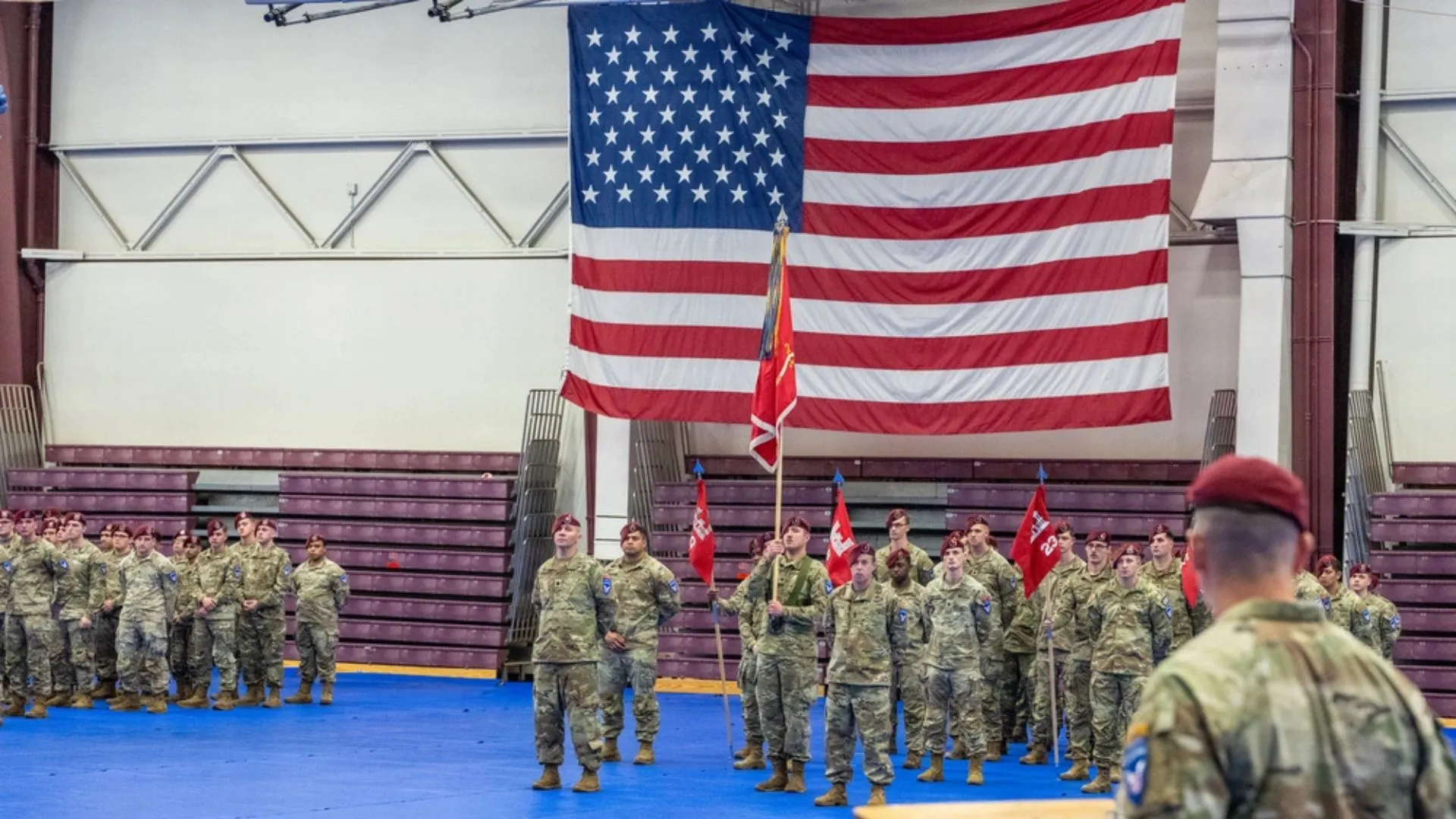
The U.S. Army’s 11th Airborne Division activated the 11th Airborne Division Sustainment Brigade (Arctic) on October 16, 2026, at Joint Base Elmendorf-Richardson, Alaska, giving the Arctic-focused division a dedicated brigade-level logistics headquarters together with its subordinate battalions and companies. The same ceremony reactivated the 106th Intelligence and Electronic Warfare (IEW) Battalion, redesignated the 17th Combat Sustainment Support Battalion as the 17th Division Sustainment Support Battalion (DSSB), and activated the 11th Airborne Division Sustainment Troops Battalion.
The new brigade completes a piece of the division architecture announced when U.S. Army Alaska was reflagged as the 11th Airborne Division on June 6, 2022. That reorganization converted the 1st Stryker Brigade Combat Team and the 4th Infantry Brigade Combat Team (Airborne) of the 25th Infantry Division into the 1st and 2nd brigade combat teams of the 11th Airborne, and division leadership said at the time that it intended to build a division sustainment brigade. The activation lands nine days after the Army released its operational guidance How the Army Fights on October 7, 2026, which names endurance as one of four elements of Army land power.
How the 11th Airborne Sustainment Brigade Is Built for Arctic Missions
Col. George Plys commands the brigade, which now sits alongside the division’s two infantry brigade combat teams. The division, the youngest in the active Army, says it is growing faster than any comparable unit. At the uncasing, Plys said the event represented “much more than the unfurling of our unit colors.”
The 17th DSSB brings the deepest institutional experience to the new formation. The battalion traces its lineage to the 7th Ordnance Battalion, constituted on July 25, 1941, and was reorganized at Fort Richardson in 2006 before taking the combat sustainment support title that October. It deployed to Iraq from July 2007 to October 2008, supporting Multinational Forces-North from Forward Operating Base Q-West for 15 months. Army records have described it as the largest battalion-level formation in U.S. Army Alaska, with companies split between Joint Base Elmendorf-Richardson and Fort Wainwright.
A combat sustainment support battalion is an area-support unit that serves whatever formations operate in its sector; a division sustainment support battalion is task-organized to push supply, transportation and maintenance forward for one division’s fight. The division has not published the brigade’s authorized strength, company roster or equipment set.
Endurance Doctrine Ties Arctic Logistics to How the Army Fights
How the Army Fights, developed by the Vice Chief of Staff of the Army, is a 46-page document that builds on multidomain operations doctrine at the operational level of war. It organizes land power around convergence, strike, close battle and endurance, defining endurance as the ability to posture, protect and project combat power across time, distance and contested conditions. The guidance assigns convergence and endurance the role of setting conditions, while strike and close battle deliver decisive effects. It also calls for positioning capabilities forward, close to likely combat zones.
Maj. Gen. John Cogbill, the division’s commanding general, drew the same link at the ceremony. “Our ability to endure and sustain ourselves in the crucible of large-scale combat operations is impossible without the formations you see in front of you today,” he said.
In Alaska, that requirement is physical before it is doctrinal. Army sustainment planners have long identified long distances, limited lines of communication, special storage and handling requirements, and scarce commercial and military infrastructure as the defining constraints on Arctic logistics. During the Joint Pacific Multinational Readiness Center (JPMRC) 24-02 rotation in February 2024, a forward support troop from the division’s 2nd Brigade validated over-the-snow resupply by snowmobile down to individual paratroopers, a method the division had previously used only on a limited basis. During its JPMRC Alaska rotation in February 2026, the division relied on a Logistics Support Element (Division) from the 402nd Army Field Support Brigade to reach Army Materiel Command enterprise support. A division sustainment brigade gives the 11th Airborne an organic headquarters to plan and synchronize that effort.
106th IEW Battalion Adds Division-Level Intelligence and Electronic Warfare
The reactivated 106th IEW Battalion follows a pattern set across the force. The Army stood up the 103rd IEW Battalion at Fort Stewart, Georgia, in September 2022 as the first unit of its kind, combining human intelligence, signals intelligence and geospatial intelligence Soldiers to support the 3rd Infantry Division. The model returns collection and electronic warfare capacity to the division as the Army’s principal warfighting echelon.
Plys framed the two battalions as complementary. “One sustains the force; the other provides the intelligence and electronic warfare capabilities that help commanders understand the battlefield and make informed decisions,” he said. The division announcement grouped the 106th among the brigade’s subordinate battalions but did not detail its command relationship, its strength, or the collection and electronic attack systems it will field.
Analysis: The activation adds structure rather than combat mass, and that is the point. For two light infantry brigades operating across Alaska’s distances, the binding constraint in large-scale combat is distribution, not firepower: fuel, ammunition, cold-weather equipment and maintenance must move over a thin road and rail network in extreme cold. Placing that problem under a single brigade commander answerable to the division aligns the 11th Airborne with the endurance element of How the Army Fights and with its call to posture capability forward. Alaska sits at the northern edge of both U.S. Indo-Pacific Command and U.S. Northern Command, which makes a self-sustaining division there a theater asset rather than a local one. Pairing sustainment with division-level intelligence and electronic warfare also suggests the Army expects its Arctic logistics nodes to be detected and targeted, not merely stretched.
The next indicators will be how quickly the new battalions reach full manning and equipment, and whether that structure comes from new authorizations or from existing Alaska-based units. The brigade’s first JPMRC rotation in the field will offer the earliest public test of its ability to sustain both brigade combat teams in extreme cold weather conditions.