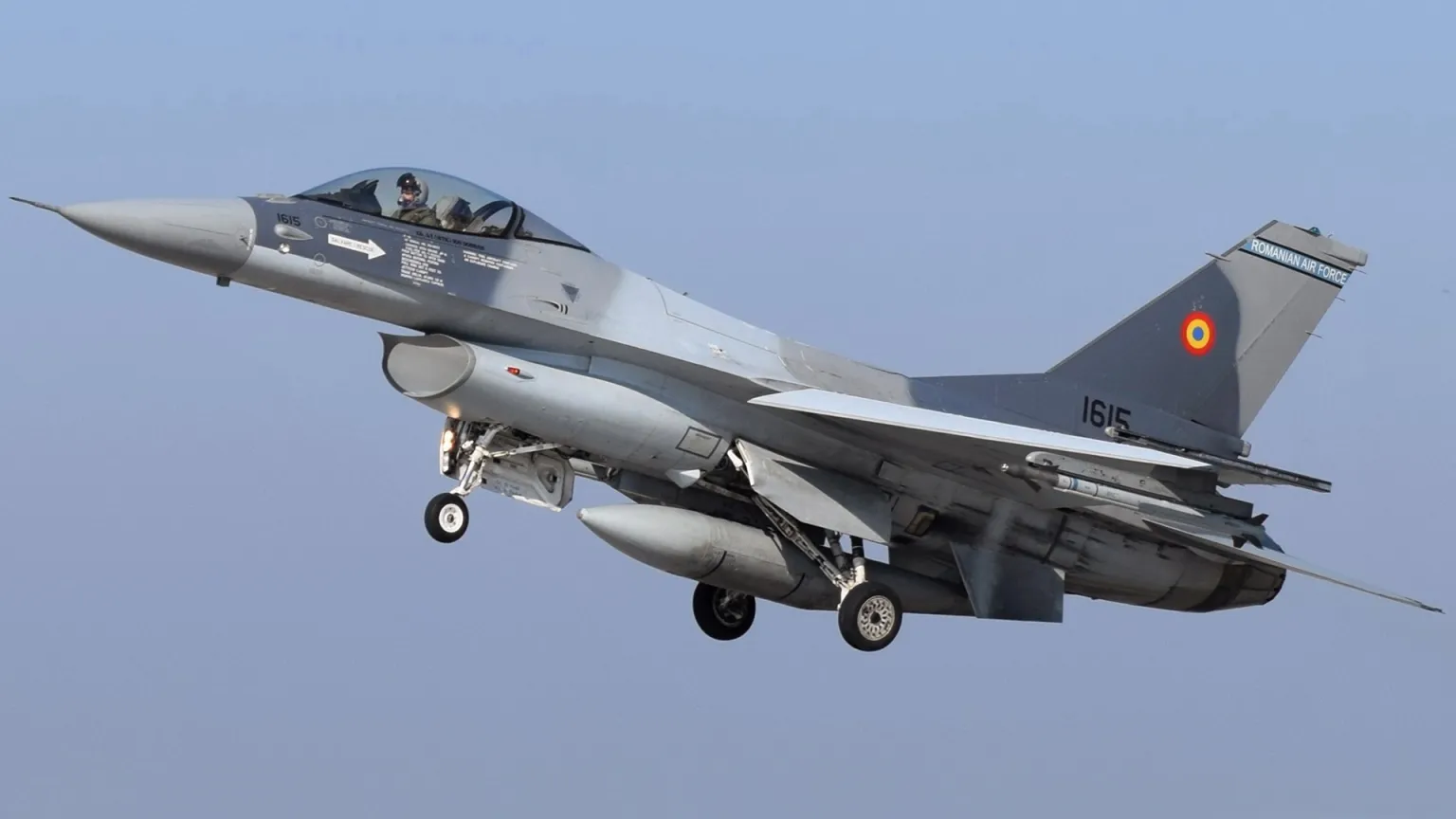
Two Romanian Air Force F-16 fighters on Air Policing alert duty shot down two jet-powered, Geran-family attack drones over Romania’s territorial waters near Sulina on October 17, 2026, the Romanian Ministry of National Defense (MApN) said. Scrambled from the 86th Air Base at Borcea at 17:43 local time, the jets destroyed the first drone at 18:01 and the second at 18:05, one kill per aircraft.
The engagement capped a week of mounting pressure on the Danube Delta. On October 14, a drone briefly entered Romanian airspace east of Sulina before turning back toward Ukraine, one of several brief incursions that week that did not lead to an engagement. President Nicușor Dan said drones struck merchant ships off the coast, including the tanker Wine Trader, which caught fire about 13 nautical miles southeast of Sulina on October 15 with seven sailors reported missing. Romania has held peacetime authority to destroy unauthorized drones since May 19, 2025; its F-16s first used it on July 24, 2026, followed by kills on July 25 and July 26.
Romanian F-16s Close a Six-Minute Engagement off Sulina
MApN radars first detected a group of aerial targets about 120 kilometers east of Snake Island, flying southwest toward the Romanian coast. The first drone crossed into national airspace at 17:59 and was destroyed two minutes later southeast of Sulina. The second entered at 18:01 and was downed at 18:05 east of the town; the ministry’s updated statement put its time in Romanian airspace at five minutes. Both fell into territorial waters. The ministry has not said how many targets made up the group.
The tempo contrasts with the July 24 engagement, when a drone that President Dan described as a Shahed model was tracked for roughly 80 minutes as it moved toward Sulina and then Buzău before an F-16 destroyed it with an air-to-air missile over an uninhabited area near Padina. Over open water, the collateral-damage calculation that governs overland engagements largely falls away, allowing pilots to fire almost as soon as a target crosses the 12-nautical-mile territorial limit.
The ministry has not disclosed which weapon the pilots used on October 17. Romania’s F-16AM/BM fighters are secondhand Block 15 Mid-Life Update (MLU) airframes, 17 acquired from Portugal and 32 from Norway, for a planned fleet of 49. The MLU package brings the jets to a standard broadly comparable to the US Air Force’s Block 50/52, and publicly available specifications indicate an AN/APG-66(V)2 pulse-Doppler radar, which has to separate small, low-flying targets from sea clutter. Beyond air-to-air missiles, the fleet’s options include the internal 20 mm M61A1 cannon, which a Romanian F-16 used on August 20 to strafe an explosive-laden naval drone near the Neptun Deep gas platform.
Inside the Jet-Powered Geran Family and Its Speed Advantage
MApN did not specify which variant it engaged. Geran is the designation Russia uses for its locally produced derivatives of Iran’s Shahed drones, and the ministry stopped short of formally attributing the launch. According to Ukrainian military intelligence (HUR), the jet-powered branch now spans three types. The Geran-3, which reuses the Geran-2 airframe with a Chinese Telefly JT80 turbojet, reaches 300 to 370 km/h; HUR said in August that its production has stopped. The Geran-4, introduced in May 2026, maneuvers at 300 to 400 km/h with a top speed of 500 km/h, a range of up to 450 kilometers and a 50- or 90-kilogram warhead. The Geran-5, a design resembling Iran’s Karrar first identified in January 2026, pairs a Telefly TF-TJ2000A turbojet with a 90-kilogram warhead, a cruise speed of 450 to 600 km/h, a range of up to 950 kilometers and an 850-kilogram takeoff weight.
Speed is the operational point. The piston-engined Geran-2 flies at under 200 km/h by open-source estimates, slow enough for helicopters, machine-gun teams and interceptor drones. Jet variants outrun most of those tools, which is why Ukraine increasingly assigns them to fighters: President Volodymyr Zelensky said on October 17 that combat aircraft now account for more than half of the jet-powered drones Ukraine shoots down. HUR said in August that Russian industry produces around 3,000 Geran-4 and Geran-5 drones per month.
For Romania, the arithmetic is tight. At 450 to 600 km/h, a drone crossing the coast at Sulina could reach Tulcea, roughly 65 kilometers inland, in about seven to nine minutes. On September 8, a jet-powered drone that open-source analysts identified as a Geran-4, a designation Bucharest has not confirmed, crossed Moldovan and Romanian airspace without being engaged.
Analysis: October 17 shows that Romania’s air policing chain can detect, scramble and kill fast drones within minutes, but the geometry favored the defender: detection 120 kilometers out, 16 minutes between scramble and first incursion, and an engagement area over water. Overland, pilots have held fire until targets cleared populated areas; jet propulsion shrinks the time for that judgment. A secondhand fleet of 49 F-16s, three of them deployed this month to Italy for NATO’s Steadfast Noon exercise, must cover national alert duty and allied rotations until 32 F-35As begin arriving in the early 2030s. Ground-based short-range air defense around the Delta and allied fighters under NATO’s Eastern Sentry posture will need to carry more of the load as jet drones grow as a share of Russia’s strike mix.
Open questions include the weapon used, whether debris can be recovered from the sea and which Geran variant was involved; MApN said further details would follow once the mission concluded. After the tanker strikes, NATO Secretary General Mark Rutte said the Alliance was in contact with Romanian officials and would adjust its deterrence and defense posture as needed; the October 17 engagement now feeds directly into that discussion.