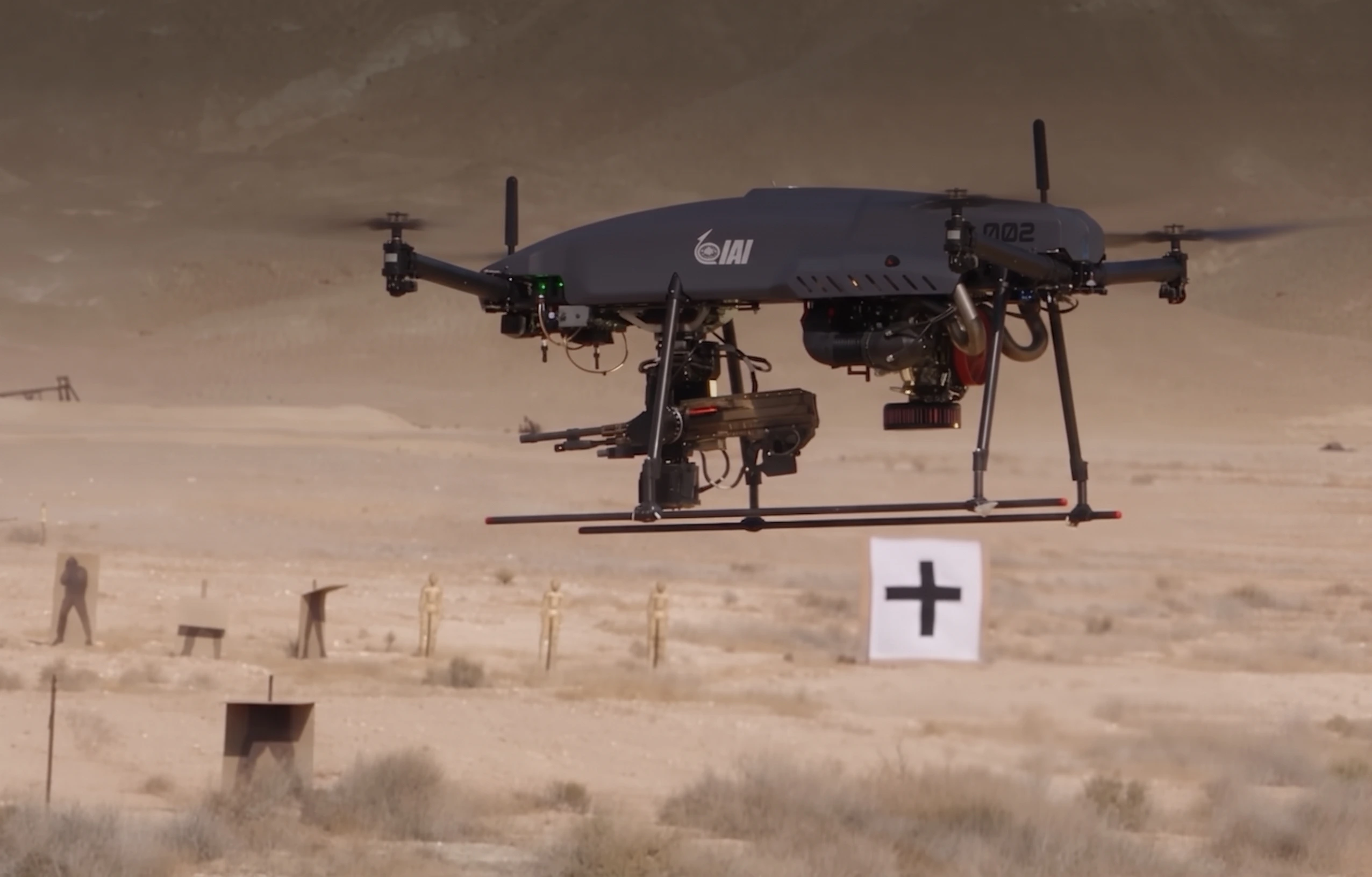
Israel Aerospace Industries (IAI) and SIG SAUER have completed a live-fire test of FIRE STORM 250, a quadcopter unmanned aircraft system (UAS) armed with SIG SAUER’s MICROLIGHT Remote Controlled Weapon Station (RCWS) and an M250 machine gun, the companies announced on October 13, 2026, at the Association of the United States Army (AUSA) annual meeting in Washington. During the trial, the aircraft hovered over a simulated battlefield, identified targets with its onboard camera and engaged them in single-shot and semi-automatic modes from varying distances and altitudes.
The test comes 12 months after the system was unveiled at AUSA in October 2025; it was then displayed at the SHOT Show in Las Vegas in January 2026. The timing tracks Pentagon demand: an April 30, 2025, memo from Defense Secretary Pete Hegseth directed the Army to field unmanned systems and launched effects in every division by the end of 2026. The test date and site were not disclosed; the trial was reportedly conducted in Israel.
FIRE STORM 250 Live-Fire Test and APUS 60 Airframe Design
FIRE STORM 250, also marketed by IAI as APUS MG, is built on the APUS 60, a heavier member of the APUS quadcopter family IAI developed with Aerotor Unmanned Systems under a memorandum of understanding signed in April 2024. Instead of battery-powered electric motors, a central heavy-fuel internal combustion engine runs at constant speed, and the aircraft maneuvers by varying rotor blade pitch. IAI rates the smaller APUS 25 at a 24-kilogram maximum takeoff weight, up to 10 kilograms of useful load and up to 8 hours of endurance; the APUS 60 scales the design to a payload of up to 35 kilograms (77 pounds).
For FIRE STORM 250, IAI quotes an endurance of up to three hours with 200 rounds aboard. The multi-fuel engine runs on common operational fuels, with IAI listing Jet-A1, JP-5 and JP-8 for the APUS 25. A platoon can therefore refuel the aircraft from the same supply chain that feeds its vehicles instead of cycling battery packs through generators. Vertical takeoff and landing (VTOL) operation removes the need for runways, launch rails or recovery nets. IAI adds that several aircraft can operate simultaneously to sustain day-and-night coverage, a relay concept SIG SAUER has pitched for protecting key infrastructure, forward operating bases and moving convoys.
IAI has not published APUS 60 dimensions, cruise speed, ceiling or datalink range, nor any accuracy data from the trial. The release also makes no mention of automatic burst fire, the mode in which the M250’s recoil would place the heaviest load on a hovering airframe.
53 Pounds, 200 Rounds: MICROLIGHT RCWS and M250 Integration
IAI describes the MICROLIGHT as the world’s lightest aerial RCWS. The combat-ready package, comprising the weapon station, the M250 and 200 rounds, weighs 53 pounds (about 24 kilograms), within the APUS 60’s quoted payload. The station stabilizes the weapon and fuses sensor and fire-control data into a single targeting solution. The architecture is human-in-the-loop: the operator receives live imagery, tracking data and engagement options, and must authorize every engagement. Moshe Levy, executive vice president and general manager of IAI’s Military Aircraft Group, said the system extends tactical reach while “retaining human control over engagement decisions.”
The M250 is the Army designation for the SIG LMG 6.8, selected under the Next Generation Squad Weapon (NGSW) program in April 2022 through a 10-year production contract that also covers the M7 rifle. The Army granted both weapons Type Classification-Standard in May 2025, clearing the M250 to replace the M249 Squad Automatic Weapon. Publicly available specifications indicate a 17.5-inch barrel, a weight of roughly 13 pounds with bipod and a cyclic rate near 800 rounds per minute. The Army version fires the 6.8x51mm cartridge, while the Israel Defense Forces (IDF) began using a 7.62x51mm NATO variant in 2025. The airborne configuration reportedly accepts either caliber; the companies have not said which was fired in the test.
At the reported cyclic rate, 200 rounds equal roughly 15 seconds of continuous fire, which helps explain the emphasis on single-shot and semi-automatic engagements. Suppressive fire, one of the missions IAI lists alongside close air support (CAS) and border security, will be bounded by that load, and each reload means recovering the aircraft.
Analysis: FIRE STORM 250’s significance lies less in the gun than in the sensor-to-shooter loop it places at the tactical edge. In Ukraine, most armed small drones, from first-person-view (FPV) attackers to loitering munitions, are expended in a single strike. FIRE STORM 250 is recoverable, so its cost per engagement is measured in rounds rather than airframes. For US buyers, a gun already entering Army service brings ammunition and spare-parts commonality with infantry squads. Yet a hovering, engine-driven quadcopter carries acoustic and thermal signatures, operates within reach of the small arms and counter-UAS systems proliferating at the front, and depends on a datalink that electronic warfare can contest. A human-in-the-loop weapon cannot fire once that link is lost.
Neither company has announced a customer, contract, unit cost or production schedule; when IAI unveiled the system in October 2025, it said it was offering it to international customers for evaluation. The next markers are published accuracy data, a demonstration of automatic fire from the hover, a caliber decision, and whether the US Army or the IDF commits to a formal evaluation.