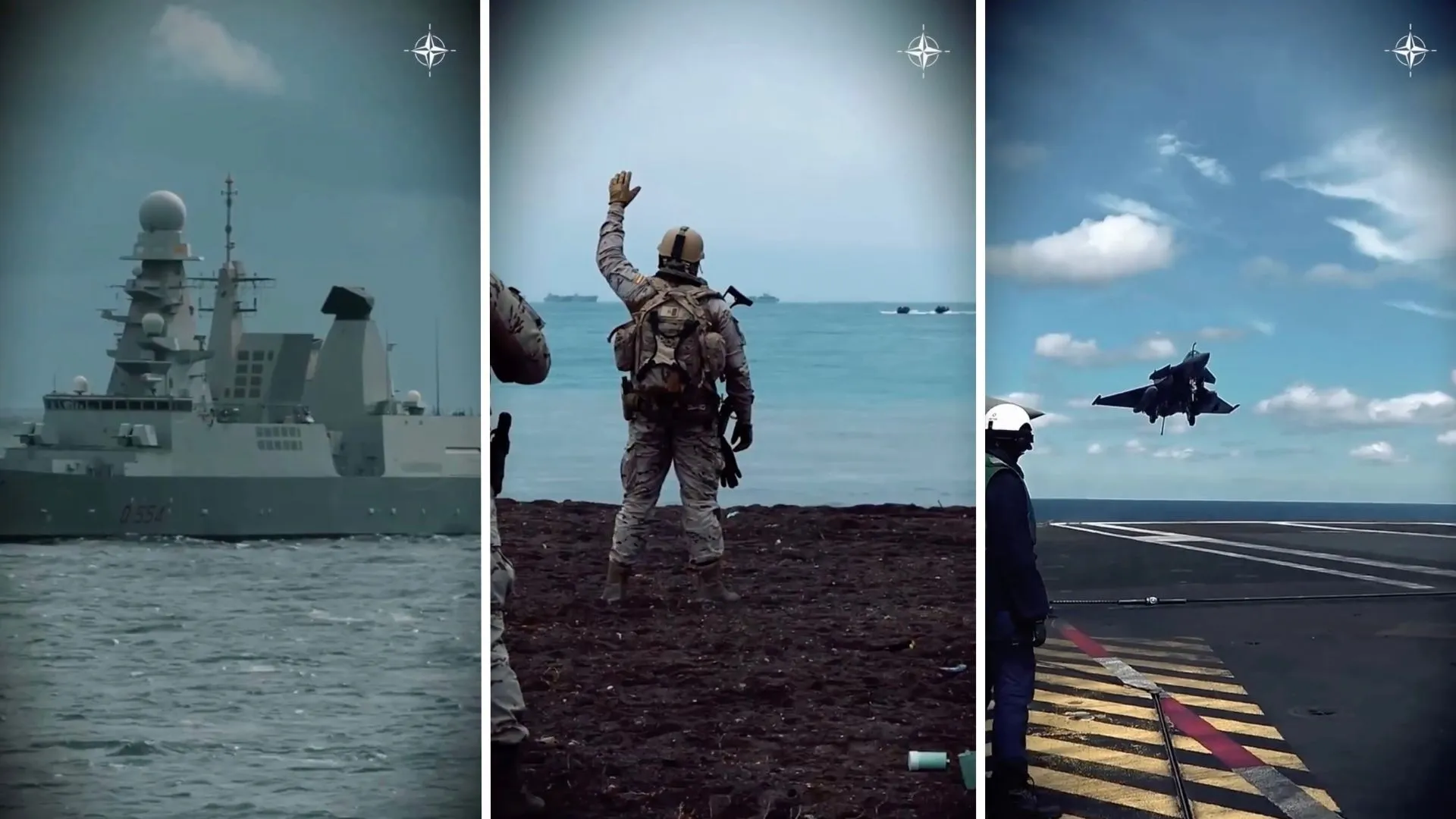
NATO launched Neptune Strike 26-4 on October 16, 2026, the fourth and final 2026 iteration of its premier enhanced Vigilance Activity, with 17 Allies, more than 20 naval vessels, over 40 aircraft and approximately 52 coordinated activities from the Mediterranean to the Baltic. Led by Naval Striking and Support Forces NATO (STRIKFORNATO), it is built around three maritime formations: Italy’s carrier strike group centered on ITS Cavour, Türkiye’s expeditionary strike group led by the amphibious assault ship TCG Anadolu and the United Kingdom’s carrier strike group led by HMS Prince of Wales.
Conceived in 2020 under NATO’s Project Neptune, the series places national carrier and expeditionary strike groups under Alliance command to rehearse high-end maritime strike. Earlier 2026 iterations ran in the Mediterranean in late March, with French and Italian carrier strike groups and Spain’s Juan Carlos I, and in July across the High North, where the UK carrier strike group and a Spanish expeditionary strike group led by Castilla operated as part of Arctic Sentry. Allied Joint Force Command Naples said this iteration spans all three NATO Joint Operations Areas and addresses threats to Allied airspace along the eastern flank, where Romanian fighter jets downed three suspected Russian drones in late July.
Neptune Strike 26-4 Order of Battle: Cavour, Anadolu and Prince of Wales
Italy’s group pairs Cavour, a 244-meter short-takeoff, vertical-landing carrier of about 30,000 tonnes full load per publicly available specifications, with the Horizon-class air-defense destroyer ITS Andrea Doria (D 553), armed with Aster 15 and Aster 30 missiles. NATO lists the frigate slot as ITS Carlo Margottini (F 592) or ITS Virginio Fasan (F 591), both anti-submarine FREMMs. Cavour operates F-35B and AV-8B+ aircraft; its embarked air group for this iteration has not been published.
Türkiye’s formation centers on TCG Anadolu (L-400), a 231-meter amphibious assault ship derived from Navantia’s Juan Carlos I design, displacing roughly 27,000 tonnes full load per publicly available specifications. It sails with the G-class frigate TCG Gaziantep (F-490) and the Gür-class submarine TCG Gür (S-357). Without fixed-wing jets since Türkiye’s removal from the F-35 program, Anadolu operates helicopters, landing craft and embarked marines, and has hosted autonomous takeoff and landing trials of the Bayraktar TB3 uncrewed combat aircraft.
The UK group is led by HMS Prince of Wales (R09), a 65,000-tonne Queen Elizabeth-class carrier, escorted by the Type 45 destroyer HMS Dauntless (D33), whose Sea Viper system and SAMPSON radar anchor air defense, and Norway’s Aegis-equipped frigate HNoMS Fridtjof Nansen (F310), armed with the Naval Strike Missile. The carrier’s participation aligns with the second phase of Operation Firecrest, the UK’s 2026 deployment to the North Atlantic and northern Europe; in the first phase, it embarked eight F-35B jets, three Merlin Mk2 and two Wildcat HMA2 helicopters.
How STRIKFORNATO Commands Strike Groups Across Three Joint Operations Areas
STRIKFORNATO, headquartered in Oeiras, Portugal, is the Alliance’s maritime strike integrator, giving the Supreme Allied Commander Europe flexible options for joint effects across his area of responsibility. Neptune Strike 26-4 stretches that role across the regions of Joint Force Commands Norfolk, Brunssum and Naples. JFC Norfolk said the activity ties the formations into its mission of securing North Atlantic sea lines of communication, and NATO says forces will coordinate across maritime, air, land, cyber and space operations.
The 17 participants are Albania, Croatia, Finland, France, Germany, Greece, Italy, Lithuania, Norway, Poland, Romania, Slovakia, Slovenia, Spain, Türkiye, the United Kingdom and the United States. Rear Adm. Eduardo Guitian Crespo, STRIKFORNATO’s deputy chief of staff for operations, described the goal as turning national capabilities into an integrated NATO force, while Adm. George Wikoff, commander of JFC Naples, said the activity shows NATO is ready to deny a potential adversary its objectives. NATO has not released sortie figures or land ranges; in Neptune Strike 25-4 last November, carrier aircraft from the Mediterranean struck training ranges in Bulgaria, Poland and Romania.
Analysis: The force mix shows how far the series has shifted toward European decks. Earlier iterations were built around US supercarriers, including USS Gerald R. Ford in September 2025, but NATO named no US carrier among the lead assets for 26-4. Strike aviation now rests on two short-takeoff, vertical-landing carriers whose fixed-wing air groups are a fraction of a US carrier air wing, while Anadolu adds amphibious lift rather than fixed-wing strike. The test is whether STRIKFORNATO can task these decks across three Joint Operations Areas as one Alliance force rather than parallel national deployments.
Published end dates diverge: current reporting gives November 5, while earlier schedules and Turkish Armed Forces announcements gave October 21; NATO has not explained the difference. Neptune Strike 26-4 closes the 2026 cycle, and 2027 planning will reflect a shift in British carrier readiness as HMS Queen Elizabeth resumes very high readiness duty from Prince of Wales. NATO has not said whether live firings or amphibious landings are planned before the activity ends.