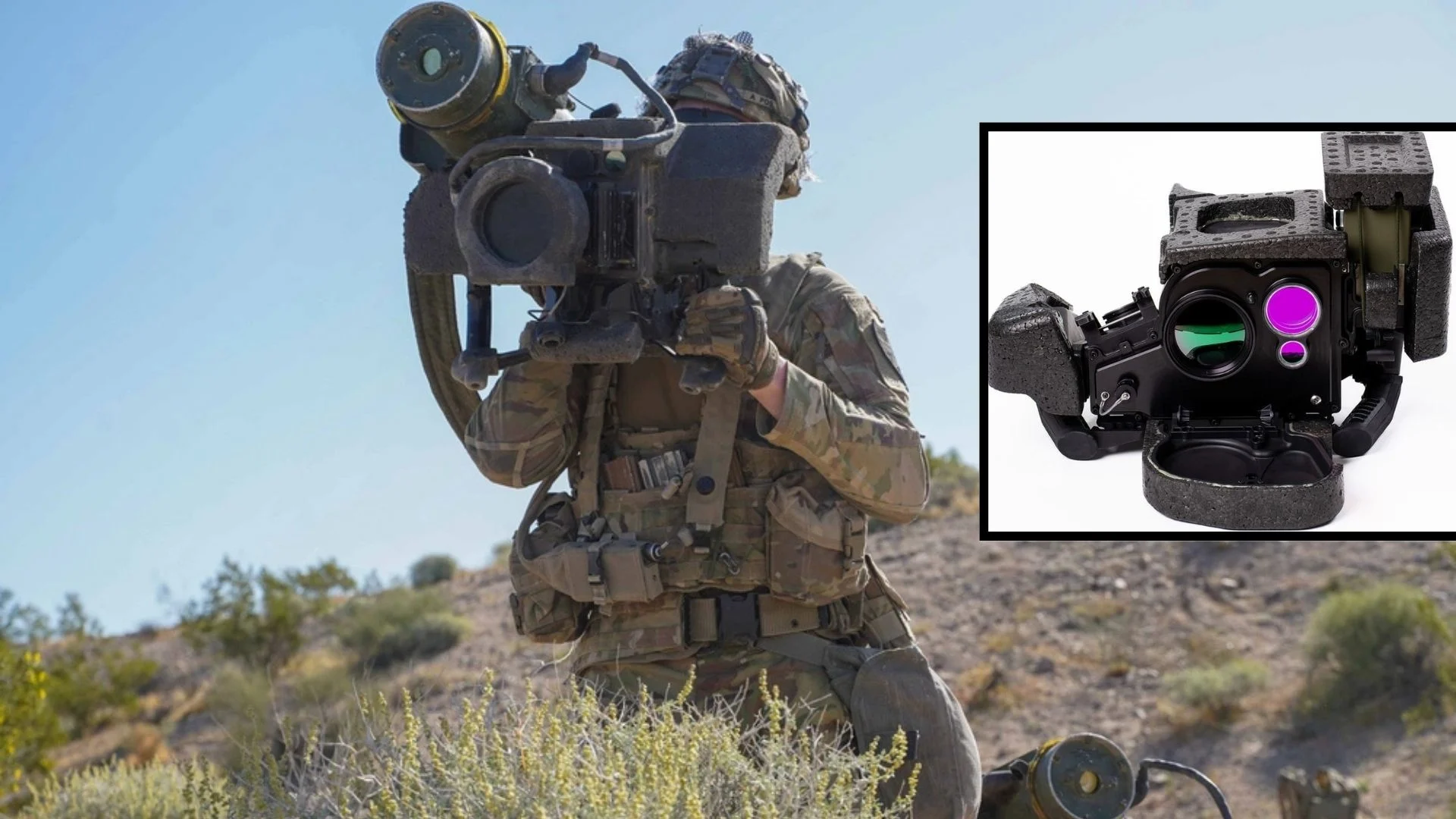
The U.S. Army has awarded the Javelin Joint Venture (JJV), the partnership between RTX’s Raytheon and Lockheed Martin, a $215 million production contract for the Lightweight Command Launch Unit (LWCLU), the next-generation targeting and fire control unit for the FGM-148 Javelin anti-tank guided missile. Announced on October 19, 2026, the award follows the delivery of the first LWCLUs to the Army on May 26, 2026, and continues the replacement of the legacy Block I Command Launch Unit (CLU).
The contract pushes the program deeper into production after a protracted path to fielding. The Army awarded a low-rate initial production contract in June 2022, and Raytheon said that October that first deliveries were expected in 2025. A first full-rate production contract followed in October 2024, but the first units reached the Army only in May 2026, while Javelin demand stayed elevated following large-scale transfers to Ukraine from 2022.
Javelin LWCLU Design: Smaller Footprint and Doubled Detection Range
According to the JJV, the LWCLU is 30% smaller and 25% lighter than the Block I CLU while doubling target detection and recognition range. No absolute weight has been published for the new unit, but Lockheed Martin lists the current CLU at 15.4 pounds (7.0 kg), implying a saving of nearly 4 pounds per launcher. For dismounted teams already carrying 34-pound missile rounds, that margin translates directly into mobility.
The JJV says the LWCLU maximizes surveillance for soldiers while offering day and night engagement capability.
Detection range carries the clearest operational payoff. Because the gunner locks the target through the CLU before launch, sight performance sets a practical ceiling on standoff distance. In British Army trials in May 2025, an LWCLU-equipped crew engaged a target at roughly 4 km, reported at the time as a record for the system. The new unit’s exact detection and recognition ranges remain undisclosed.
How Raytheon and Lockheed Martin Are Scaling LWCLU Production
The JJV states that the LWCLU works with all current, past and future Javelin variants, letting the Army field it without requalifying a missile inventory that extends to the multipurpose-warhead FGM-148F. That matters for an installed base of more than 55,000 Javelin missiles and more than 12,000 reusable CLUs produced to date.
Production is split between Raytheon in Tucson, Arizona, and Lockheed Martin in Orlando, Florida. Raytheon said in May that it had invested $22 million to modernize the LWCLU factory and was ramping annual output. “By modernizing our factory and strengthening our production line, we’re ensuring soldiers receive a lighter, more capable launcher that improves operational readiness across the force,” said Jenna Hunt Frazier, JJV president and Javelin program director at Raytheon.
The announcement does not disclose unit quantities, the period of performance or any foreign military sales share, so the number of launchers covered cannot be derived from the contract value.
Analysis: The award matters less for its size than for what it says about Army anti-armor priorities. The war in Ukraine has exposed dismounted anti-tank teams to persistent drone surveillance, where carried weight, time spent in a firing position and engagement distance all shape survivability. A lighter sight that doubles detection and recognition range lets crews engage from further back and displace faster, extending the relevance of a missile family that entered U.S. service in the mid-1990s instead of replacing it. The harder test sits with the industrial base, which must sustain launcher output alongside missile production as U.S. and allied orders compete for the same capacity.
The next milestones are the delivery schedule under the new contract, the Army’s sequencing of LWCLU fielding across units, and compatible training systems, which the Pentagon’s Director, Operational Test and Evaluation said in its fiscal 2025 annual report were still in development. International demand is the other variable. The State Department approved a possible sale of 513 LWCLUs to the United Kingdom in 2022, and further allied buys would add volume to the Tucson line as the Army works through its own Block I replacement.