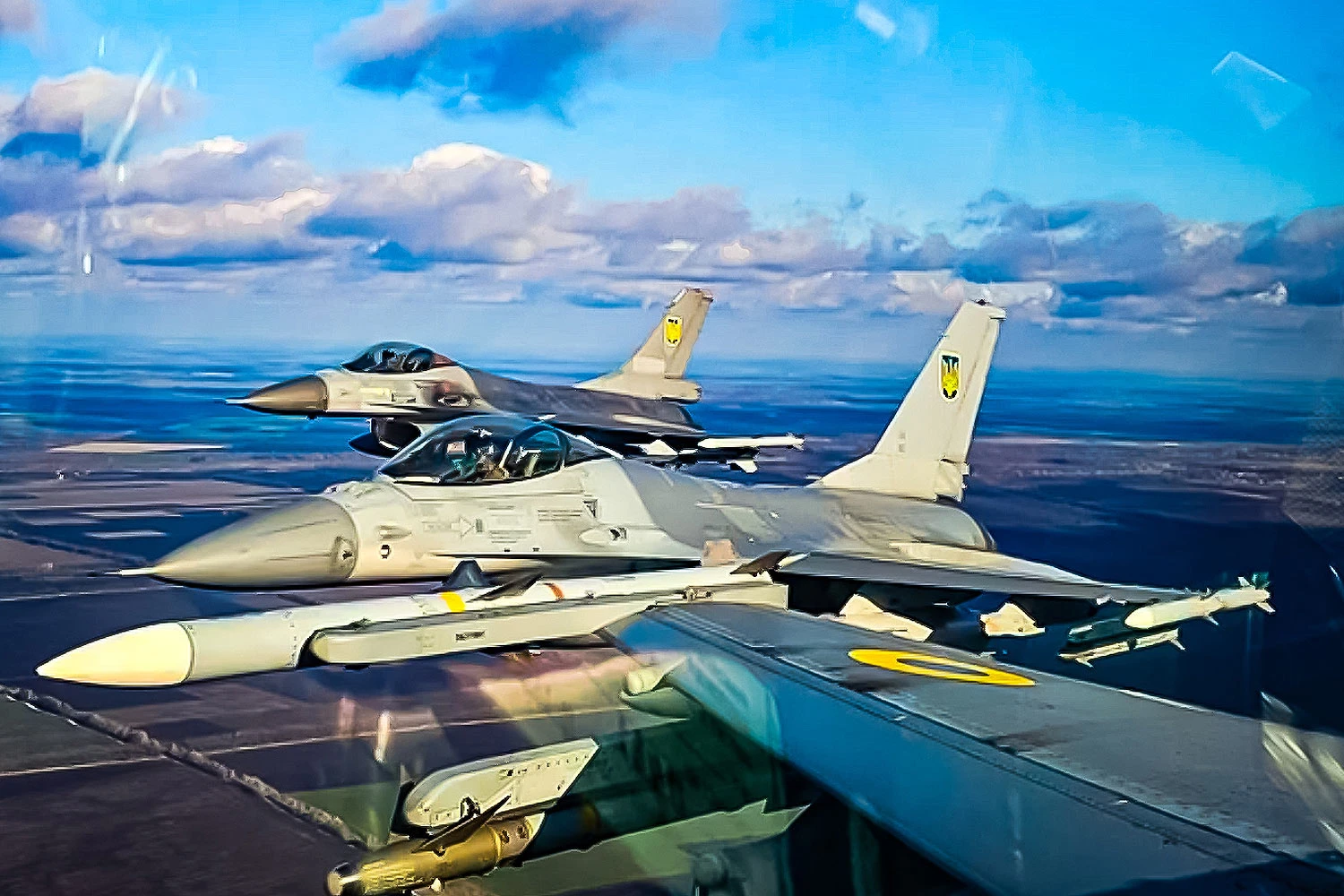
The Ukrainian F-16 fleet has become Kyiv’s frontline airborne interceptor against Russia’s jet-powered Geran drones, and the tempo is wearing it down. Of roughly 50 Fighting Falcons, about half are grounded for maintenance elsewhere in Europe, President Volodymyr Zelensky said. Air Force spokesman Col. Yurii Ihnat told The New York Times that the jets downed a large share of the 1,900 jet drones Ukraine intercepted in September, out of roughly 3,500 that Russia launched.
The strain reflects a shift in Russia’s strike campaign from the propeller-driven Geran-2, its domestic version of Iran’s Shahed-136, to the turbojet-powered Geran-4 and Geran-5. Ukraine’s military intelligence directorate (HUR) estimates Russian plants now build about 3,000 jet Gerans a month, more than the piston-engine models. Each costs an estimated $70,000 or less; the fighters chasing them are multimillion-dollar aircraft Ukraine cannot quickly replace.
How the Ukrainian F-16 Fleet Hunts Jet-Powered Geran Drones
Speed is the core problem. Open-source estimates put the early Geran-3 at 300 to 370 km/h and the Geran-4 and Geran-5 at 400 to 600 km/h, near subsonic cruise missile performance and beyond the reach of most low-cost interceptor drones. Ukraine’s September figures imply a jet drone interception rate near 54 percent, against more than 90 percent for piston-engine Shaheds, according to Zelensky.
The F-16 closes that gap with speed, altitude and onboard sensors. Ukraine flies F-16AM/BM jets modernized under the Mid-Life Update (MLU) program and donated by Denmark, the Netherlands and Norway. Publicly available specifications indicate a Pratt & Whitney F100-PW-220-series turbofan producing roughly 23,800 pounds of afterburning thrust, a top speed near Mach 2 and an AN/APG-66(V)2 pulse-Doppler radar. The air-to-air load pairs AIM-9 Sidewinder infrared-guided missiles with AIM-120 AMRAAM radar-guided missiles, plus an internal M61A1 20 mm cannon. One pilot recently downed 10 jet drones in a single sortie, and in July an F-16 shot down a Russian Su-35 fighter, according to Ihnat.
Missiles drive the cost of each kill. US Air Force budget data put an AIM-9X at about $472,000 and an AIM-120D at about $1.1 million per round; Ukraine’s exact inventory mix is not public, and ammunition supply is a top concern in Kyiv. Since December 2025, Ukrainian F-16s have carried AN/AAQ-33 Sniper targeting pods and LAU-131 launchers for the BAE Systems APKWS II laser-guided 70 mm rocket, with the Ukrainian Air Force releasing engagement footage in February 2026. A December 2025 image showed two seven-round pods, or 14 rockets, under a single jet, multiplying engagements per sortie.
Fetesti Training, Belgian F-16s and Gripen: Rebuilding Ukraine’s Fighter Force
Availability is eroding. Zelensky has said Kyiv wants to move most of that maintenance work into Ukraine to shorten turnaround times. Open-source loss tracking counts five Ukrainian F-16s damaged or destroyed since the first jets arrived in the summer of 2024, including the aircraft of Lt. Col. Oleksiy Mes, killed in August 2024 while engaging a Russian strike. Retired Lt. Gen. David Deptula, dean of the Mitchell Institute for Aerospace Studies, told the Times that relying on a small fighter force as a substitute for layered air defense is “not a sustainable long-term proposition,” noting that each drone sortie is a sortie lost to offensive counter-air.
Pilot output is the second constraint. The European F-16 Training Center (EFTC) at Romania’s 86th Air Base near Fetesti, opened in November 2023 with Dutch-supplied F-16s and Lockheed Martin instructors, is the only site outside the United States where Ukrainians fly the type. Bill Thomas, the retired US Air Force colonel running the program, told the Times that 19 Ukrainian pilots have graduated since September 2024 from a roughly six-month course that now emphasizes counter-drone tactics far more than pre-2022 NATO syllabi.
Reinforcements remain slow. Belgium, which first committed F-16s in 2023, has yet to deliver a flyable jet to Ukraine: four airframes handed over this year remain at Sabca in Gosselies, too old to fly and used to train Ukrainian technicians. Zelensky said at the end of September that Belgium would deliver three F-16s by year-end, a plan Defense Minister Theo Francken had announced earlier in the year. Under a July 1, 2026, agreement, Ukraine is buying 16 new Saab Gripen E fighters, with deliveries from early 2029, while Sweden donates 16 Gripen C/D jets due in early 2027. France has agreed to sell Dassault Rafales, at least two years from delivery. Both types can fire deep strike missiles, which Ukraine’s F-16s cannot.
Kyiv is also negotiating with Lockheed Martin for the F-16 Block 70/72, which requires US government approval and could bring longer-range missiles. Its AN/APG-83 active electronically scanned array radar would substantially improve detection range and multi-target tracking over the APG-66. Air Force commander Lt. Gen. Anatolii Kryvonozhko credits Ukrainian F-16 pilots with 666 cruise missiles and about 2,500 drones shot down.
Analysis: The F-16 drone war exposes a structural mismatch rather than a platform failure. Ukraine is spending its scarcest air assets, airframe hours and trained pilots, against a target Russia builds at roughly 3,000 units a month. APKWS II improves the cost per kill but not the sortie ceiling, and every drone patrol defers counter-air missions. For NATO air forces planning to meet mass jet-powered one-way attack drones with fighters, the arithmetic is identical, strengthening the case for cheap, high-speed interceptors layered beneath fighter cover.
Next milestones include Belgium’s three F-16s by the end of 2026, the Gripen C/D transfer in early 2027 and any US decision on a Block 70/72 sale. Kyiv is also scaling jet-powered interceptor drones, AI-guided gun turrets and low-cost interceptor missiles, none yet fielded in volume. Until then, the F-16 fleet will carry much of Ukraine’s winter air defense burden.