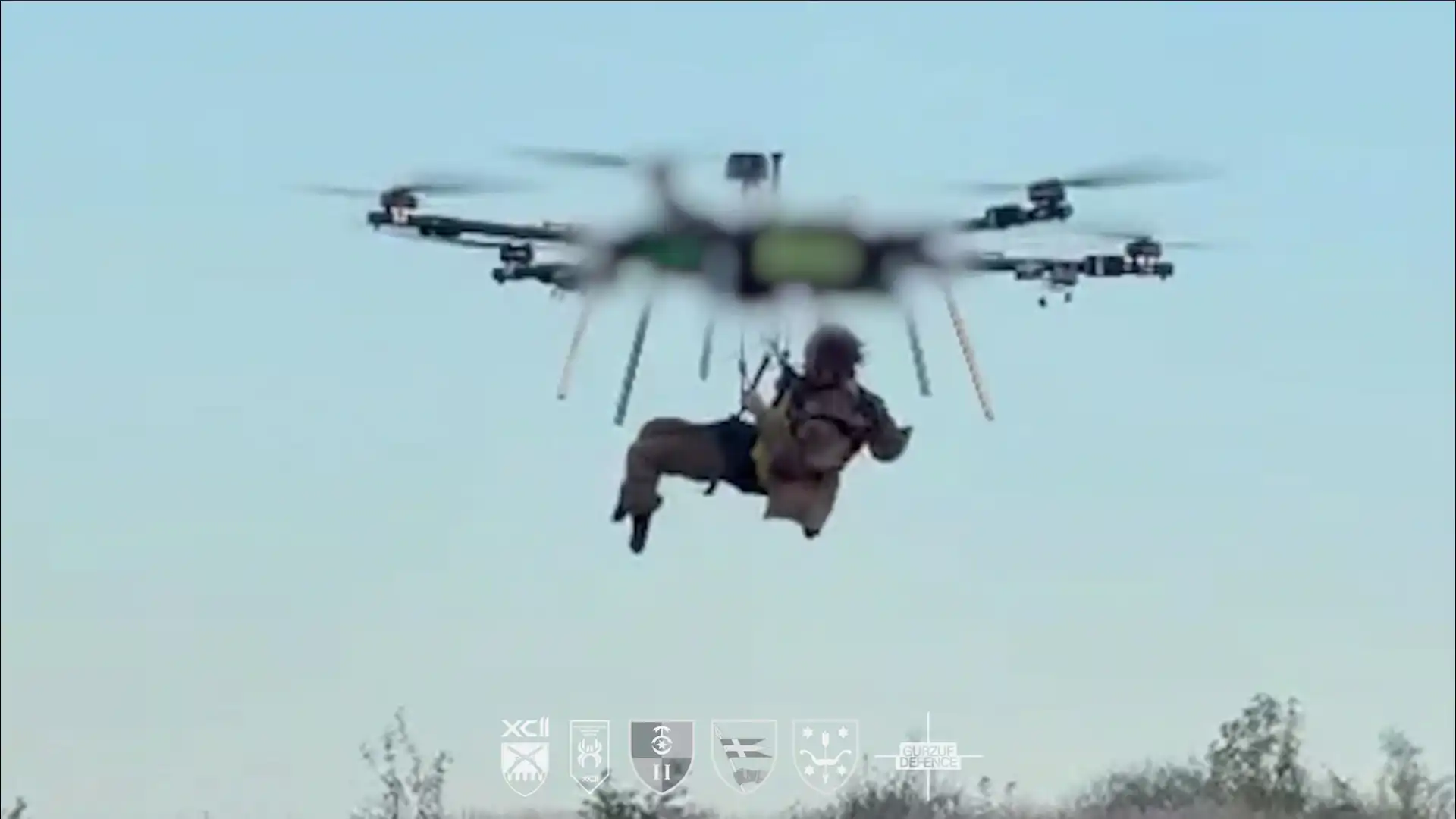
Ukraine’s Armed Forces say a heavy hexacopter has flown a wounded infantryman out of a mined, drone-saturated front-line position, in what they describe as the world’s first drone casualty evacuation (CASEVAC) from the line of contact. Footage released on October 19, 2026, by the 92nd Separate Assault Brigade shows the soldier, from the 30th Separate Mechanized Brigade, clipping a harness to the drone before being lifted out. The mission’s date and location have not been disclosed, and the claim has not been independently verified.
In some sectors, the kill zone covered by Russian first-person-view (FPV) drones and artillery extends 10 to 15 kilometers or more. Unmanned ground vehicles (UGVs) have filled the gap: Defense Ministry data logged about 112,000 UGV logistics and evacuation missions from January through August 2026, with August’s 25,143 missions running 3.3 times January’s total. But ground robots are slow, mine-exposed and hunted by FPVs, and some need two to three hours to reach a forward position.
How the 92nd Brigade Planned Its Drone Casualty Evacuation Mission
The infantryman was wounded while holding his position. With the approaches mined and Russian drone activity intense, a UGV run was ruled out, according to Ukraine’s Defense Ministry, so the 92nd Brigade’s unmanned ground systems company turned to an aerial option it had never attempted. The operation involved the 92nd Brigade, the 30th and 14th Separate Mechanized Brigades, the 10th Army Corps and manufacturer Gurzuf Defence, which supplied a heavy hexacopter free of charge.
Brigade specialists and Gurzuf engineered a solution to keep the drone stable with a human load slung beneath it, preventing rollover and excessive swing, then rehearsed on Gurzuf’s test ranges. A 30th Brigade UAV operator flew the aircraft while the casualty stayed in contact with him. In flight, the soldier hangs below the drone’s rigid landing legs. The ministry says he survived and is now in treatment and rehabilitation.
The brigade has not named the airframe or disclosed flight distance or duration. Open-source reporting links the mission to Gurzuf’s Ayudag-6, unveiled in March 2026 as a cargo lifter with future casualty evacuation potential. Manufacturer figures give the six-motor Ayudag-6 a weight of about 98 kilograms, a payload of 70 to 90 kilograms (154 to 198 pounds), a range of up to 25 kilometers with return and an operating altitude of 150 to 300 meters, with battery packs swapped to trade range for lift. That ceiling leaves thin margin for a soldier in body armor, and the harness method requires a casualty conscious and mobile enough to secure himself.
StarGate and FC-100: Purpose-Built Medevac Drones Enter Testing
The improvised lift came days after Ukrainian manufacturer SkyFall handed StarGate, a purpose-built six-rotor medevac drone, to a combat unit for front-line evaluation. SkyFall built it at the request of the 475th Separate Assault Regiment, known as Code 9.2. Instead of a harness, StarGate carries a compartment built around a medical-grade stretcher.
SkyFall rates the aircraft at a 150-kilogram (330-pound) payload, a one-way range of 15 kilometers, a 65 km/h cruise and a 105 km/h top speed, with about 10 minutes of preflight preparation. It links over Starlink and SkyFall’s proprietary L-Link system, uses AI-assisted navigation for GPS-denied and jammed environments, carries thermal cameras for night work and can route itself home if communications are lost. During a demonstration under active jamming, it fired a net that knocked a simulated FPV attacker off course. SkyFall says StarGate kept flying after losing a rotor arm in testing but has released no combat survivability data. Each system is expected to cost at least $50,000, and the company aims to build up to 1,000 a month by the end of 2026.
Western armies are moving more slowly. During Exercise Saber Strike in May 2026, soldiers from the U.S. Army’s 2nd Cavalry Regiment strapped a test dummy to a Flowcopter FC-100 at Bemowo Piskie Training Area, Poland, during an Autonomous Triage and Treatment Challenge. Per the manufacturer, the hydraulically driven FC-100 can fly more than 60 miles (96 kilometers) with 220 pounds aboard. The Army has not announced follow-on prototyping, though it demonstrated the optionally piloted K-MAX helicopter for casualty evacuation in 2016.
Analysis: The airframe matters less than the clock. NATO’s 10-1-2 casualty care guideline, which calls for bleeding control within 10 minutes, advanced resuscitation within one hour and surgery within two, assumes evacuation assets can reach the point of injury. Ukraine’s kill zone has broken that assumption, leaving some wounded stranded for days. Aerial lifters covering 10 kilometers in minutes could restore part of that timeline, but only for some casualties: a harness lift excludes unconscious patients, and no current design offers en route care. These drones also face the same FPVs, interceptors and jamming that already hunt UGVs. Expect a layered chain in which robots, aerial lifters and crewed vehicles each take the leg they can survive, with Ukraine generating combat data NATO trials cannot.
Key details remain unconfirmed, including the evacuation distance, flight time and airframe designation. Code 9.2 says StarGate needs at least a month of front-line use before drawing conclusions, and SkyFall has not shared interim results. Gurzuf’s Ayudag-6 was still in Defense Ministry codification as of March 2026, the step that opens state contracting. Loss rates under Russian drone pressure will decide whether either approach scales beyond showcase missions.