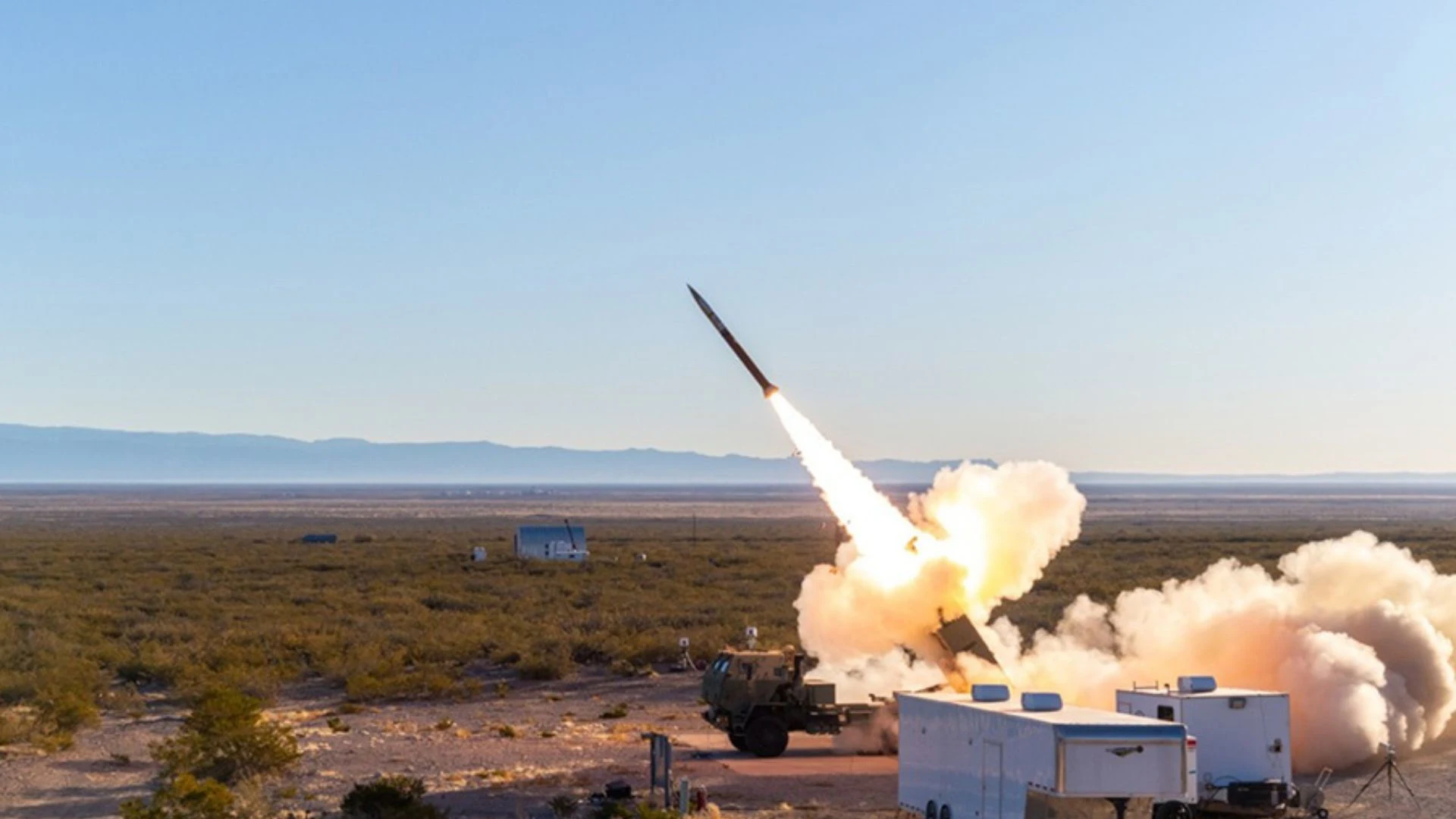
The US Army has approved Milestone C for Lockheed Martin’s Extended-Range Guided Multiple Launch Rocket System (ER GMLRS), clearing the 150-kilometer precision rocket for production and fielding after two Soldier-led operational tests at White Sands Missile Range, New Mexico. Lockheed Martin announced the transition on October 19, 2026, following flights in September and October in which both the Alternative Warhead (AW) and Unitary variants were fired in succession from an M270A2 launcher.
The decision closes a development effort the Army authorized in May 2017 as an engineering change proposal to the existing GMLRS line rather than a new-start program, and it arrives as the service shifts from qualification to volume. In August 2026, the Army published a sources-sought notice for 133,014 GMLRS-family rockets, ER rounds included, to be produced at 19,002 per year between 2028 and 2034. US inventories have been drawn down by deliveries to Ukraine and by combat expenditure in the Middle East, and the Army’s fiscal 2026 GMLRS award to Lockheed Martin, valued at $3 billion, already covers both standard and extended-range rounds.
ER GMLRS Milestone C Follows Soldier-Led Operational Testing
The September and October flights were operational test events conducted by Army crews rather than contractor teams. Lockheed Martin has not disclosed the number of rounds fired, the ranges achieved, or the unit involved, and the Army has not released the Milestone C decision date, a first-unit-equipped date, or the initial fielding quantity.
The shots cap a qualification campaign that accelerated over the past year. A December 2025 flight sent an AW round 112 kilometers from a High Mobility Artillery Rocket System (HIMARS). A January 30, 2026, test engaged area targets beyond 100 kilometers, and a February 2026 shot marked the first ER GMLRS AW launch from an M270A2, completing system qualification testing for that variant. A September 2023 flight had already demonstrated the full 150-kilometer range.
The choice of the M270A2 matters. The upgraded tracked launcher carries two six-round pods against one for the wheeled HIMARS, and several allied M270 fleets are being modernized to the same standard.
Larger Motor, Tail Control: How ER GMLRS Reaches 150 Kilometers
ER GMLRS more than doubles the reach of the baseline rocket, which Lockheed Martin lists at roughly 70 kilometers; other open-source data credit the current M30A2 and M31A2 rounds with up to 84 kilometers. The extension comes from two primary changes: a larger solid rocket motor and an aft-mounted Control Actuation System that, according to Lockheed Martin, enhances maneuverability.
Guidance remains GPS-aided inertial. A height-of-burst capability, according to company literature, lets fewer rockets engage area or imprecisely located targets. The Unitary warhead addresses point targets; the AW delivers area effects without leaving unexploded submunitions. Lockheed Martin’s ER GMLRS product card lists a payload of approximately 90 kilograms (200 pounds), in line with the 200-pound class of baseline GMLRS warheads.
ER GMLRS keeps the six-round pod and full launcher compatibility, so a HIMARS or M270 battalion roughly doubles its standoff without new vehicles, crews, or logistics. At 150 kilometers, launchers can fire from beyond the reach of most opposing tube and rocket artillery, a survivability margin Ukrainian crews have had to buy through constant displacement.
Scaling GMLRS Production Toward 19,000 Rockets a Year
ER GMLRS shares the Camden, Arkansas, production line with standard GMLRS. Lockheed Martin announced in 2025 that it was raising GMLRS capacity to 14,000 rockets per year, and it had delivered 75,000 GMLRS rockets to the US Army by 2024. The Army’s sources-sought notice sets a higher bar, with first follow-on deliveries expected in February 2030.
Solid rocket motors remain the pacing item. L3Harris announced on October 12, 2026, a $250 million Lockheed Martin follow-on contract for standard-range GMLRS motors, to be built at a new automated Camden facility opening later in 2026. Lockheed Martin and General Dynamics signed a teaming agreement in August 2024 to produce GMLRS solid rocket motors at General Dynamics’ Camden facility. ER output will depend on how quickly capacity for its larger motor matures, a rate neither company has published.
Allied demand adds pressure on the same line. Estonia and Lithuania have requested ER GMLRS through Foreign Military Sales. In Europe, the round will compete with Elbit Systems’ PULS, whose EXTRA rocket carries a publicly reported 150-kilometer range and which the Netherlands and Denmark have selected. Sabrina Barnes, Lockheed Martin vice president for Precision Fires Rockets, framed the pitch around commonality: “The value of ER GMLRS is not only the additional range. It is the ability to add capability within an existing precision fires architecture – an approach that provides a common foundation for U.S. and international operators.”
Analysis: ER GMLRS gives the Army a 150-kilometer layer between standard GMLRS and the Precision Strike Missile (PrSM) without buying a new launcher. PrSM Increment 1, ramping to 400 missiles per year, is too scarce for the volume of targets a high-intensity fight generates inside 150 kilometers: command posts, air defense radars, logistics nodes, and the artillery groupings Russian forces pulled back beyond baseline GMLRS range after 2022. A rocket built on a line measured in the tens of thousands restores pressure on that depth band at lower cost than missile-class munitions, though ER pricing is undisclosed. The risk is that the ER round competes for motor capacity with the baseline rocket the Army must also replenish.
The next public markers are the first unit equipped, an initial fielding date, and the contract structure for the 2028 to 2034 production effort. Still unresolved are the ER share of the fiscal 2026 award, the ER motor rate, and the timing of first Foreign Military Sales deliveries to Estonia and Lithuania. Fiscal 2027 appropriations for ER rounds will show how fast the Army intends to shift its inventory toward 150-kilometer reach.