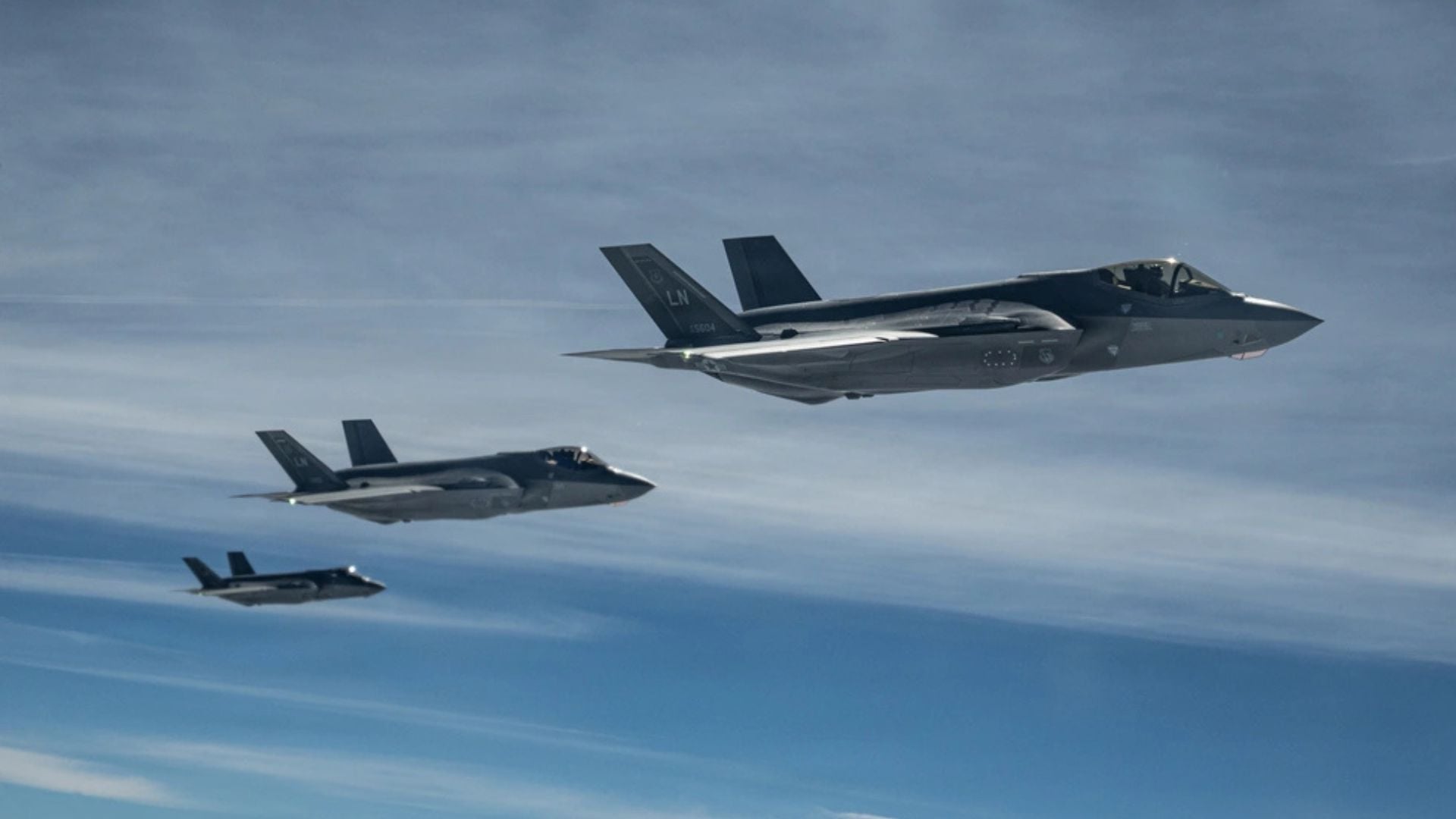
The US Air Force is planning for 1,509 combat-coded fighters by 2035, with the F-35A Lightning II making up roughly 40 percent of the fleet and the F-22 Raptor and its successor, the Boeing F-47, another 20 percent. Lt. Gen. David Tabor, deputy chief of staff for plans and programs, outlined the projection at a Pentagon media roundtable on October 20, 2026, according to Air & Space Forces Magazine, four days after the service sent its updated fighter force structure report to Congress. The full report has not been released.
The new target replaces planning data Tabor described as outdated. The October 2025 report estimated 1,271 combat-coded fighters for fiscal 2026 and set a 2030 goal of 1,369. Tabor said analysts rebuilt the assessment around geographic combatant commanders’ requirements at medium risk, work that began before combat operations against Iran earlier this year. The shortfall is also statutory: on May 5, 2026, Air Force Secretary Troy Meink told Congress the service held 1,098 fighters in its primary mission aircraft inventory, 47 below the 1,145 floor set in Title 10.
Air Force Fighter Fleet Mix Shifts Toward Stealth Aircraft
Excluding the A-10 Thunderbolt II, today’s fleet is roughly 45 percent F-16 Fighting Falcons, 30 percent F-35As, 15 percent F-15 variants and 10 percent F-22s, per Tabor’s figures. By 2035, the F-35A share would rise to about 40 percent and the F-22 and F-47 combined to about 20 percent, while F-15s and F-16s would split the remaining 40 percent roughly evenly. Stealth aircraft would grow from about 40 to about 60 percent of the inventory. These are approximate planning shares, not procurement commitments, and they do not translate into reliable type-by-type counts against the 1,509 total.
The F-47 is the most clearly scoped element. Boeing won the Next Generation Air Dominance (NGAD) engineering and manufacturing development contract in March 2025, and the Air Force targets a first flight in 2028. Service figures released in May 2025 credit the sixth-generation fighter with a combat radius of more than 1,000 nautical miles and a top speed above Mach 2, against about 590 nautical miles for the F-22, with at least 185 aircraft planned. Tabor said the Air Force still intends to replace the 186 operational Raptors it built with roughly the same number of F-47s. The range gain matters most in the Pacific, where distance from threatened bases and dependence on vulnerable tankers constrain sortie generation.
The F-16 would see the steepest decline. Older Fighting Falcons reach the end of their service lives in the mid-2030s, Tabor said, and no replacement decision has been made. A new-build variant tentatively designated F-16G, which Lockheed Martin would produce in Greenville, South Carolina, is under consideration. Tabor said that choice is unlikely to come in the fiscal 2028 budget cycle and cautioned against defaulting to new F-16s while other capability options remain under study.
F-35A and F-15EX Production Drive the 2035 Growth Target
The 140 aircraft added above the previous 2030 goal would come from a mix of F-35As, F-15EXs and F-47s, Tabor said, and reaching 1,509 depends on congressional funding and on Lockheed Martin and Boeing delivering on time. Air Force leaders have argued for years that the service must buy 72 fighters annually to replace retiring jets. The fiscal 2027 request funds 62, comprising 38 F-35As and 24 F-15EXs, a level Tabor said can ramp over time. “The question is, can industry produce at those levels?” he said, adding that contractor assurances still have to show up in deliveries.
Fiscal 2027 funding is unresolved. The request relies on $2.34 billion from a budget reconciliation bill to buy 14 of the 38 F-35As. Without it, the Air Force would have to pull money from other programs or push those jets into fiscal 2028. The service is also seeking multiyear procurement authority for the F-35 and F-15EX, a request pending before Congress that Tabor said would give suppliers the stability to expand output.
The F-15EX line is accelerating. On September 29, 2026, Boeing received a $2.38 billion Lot 7 contract for 22 Eagle IIs, bringing the total under contract to 120. Publicly available specifications indicate the F-15EX pairs two General Electric F110-GE-129 engines with the AN/APG-82(V)1 active electronically scanned array radar and the Eagle Passive/Active Warning and Survivability System (EPAWSS), and can carry up to 12 air-to-air missiles, a magazine depth that complements the F-35A’s limited internal stealth load.
Collaborative Combat Aircraft (CCA) sit outside the 1,509 count. The Air Force aims to field 500 of the uncrewed jets by 2032, and Tabor said they could eventually reduce crewed fighter requirements, though current designs do not yet change that calculation.
Analysis: The plan pursues two objectives that draw on the same production lines: a higher stealth share and a larger force. Retirements alone can lift the stealth percentage, but adding 238 jets to the fiscal 2026 baseline requires deliveries to outpace divestments, while the fiscal 2027 request sits 10 aircraft below the service’s own replacement rate and the F-47 has yet to fly. If aging F-15s and F-16s leave before replacements arrive, the Air Force could reach 60 percent stealth and still miss its capacity requirement.
Near-term decision points are congressional action on fiscal 2027 appropriations and reconciliation, a ruling on F-35 and F-15EX multiyear procurement, and the F-47’s first flight in 2028. Tabor cautioned that changing combatant command requirements and new technology, CCAs above all, will move the 1,509 figure in future reports.