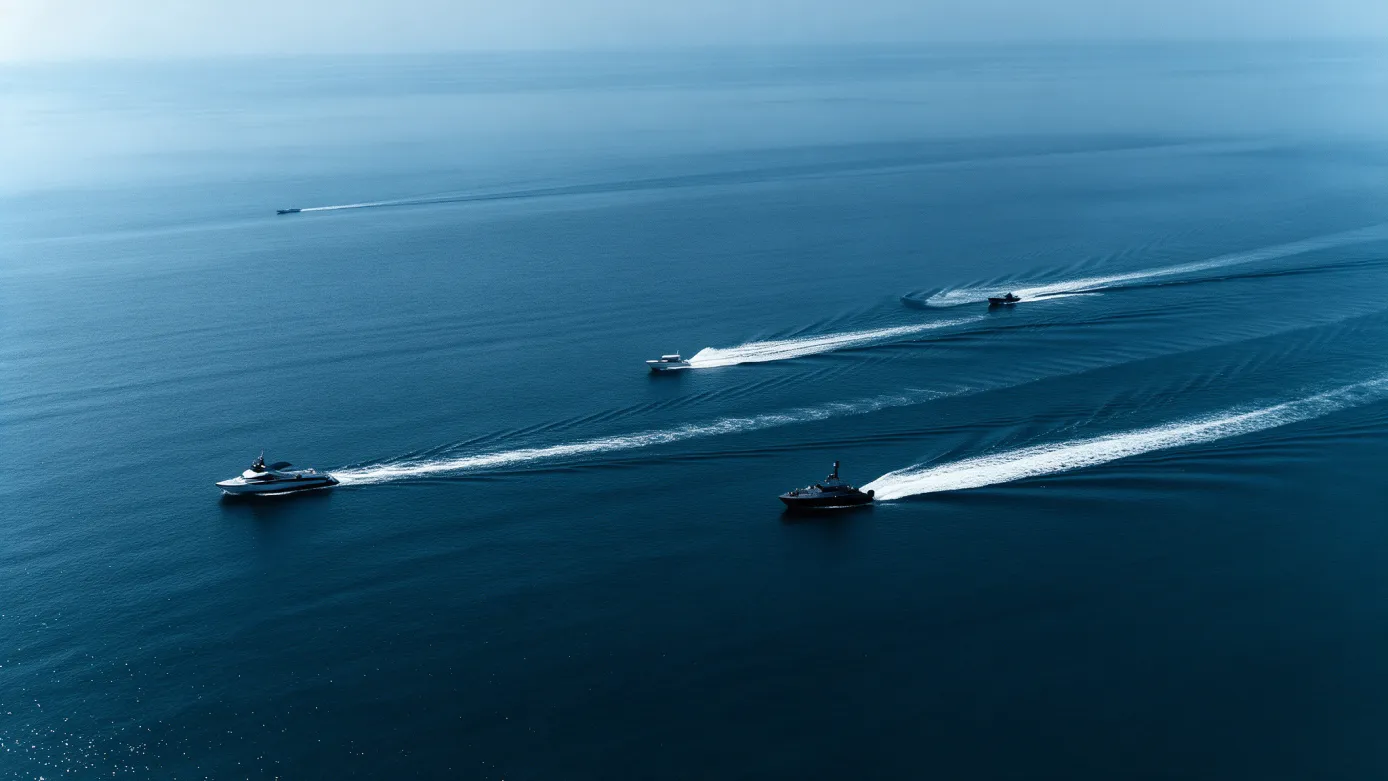
EDGE Group led the integration of sovereign autonomous systems for a UAE Navy demonstration of national and allied unmanned maritime capabilities, the Abu Dhabi-based defense conglomerate announced on October 21, 2026. The United States Navy took part in the event, while EDGE supplied planning expertise, host facilities and operational assets, with its specialists working alongside both navies on design and execution.
The demonstration comes as Gulf navies push unmanned surface vessels (USVs) from experimentation toward operational roles, and as the US Navy’s 5th Fleet continues to integrate uncrewed platforms with regional partners through Task Force 59, stood up in Bahrain in 2021. EDGE did not disclose the date, location or duration of the event, nor which US Navy units participated. According to the company, the scenarios centered on reconnaissance and protection missions executed by USVs supported by artificial intelligence, advanced sensors and command-and-control (C2) systems.
How EDGE Autonomous Systems Ran Under a Single C2 Layer
The architecture rested on three software layers. The first was TACTICA AI’s Naval Warfare C2 Centre for Autonomous Systems. TACTICA was launched at IDEX 2025 by FADA, EDGE’s space entity, as an AI-driven command, control, communications, computers and intelligence (C4I) platform; company material indicates it runs on the Technology Innovation Institute (TII) Falcon large language model and fuses satellite imagery, signals intelligence and sensor feeds. The second was HADAF, a sovereign targeting system that EDGE describes as grounded in doctrine, military operational knowledge and rules of engagement. EDGE has released no technical detail on HADAF, including how human authorization is enforced before engagement. The third was TII’s Maritime Autonomy Kit, which provides vessel-level autonomy.
Hamad Al Marar, Managing Director and CEO of EDGE, said the company’s focus is on “connecting every system through a single command layer, with people defining the mission and AI managing how it is carried out.” He added that through that layer, UAE sovereign capabilities and those of allied forces shared a unified common operating picture. That claim carries the operational weight of the event: a shared picture with US Navy assets implies data exchange across national systems, although EDGE did not specify the datalinks, message standards or classification arrangements involved.
170 M-DETECTOR, VORTEX-E and SKYSHIELD-N Form the Maritime Package
The principal surface asset was the 170 M-DETECTOR, a 17-metre vessel built by Abu Dhabi Ship Building (ADSB). Publicly available specifications for the baseline design list a length overall of 17.4 m, a beam of 4.2 m, a draft of roughly 0.85 m, and two 900 hp diesel engines driving waterjets for a maximum speed of 40 knots, with around four hours of silent electric running at 5 knots. The hull operates manned or unmanned and can carry a remote weapon station. The original design was developed with Israel Aerospace Industries and shown at NAVDEX 2023; a next-generation mine countermeasures variant with TII and Exail technology followed in February 2025. EDGE did not state which configuration took part.
Air defense of the USV group combined hard-kill and soft-kill layers. The VORTEX-E, an autonomous kinetic counter-drone interceptor from EDGE entity ADASI, was unveiled at the Dubai Airshow in November 2025. Open-source reporting credits it with a top speed of 350 km/h and describes it as still in development. SKYSHIELD-N is the naval counterpart of the SKYSHIELD counter-unmanned aircraft family introduced at IDEX 2023, which pairs 3D radars and electro-optical cameras with jamming and spoofing effectors; its naval specifications have not been published. GPS-PROTECT anti-jamming technology secured satellite navigation, while the MIRSAD-X multispectral electro-optical imager and radars handled detection and tracking.
Analysis: The hulls matter less than the control architecture. Abu Dhabi is building a sovereign C2 and targeting stack that can feed a coalition picture without surrendering national control of engagement logic, which is the role HADAF is designed to fill. For the US Navy, capable partner-built unmanned fleets extend maritime domain awareness across the Gulf and approaches to the Red Sea without committing additional US hulls. The test is whether that interoperability survives contested electromagnetic conditions and allied data-sharing rules, two areas EDGE left undocumented. The event also fits a broader US-UAE autonomy relationship that includes the EDGE-Anduril Production Alliance announced in November 2025.
Key unknowns remain: whether the UAE Navy will place orders for the integrated package, the production status of VORTEX-E, and whether the US Navy will formalize follow-on unmanned exercises with EDGE assets. The next NAVDEX exhibition in Abu Dhabi in 2027 is the most likely venue for EDGE to disclose further integration milestones.