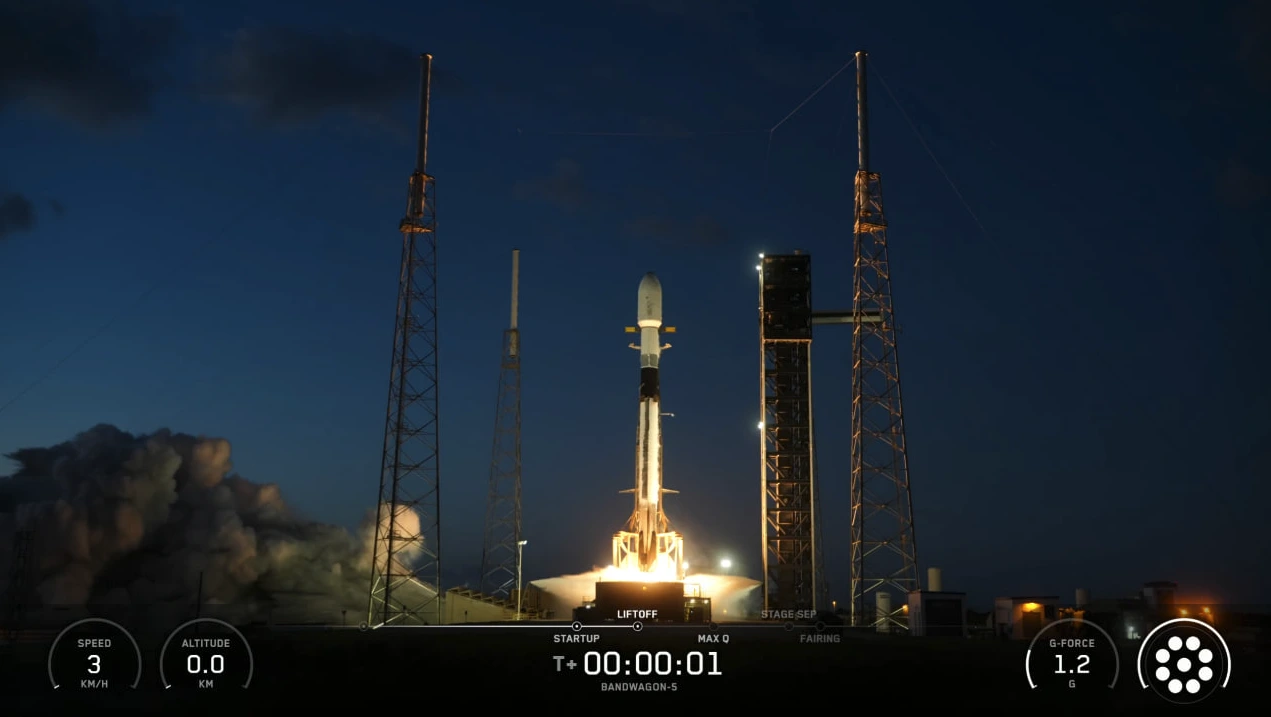
Fergani Space Technologies, the space company founded by Baykar Chairman and Chief Technology Officer Selçuk Bayraktar, launched its FRG-100D4 test satellite from Cape Canaveral Space Force Station, Florida, on October 20, 2026, aboard SpaceX’s Bandwagon-5 rideshare mission. The 160 kg spacecraft lifted off at 2:04 p.m. Türkiye time, separated from the launch vehicle about 63 minutes later, and settled into its target orbit at an altitude of 590 km, according to Baykar.
FRG-100D4 is the sixth spacecraft Fergani has placed in orbit since January 2025 and the heaviest of its 100-series satellites by a wide margin: FGN-100-D2 and FGN-100-D3 weighed 104 kg and 113 kg respectively. Baykar presents the launch as the most important step so far toward the Uluğ Bey Satellite Constellation System, a low Earth orbit (LEO) network intended to give Türkiye an independent navigation and communications capability. The company now states the constellation will comprise more than 200 satellites and will be completed with its own resources within five years.
Fergani Satellite FRG-100D4 Flies Expanded Indigenous Avionics Suite
According to Baykar, FRG-100D4 carries a set of critical components developed entirely in-house: a reaction wheel, magnetorquer, magnetometer, inertial measurement unit (IMU), Global Navigation Satellite System (GNSS) receiver, steerable solar panels, battery pack, regenerative modem, and phased-array antenna, alongside an AI-assisted onboard computer for advanced missions. The satellite also flies enhanced navigation and broadband communications payloads and, per the company, offers the highest power generation capacity of any Fergani spacecraft to date.
Compared with FGN-100-D3, whose disclosed in-house components covered attitude control, navigation, and computing, the new items on FRG-100D4 fall into two areas: power generation and storage, and the radio frequency chain. Steerable solar arrays let the bus track the sun independently of payload pointing, sustaining a higher power draw while the antennas stay Earth-facing. A phased-array antenna steers its beam electronically rather than by slewing the whole satellite, an advantage for broadband links to moving ground terminals. A regenerative modem demodulates and reprocesses signals on board instead of simply relaying them, giving the network tighter control over signal quality and routing.
Baykar has not disclosed power output, operating frequency bands, data rates, design life, or whether FRG-100D4 carries onboard propulsion. FGN-100-D2 flew a green-propellant thruster, but the October 20 announcement does not mention one.
Uluğ Bey Constellation Target Doubles to More Than 200 Satellites
The 200-satellite figure marks an expansion of the stated architecture. Fergani’s March 2026 announcement for FGN-100-D3 described Uluğ Bey as a system of more than 100 satellites, also to be completed within five years. Baykar has not explained the revision.
Fergani brands Uluğ Bey a global positioning system, a category today occupied by the US Global Positioning System (GPS), Russia’s GLONASS, China’s BeiDou, and the European Union’s Galileo. Those systems operate primarily from medium Earth orbit, at roughly 19,000 to 23,000 km. A LEO architecture at 500 to 600 km trades a small number of high-orbit satellites for many lower ones. Signals reach the receiver considerably stronger, which improves resistance to jamming, and satellite geometry changes faster, which can shorten position convergence. The cost is coverage: continuous global service demands far more spacecraft, consistent with the constellation’s planned size.
Baykar says that once the constellation is in place, Türkiye will be able to share the capability with “friendly and kindred nations.” Work on an indigenous launch vehicle continues in parallel, though no flight dates have been released.
Six Spacecraft Since January 2025: Fergani’s Flight Test Campaign
Fergani’s flight record now spans 21 months. FGN-100-D1 opened the series in January 2025. FGN-100-D2 followed on November 2, 2025, aboard Bandwagon-4, operating at roughly 510 km. On November 28, 2025, the company launched FGN-TUG-S01, an orbital transfer vehicle (OTV) with a hybrid propulsion system, on SpaceX’s Transporter-15 mission from Vandenberg Space Force Base, California.
FGN-TUG-S01 fired its hybrid engine in orbit on December 6, 2025, completing an orbit-raising maneuver before releasing FRG-10D1, a 10 kg CubeSat, into its target orbit. Fergani describes the event as the first in-space ignition of a hybrid rocket engine, a claim that has not been independently verified. FGN-100-D3 then reached a 500 to 520 km orbit on March 30, 2026, after launch from Vandenberg on Transporter-16.
The OTV matters for Uluğ Bey: rideshare missions release satellites into the orbit chosen for the overall manifest, and a tug lets Fergani move spacecraft into the distinct planes and altitudes a navigation constellation requires. Publicly available launch records nonetheless show that every Fergani spacecraft to date has reached space on a SpaceX Falcon 9.
Analysis: Fergani is applying the Baykar method to space: vertical integration, short iteration cycles, and in-house replacement of subsystems that would otherwise be sourced abroad. Canada’s 2020 suspension of export permits for the optical sensors fitted to the Bayraktar TB2 pushed Türkiye toward domestic alternatives, and attitude control hardware, GNSS receivers, and radio frequency components face comparable export-control exposure in the space sector. The scale gap remains wide. Six spacecraft in 21 months, all test articles, set against more than 200 satellites within five years implies an average of roughly 40 per year from a company that has not yet demonstrated serial production. For NATO, a sovereign Turkish LEO navigation layer would add resilience in a region where GNSS jamming and spoofing around the Black Sea and Eastern Mediterranean are well documented, but it would sit outside allied positioning, navigation, and timing (PNT) arrangements unless Ankara chooses to integrate it.
Near-term indicators include in-orbit performance data from the FRG-100D4 power and broadband subsystems, any Uluğ Bey frequency filings with the International Telecommunication Union, and the shift from test satellites to production-standard constellation spacecraft. Baykar has not announced a date for the first operational Uluğ Bey launch, a customer for the service, or a timeline for its indigenous launch vehicle. Those answers will determine whether the five-year target holds.