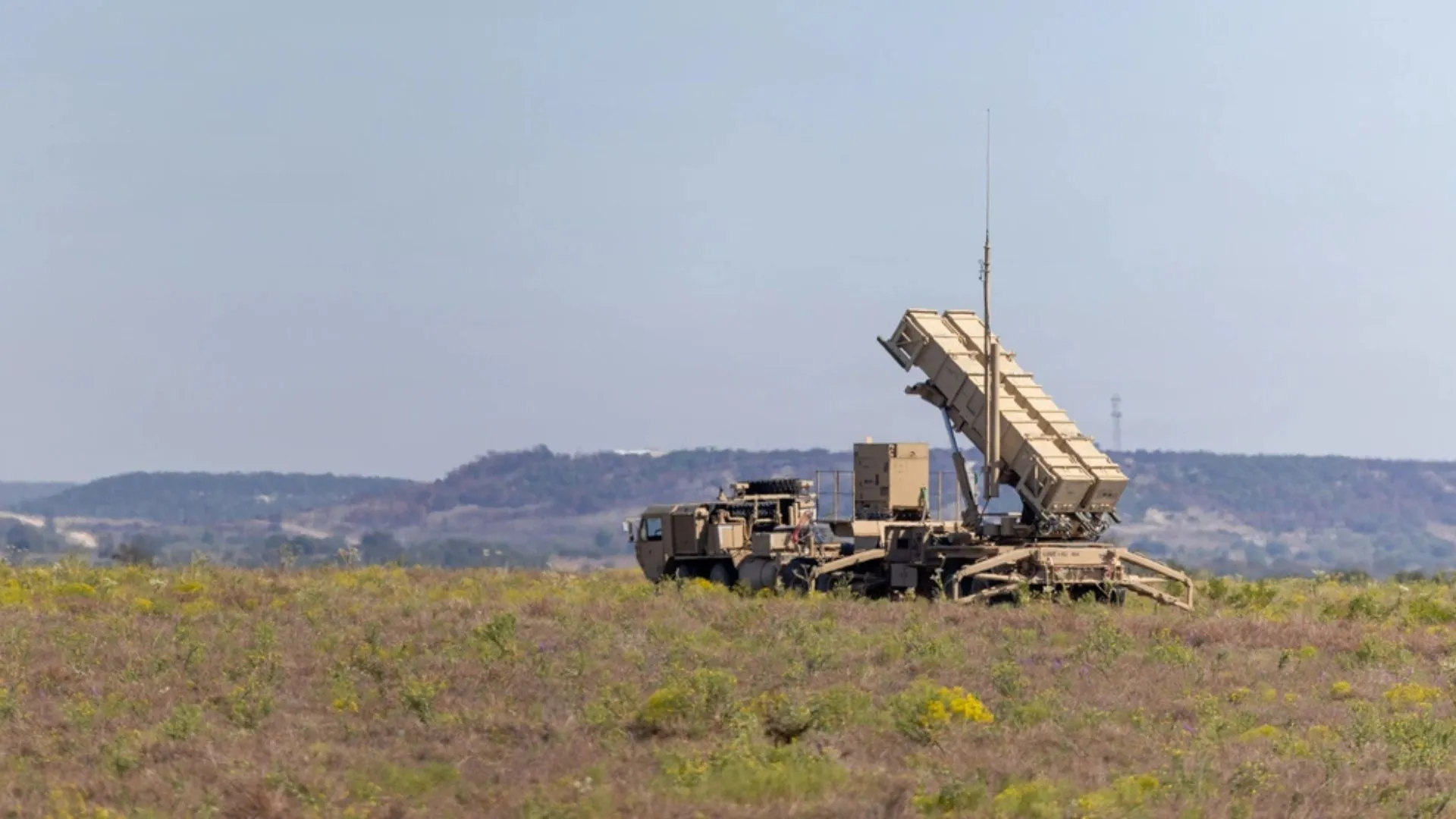
The U.S. Army’s 1st Battalion, 62nd Air Defense Artillery Regiment (1-62 ADA) has moved its Patriot launchers, fire control and support vehicles into the field at Fort Hood, Texas, for a 21-day battalion-wide mission readiness exercise that began October 19, 2026. Imagery released by the Army on October 21, 2026, shows M903 launching stations from Bravo and Delta batteries in the field as the unit, known as the Hunter Battalion, works through establishing, operating and sustaining a complete Patriot defense.
The exercise comes as the Patriot force remains one of the Army’s most heavily tasked formations. Patriot units defended Al Udeid Air Base in Qatar against Iranian missiles in June 2025, and the Army said in August 2025 that it would grow its Patriot force from 15 to 18 battalions, plus a composite battalion for the Guam Defense System. 1-62 ADA is assigned to the 69th Air Defense Artillery Brigade, which reports to the 32nd Army Air and Missile Defense Command. Its sister unit, 1st Battalion, 44th ADA Regiment, returned to Fort Hood on September 20, 2025, after a U.S. Central Command (CENTCOM) rotation supporting Operation Spartan Shield.
How the Patriot Readiness Exercise Tests 1-62 ADA as a Formation
Unlike the battery-level events earlier this year, the October exercise evaluates the battalion as a single fighting organization. According to the Army, observers and controllers are assessing how the firing batteries, Headquarters and Headquarters Battery and supporting elements function together across the 21-day window, rather than grading individual crew tasks. Battalion commander Lt. Col. John Nastus framed the event as the point where the unit validates its equipment and soldiers as a combat-ready team, with leaders identifying which processes hold up and which need more repetitions.
The exercise caps a progressive training cycle. Bravo Battery radar crews drilled emplacement and safety procedures on February 12, 2026, Alpha Battery ran a field training exercise on April 1, 2026, and Delta Battery conducted a site establishment operational readiness exercise on July 9, 2026.
The released imagery shows the full battery architecture in play. Soldiers emplaced the OE-349 antenna mast group, the radio relay that ties a battery into the battalion’s air defense network, and cabled it to the AN/MSQ-104 engagement control station, the node from which a battery fights its engagements. Crews positioned a Patriot tactical control station and drove grounding rods during emplacement, while Echo Company soldiers provided site security with vehicle-mounted M2 .50-caliber machine guns.
M903 Launching Station Loadouts and PAC-3 MSE Interceptor Capacity
The M903 launching station featured in the imagery is the current production standard for Patriot. Publicly available specifications indicate it can carry up to 16 PAC-3 Cost Reduction Initiative (CRI) interceptors, up to 12 PAC-3 Missile Segment Enhancement (MSE) rounds, or four PAC-2 Guidance Enhanced Missile (GEM) interceptors, and can mix PAC-3 variants on a single launcher. That represents up to four times the four-round capacity of the legacy M901.
The difference matters operationally. The PAC-3 MSE uses a larger dual-pulse solid rocket motor and hit-to-kill guidance, extending engagement range and intercept altitude against tactical ballistic and cruise missiles, while higher round counts per launcher reduce how often a battery must reload under fire. Army imagery shows a Bravo Battery M903 towed into the training area by an M983 Heavy Expanded Mobility Tactical Truck (HEMTT).
The Army has not disclosed which interceptor loadouts 1-62 ADA employed or whether inert training canisters were used. The equipment shown also reflects the current Patriot configuration: no Lower Tier Air and Missile Defense Sensor (LTAMDS) radar or Integrated Battle Command System (IBCS) components appear in the published imagery.
Analysis: The exercise illustrates how the Army is managing Patriot demand before new force structure arrives. Until the three additional battalions are fielded, the existing Patriot force must absorb the same operational load, and the practical way to keep it deployable is to recertify battalions quickly at home station. A 21-day collective evaluation that stresses emplacement, communications, security and sustainment at the same time is that mechanism. It also rehearses the skills that will matter most once IBCS and LTAMDS allow batteries to disperse into smaller, more widely spread elements: rapid displacement, resilient networking and self-sufficient site defense.
With 21 days of field training planned from October 19, the exercise runs into early November 2026. The Army has not linked the evaluation to a deployment, although the battalion followed a similar pattern in 2015, when a mission rehearsal exercise at Fort Hood preceded a CENTCOM rotation. Open questions include the evaluation outcome, the battalion’s next tasking and when 1-62 ADA will transition to IBCS and LTAMDS under the Army’s Patriot modernization plan.