Germany and the United Kingdom mark two years of the Trinity House Agreement on October 23, 2026, with the pact now producing allied aircraft deployments, new industrial capacity, and a joint long-range missile program. On October 15, UK Minister for Defence Readiness and Industry Luke Pollard hosted German State Secretary for Armament and Innovation Jens Plötner at Lancaster House in London, where Deep Precision Strike topped the agenda.
German Defense Minister Boris Pistorius and then-Defence Secretary John Healey signed the agreement in London on October 23, 2024. It was the first bilateral defense agreement between the two countries since Brexit, covering air, land, sea, space, and cyber. Its political frame widened on October 8, 2026, when Chancellor Friedrich Merz and Prime Minister Andy Burnham exchanged ratification instruments in Berlin for the Kensington Treaty, which commits each country to assist the other, including by military means, in case of armed attack. Healey is now Chancellor of the Exchequer; Wes Streeting has led the Ministry of Defence since July 2026.
Deep Precision Strike Tops the Trinity House Agreement Agenda
Deep Precision Strike (DPS) is the agreement’s most ambitious program. Both governments have set a joint range requirement of more than 2,000 km, roughly four times the 500 km range publicly attributed to Germany’s Taurus KEPD 350 air-launched cruise missile. Berlin sits about 1,600 km from Moscow. A ground-launched weapon in that class falls in the band the Intermediate-Range Nuclear Forces (INF) Treaty prohibited until its collapse in 2019, giving European allies a conventional deep-strike option that does not depend on aircraft penetrating Russian air defenses.
A memorandum of understanding signed in March 2026 opened joint work with industry to align military requirements. After a March 16 session of the bilateral Ministerial Group on Equipment and Capability Cooperation (MECC) in Berlin, the UK Ministry of Defence described DPS as a family of stealth cruise and hypersonic weapons, with ground-launched systems first and air- and sea-launched variants possible later. MBDA has said the partners intend to advance two ground-launched designs, including a hypersonic glide vehicle, and to begin accelerated full development in 2027. Entry into service is planned for the 2030s, and the program remains open to other allies.
Funding detail remains thin. London has said its spending on long-range and hypersonic weapons projects would exceed £400 million in the 2025-26 financial year, a figure that also covers the Stratus program with France and Italy. No prime contractor, budget split, or workshare for DPS has been made public. The October 15 follow-on panel at the German Embassy featured Philipp Kerth, chief executive of German hypersonics firm Hypersonica, alongside a Rolls-Royce executive.
From Lossiemouth to Telford: P-8A Patrols and RCH 155 Production
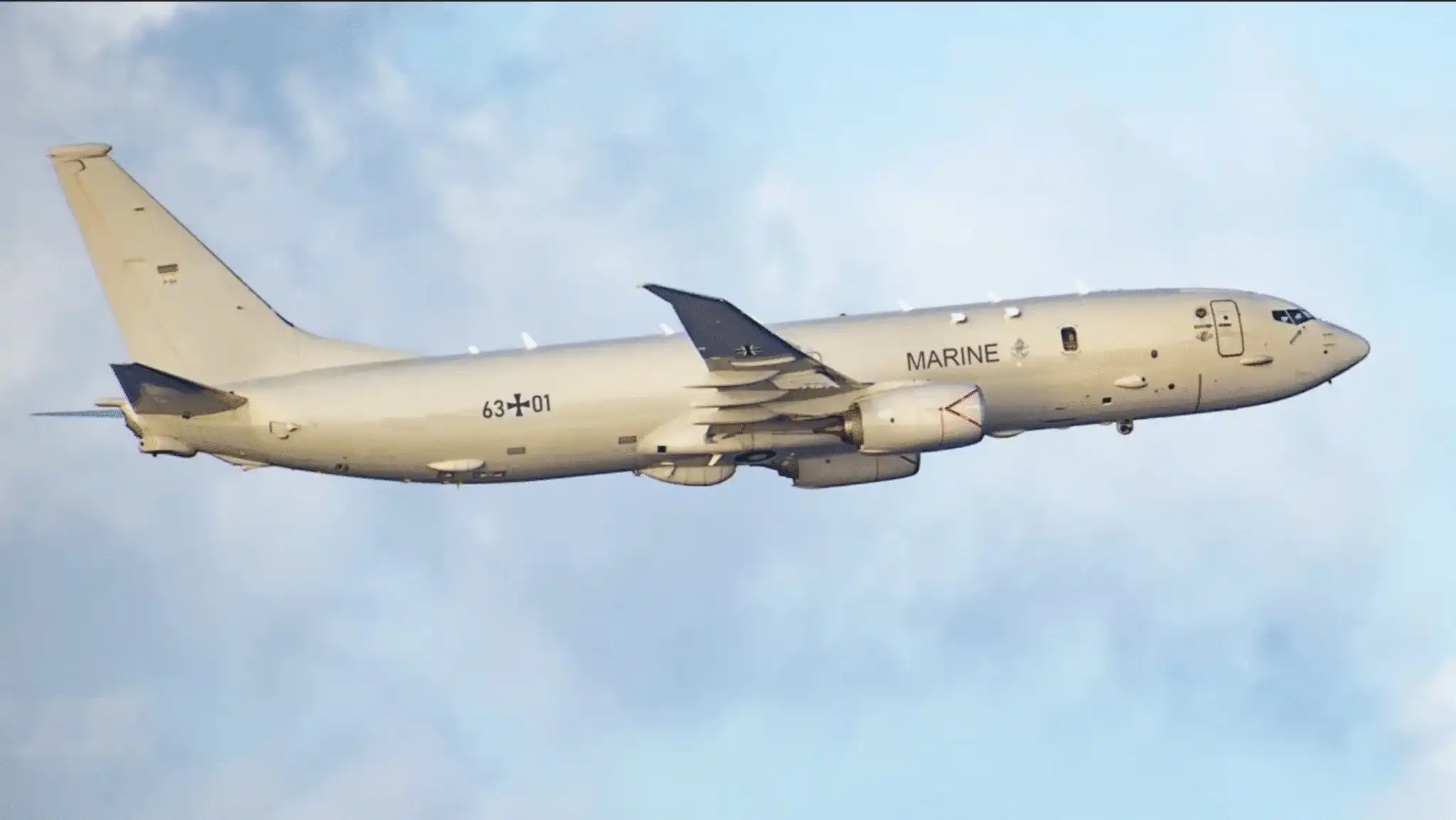
At sea, the agreement is already operational. Germany ordered eight Boeing P-8A Poseidon maritime patrol aircraft through U.S. Foreign Military Sales to replace its P-3C Orion fleet; the first, serial 63+01, was handed over in Seattle on October 1, 2025, for Naval Air Wing 3 at Nordholz. In April 2026, a German P-8A deployed to RAF Lossiemouth in Scotland for the first time, flying alongside the Royal Air Force’s nine Poseidon MRA1 aircraft. German crews had already flown two Baltic Sentry missions aboard RAF Poseidons. Both fleets are to carry Sting Ray Mod 1 lightweight torpedoes under a planned joint purchase. Shared basing puts German crews closer to the Greenland-Iceland-UK (GIUK) gap, the main Atlantic transit route for Russia’s Northern Fleet submarines, while common maintenance and logistics shrink each German detachment’s footprint.
On land, the UK ordered 72 RCH 155 wheeled howitzers in May 2026 under a £1 billion investment to replace the AS90 self-propelled guns given to Ukraine in 2023. Built by ARTEC, the Rheinmetall and KNDS joint venture, the RCH 155 mounts a remotely operated 155mm L/52 gun module on a Boxer drive module and, according to the UK Ministry of Defence, fires up to eight rounds per minute at targets up to 70 km away. Its barrels, breeches, and recoil systems will come from Rheinmetall’s new Gun Hall in Telford, Shropshire, built for 155mm artillery barrels and 120mm tank guns and restoring a UK barrel-making capability absent for about a decade. The British Army also has 623 Boxer vehicles on contract, assembled in Telford and Stockport.
Analysis: By its own Section 10, the Trinity House Agreement is not a treaty and creates no legally binding obligations; its weight comes from governance and funding. That structure, a Defence Ministerial Council overseeing a Military Steering Committee, the MECC, and a Defence Policy Dialogue with a nuclear sub-group, has delivered fastest where a common platform already existed, as with the P-8A and Boxer. DPS is the harder test: two years in, it has a range requirement and two concept paths but no selected design or public budget. The collapse of the Franco-German Future Combat Air System (FCAS) fighter effort in June 2026, and Burnham’s stated openness on October 8 to German entry into the Global Combat Air Programme (GCAP), could push combat aviation into the same bilateral channel, a far heavier load than the framework has carried.
Next milestones include the planned 2027 start of DPS full development, first barrel output from Telford, RCH 155 deliveries, and further German P-8A rotations through Lossiemouth. Public detail remains limited on the cyber Lighthouse project added in October 2025 and the Counter-Hybrid Partnership. Whether Berlin moves from exploratory to formal GCAP talks will show how far the framework can stretch.